On Wednesday, Mayor Eric Adams kicked off his CARE (City Agencies Revitalizing the Economy) initiative by breaking ground on what will be the largest-ever commercial building in the Broadway Junction area of East New York.
The CARE strategy leverages long-term commercial leases from city agencies — in this case, the Department of Social Services’ Human Resources Administration (HRA) — to bring jobs closer to communities and catalyze new commercial development outside of traditional central business districts.
The new building at 2440 Fulton St., developed by the Leser Group and designed by Marvel Architects, will bring best-in-class commercial space that will host more than 1,100 employees of HRA, along with private-market tenants.
The new space will allow HRA to improve client experience with rapid electronic check-in systems, upgraded self-service technology and expanded waiting areas. The new building will also offer about 80,000 square feet of private-market commercial space, including new retail space along Fulton Street, Herkimer Street, and Van Sinderen Avenue.
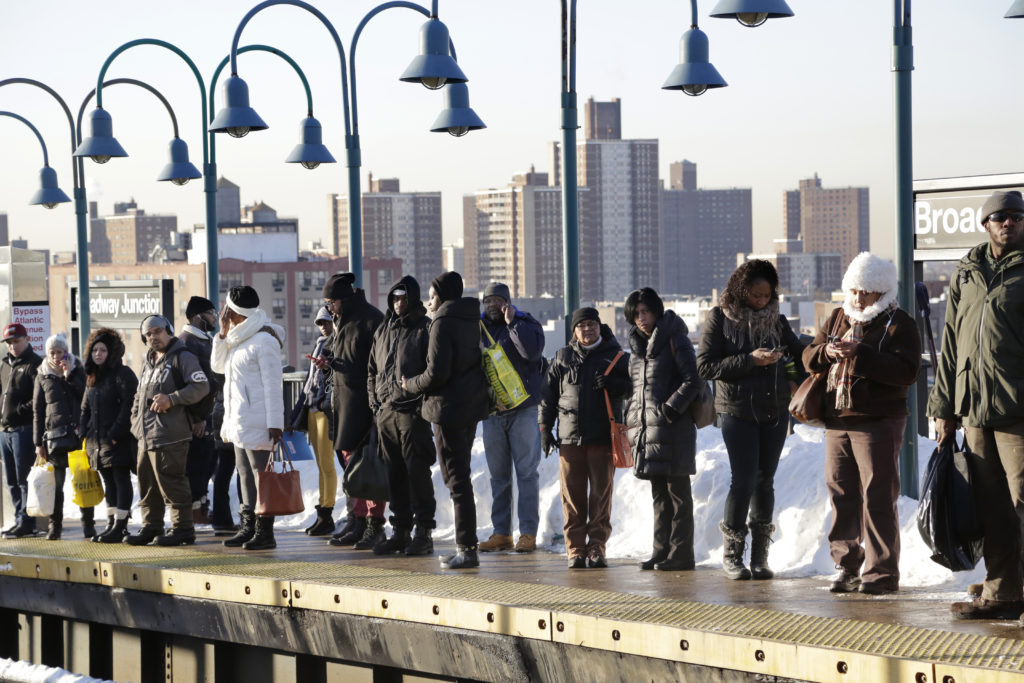
The last time the long-neglected Broadway Junction area was in the news was in November 2021, when the federal government announced a grant of $15 million to add seven disabled-accessible elevators to the maze-like Broadway Junction subway transfer station, which serves five subway lines.
A front-view rendering of the new building at 2440 Fulton St., part of Phase One of Mayor Eric Adams’ “CARE” strategy. Photo courtesy of Lifang
The most recent development — the aforementioned Fulton Street office building — is the result of a collaborative multi-agency effort between DSS, the New York City Economic Development Corporation (NYCEDC), the New York City Department of Citywide Administrative Services (DCAS) and the Leser Group. It builds on work NYCEDC began in 2017 to encourage investment in commercial markets across the city.
A page about Broadway Junction on the NYCEDC website reads, “Despite its exceptional transit access and vibrant surrounding neighborhoods, Broadway Junction is not yet a true transit hub or economic center. The area lacks basic services and amenities and is dominated by vacant sites, parking uses, poor lighting, and confusing streets.”
“When I outlined my economic recovery blueprint last month, I spoke about not going back to the way things were before the pandemic — and that is what this strategy and this groundbreaking are all about,” said Mayor Adams. “We are building a more inclusive economy that works for all New Yorkers, in every neighborhood and every borough, and city government is leading the way.”
Commuters wait for the L train at one of the platforms of the Broadway Junction subway transfer complex. AP Photo/Mark Lennihan
“The CARE strategy is an innovative solution to support new development in underserved areas across the city and is a key component of Mayor Adams’ blueprint for the city’s economic recovery,” said NYCEDC President and CEO Andrew Kimball. “Today’s groundbreaking is just the beginning of utilizing city offices to create new commercial centers —bringing quality jobs, services and amenities to neighborhoods across the city.”
“We are a five-borough city, with diverse neighborhoods within each borough,” said DCAS Commissioner Dawn M. Pinnock. “For far too long, city offices have been heavily concentrated in too few places. Our government needs to be closer to the people and should be an engine for economic growth in commercial areas across the city.”
“This project defines public-private partnership,” said Fernando Fisbein, representative of the Leser Group. “It represents a true collaboration between multiple public agencies and local businesses to achieve key community goals, including connecting critical city services to the communities that access them; anchoring a commercial hub for local businesses, nonprofits, and institutions; and creating new energy and opportunity for the Broadway Junction neighborhood.
“In achieving these goals, this building will produce over 200,000 square feet of brand-new, class A office space for HRA and create over 100,000 square feet of office and retail space for public, private, and nonprofit organizations,” Fisbein added.
In addition to 2440 Fulton St., NYCEDC is currently reviewing proposals for the next phases of the “CARE” strategy in Queens and the Bronx.
“For too long, East New York has been at the receiving end of both private and public disinvestment, predation, and neglect,” said Councilmember Sandy Nurse, who represents the Broadway Junction area. “We are encouraged by the city’s ‘CARE’ strategy, and we hope that today signals a new commitment by the city and this administration to direct public attention, time, and investment to my district.”
“After years of community engagement and planning, today marks a new beginning for Broadway Junction,” said Bill Wilkins, director of economic development and housing, Local Development Corporation of East New York. “We are starting to see the fruits of our advocacy and hard work to create new jobs and opportunity for East New York.”
SUNSET PARK — “As a resident of Marine Park, one of the great surprises I found biking around Industry City and visiting Japan Village was to discover Bush Terminal Park. I continue to be amazed at the serene hideaways that the city offers in some of the busiest places — and, still, with an iconic view.”
BROOKLYN HEIGHTS — ‘A miracle that no one was killed …’ That’s what neighbors are saying about the collapse of the Hotel St. George marquee. Shown in this photograph are workmen beginning the removal and repair of the historic, old neon sign at the corner, referencing a relic of Brooklyn Heights’ past: the St. George Hotel.
ATLANTIC AVENUE — Exhausted shopper with cluster of bags and goods from mall at Boerum Place stops to look at huge construction site across the street. “Is that REALLY going to be a jail??” Her male companion is reassuring, “Nothing like Rikers … this is 21st Century.”
BROOKLYN HEIGHTS — Overheard in line at one of most popular pastry outlets on Montague Street: “Hope I can get them into a camp …” A mother with two pre-schoolers in tow was showing a friend the Dodge Y flyer for Healthy Kids Day on Saturday, April 18.