Newtown Creek: How to fix the combined sewage overflow problem
By By Scott Enman
May 3, 2017
Copy Link
Email
Facebook
X
LinkedIn
WhatsApp
Telegram
Pinterest
Print
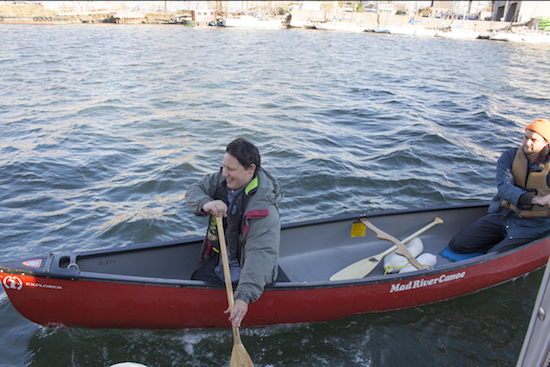
“The wind blew and the sh*t flew,” were the first words the Brooklyn Eagle heard one morning before climbing aboard the Riverkeeper patrol boat to explore Newtown Creek.
While many Brooklynites know of the Gowanus Canal — arguably one of the dirtiest waterways in America — fewer are aware of Brooklyn’s almost equally polluted body of water: Newtown Creek.
The 3.5-mile estuary runs through a part of the border between Brooklyn and Queens and along the edges of Greenpoint and East Williamsburg.
The Eagle had the privilege of joining Riverkeeper’s Patrol Boat Capt. John Lipscomb — the man responsible for the aforementioned rhyme — on his patrol through the waterway.
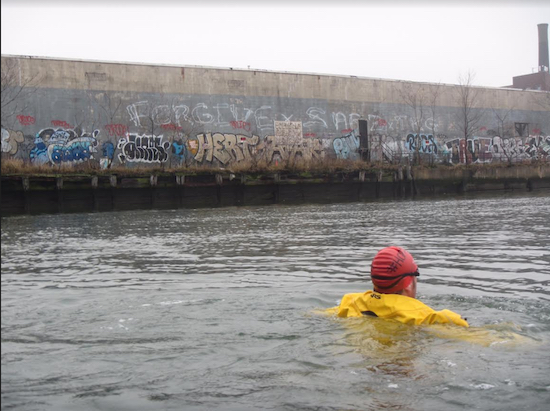
On a rainy December 2015 morning, the Eagle spoke with clean water activist Christopher Swain after he swam in Newtown Creek.
“There were used condoms, turds and sewage, and my eyes were burning underneath my goggles from the oil,” Swain said.
He added, “This was the most polluted swim I’ve done in two decades. Newtown Creek made the Gowanus seem charming.”
In both accounts, a common toxin encountered in the water was human feces.
Excrement is prominent in New York City’s waterways due to Combined Sewage Overflow (CSO).
When it rains, New York City’s sewer systems are flooded with stormwater and CSO is subsequently sent into more than 400 locations along the coasts of the five boroughs.
Newtown Creek and the Gowanus Canal are notorious for their CSOs.
Willis Elkins, program manager of Newtown Creek Alliance, told the Eagle that Newtown Creek has 22 CSO pipes and four major pipelines.
To fix the CSO problem, the New York State Department of Environmental Conservation and the New York City Department of Environmental Protection (DEP) created a CSO Long Term Control Plan (LTCP) in March 2012.
According to the agreement, “DEP will develop 10 water body-specific LTCPs, plus one citywide LTCP to reduce CSOs and improve water quality in the city’s waterways.”
The goal of each LTCP is to “identify appropriate CSO controls necessary to achieve water body-specific water quality standards, consistent with the Federal CSO Policy and the water quality goals of the Clean Water Act.”
Last week, a review of several alternatives for solving the CSO problem was discussed at the Newtown Creek Waste Water Treatment Plant.
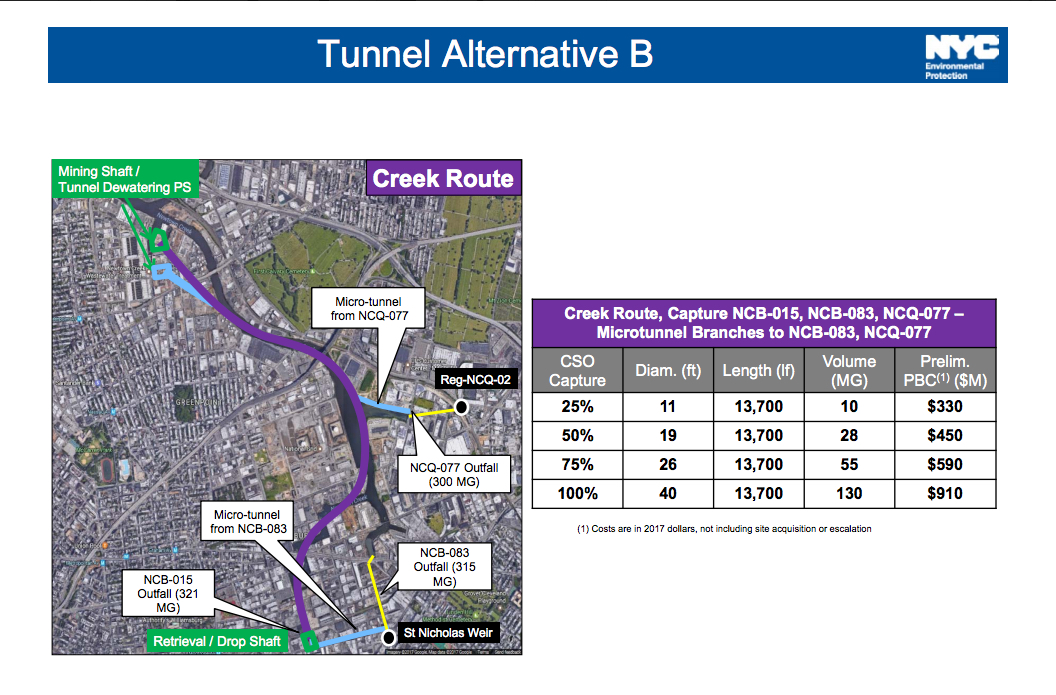
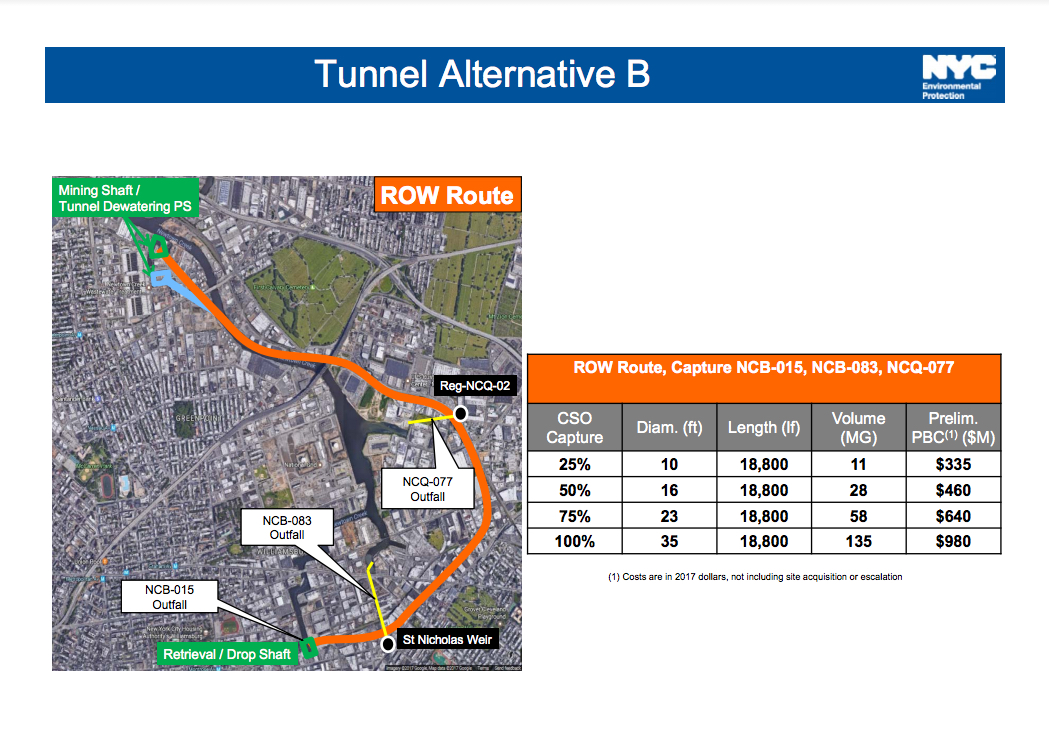
One option included digging a 2.5-mile long tunnel that would capture sewage runoff rather than let it enter the waterway.
A range of options was proposed by DEP, including four preliminary tunnel routes. Two of the routes run along the creek while the others are situated more inland under the streets of Queens.
While the length of the tunnels remains the same, the diameter of each of the corridors and the percentage of CSO capture rate varies.
For example, one storage tunnel route with a 10-foot diameter with a 25 percent CSO capture rate would cost $335 million. A 35-foot diameter with a 100 percent CSO capture rate for the same route would cost $980 million.
“It is encouraging to see DEP considering big investments to reduce the amount of untreated sewage entering Newtown Creek,” Willis told the Eagle. “We appreciate the complexity in trying to capture over a billion gallons of combined sewage per year, but feel that a drastic reduction, like a massive storage tunnel, may be the only realistic solution for improving water quality in this very impaired waterbody that connects Brooklyn and Queens.
“While we look forward to sharing our own comments on the proposed options in the coming weeks; we also ask that DEP commit to further engagement with community members and elected officials to discuss these proposals in greater detail. Capturing CSO is not only a technical issue but a critical one in protecting the health of the environment and NYC residents for generations to come.”
Other Options
Other options presented include installing sewage and stormwater retention tanks, creating new pumping stations and creating green infrastructure along the creek.
The Gowanus Canal, for example, had green infrastructure installed in November and will have two 8 million-gallon tanks installed along its shores in the future.
The canal’s green infrastructure includes a Sponge Park and 70 curbside rain gardens. They improve the health of the Gowanus Canal, clean the air around it and beautify the neighborhood.
The $1.5-million, 1,800-square-foot park captures and cleans stormwater that runs down Second Street before it enters the canal. The park will collect an estimated 1 million gallons of stormwater annually.
The curbside rain gardens, which were designed by DEP and the Department of Design and Construction, are spread out across the Gowanus Canal Watershed in Boerum Hill, Carroll Gardens, Gowanus, Park Slope and Prospect Heights.
They have the capacity to collect and absorb more than 6 million gallons of stormwater each year.
Both the park and rain gardens capture stormwater and allow it to be naturally absorbed into the ground, therefore reducing sewer overflows into the Gowanus Canal.
SUNSET PARK — “As a resident of Marine Park, one of the great surprises I found biking around Industry City and visiting Japan Village was to discover Bush Terminal Park. I continue to be amazed at the serene hideaways that the city offers in some of the busiest places — and, still, with an iconic view.”
BROOKLYN HEIGHTS — ‘A miracle that no one was killed …’ That’s what neighbors are saying about the collapse of the Hotel St. George marquee. Shown in this photograph are workmen beginning the removal and repair of the historic, old neon sign at the corner, referencing a relic of Brooklyn Heights’ past: the St. George Hotel.
ATLANTIC AVENUE — Exhausted shopper with cluster of bags and goods from mall at Boerum Place stops to look at huge construction site across the street. “Is that REALLY going to be a jail??” Her male companion is reassuring, “Nothing like Rikers … this is 21st Century.”
BROOKLYN HEIGHTS — Overheard in line at one of most popular pastry outlets on Montague Street: “Hope I can get them into a camp …” A mother with two pre-schoolers in tow was showing a friend the Dodge Y flyer for Healthy Kids Day on Saturday, April 18.

 Other Options