New York poised to lift veil on police disciplinary files
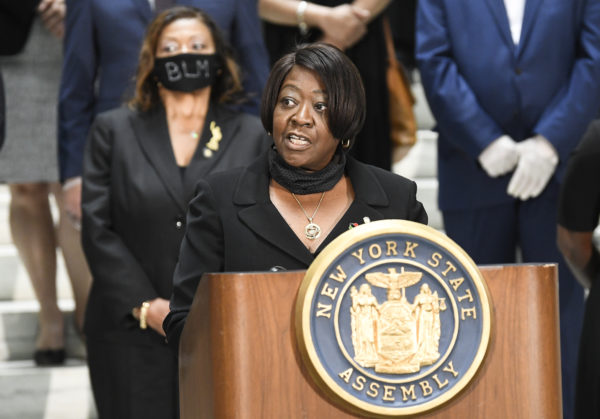
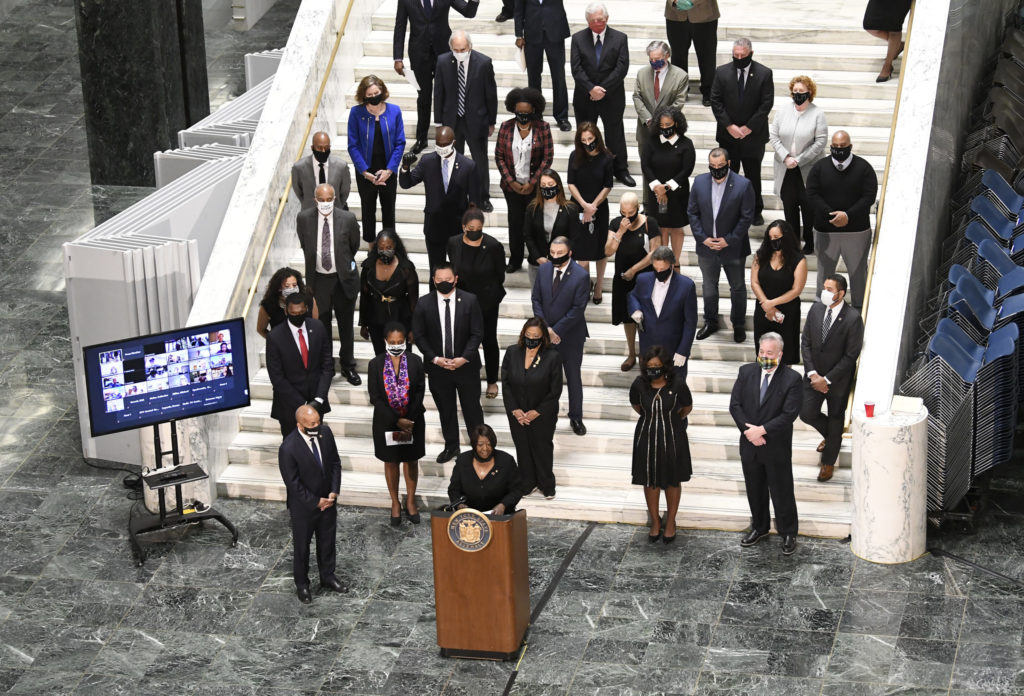
Assembly Majority Leader Crystal D. Peoples-Stokes, D-Buffalo, spoke in favor of new legislation for police reform while standing with assemblymembers during a news briefing at the state Capitol on Wednesday. Photo: Hans Pennink/AP
By Marina Villeneuve Associated Press
June 9, 2020
Copy Link
Email
Facebook
X
LinkedIn
WhatsApp
Telegram
Pinterest
Print
ALBANY, N.Y. (AP) — A decades-old law that kept law enforcement officers’ disciplinary records secret in New York appeared to be headed for an overhaul this week as state lawmakers moved to act on a number of police accountability measures prompted by street demonstrations over the death of George Floyd.
The state law, known by its section title, 50-a, was passed in the 1970s to prevent criminal defense attorneys from subjecting officers to cross-examinations about irrelevant information in their personnel file. The law applies to jail guards and firefighters, as well.
But over the years, the law also draped a veil over most records of alleged police misconduct. Formal complaints about excessive force by officers are not public in New York. In recent years, police departments have cited the law in refusing to say even whether officers have been punished.
The Democrat-led Legislature planned to pass a repeal this week and Gov. Andrew Cuomo said Monday he intends to sign it, noting that such records are already available for other government employees, such as teachers and toll takers.
“Their records will be available,” Cuomo said. “It is just parity and equality with every other public employee.”
The leaders of a coalition of police unions argued in a statement Monday that releasing such records, including complaints, could leave officers facing “unavoidable and irreparable harm to reputation and livelihood.”
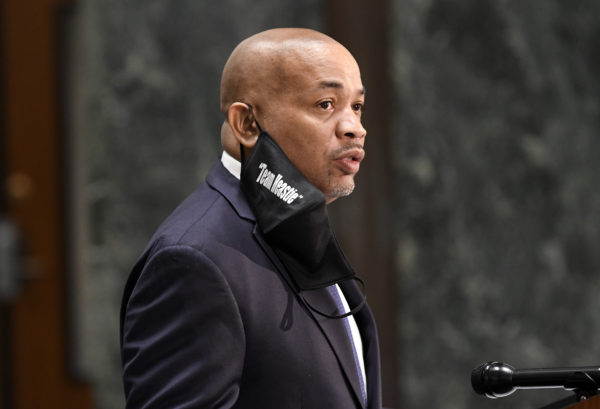
New York State Assembly Speaker Carl Heastie, D-Bronx, spoke in favor of the new legislation in Albany on Wednesday. Photo: Hans Pennink/AP
The legislation would provide officers with some privacy protections, including redaction of home addresses, personal phone numbers and email addresses.
The legislation was among a package of police accountability bills that began to move through the legislature Monday, and some of which were passed. The state Senate and Assembly passed legislation that bans police chokeholds, guarantees the right to record police activity and collects more data on deaths in custody.
Another bill that makes it easier to file civil lawsuits against people who call 911 and falsely accuse someone of criminal activity based only on their race or background also passed.
A vote on opening police disciplinary records could come as soon as Tuesday.
Meanwhile, the protests that sparked the reform push continued around New York City on Monday, and organizers urged people to stay in the streets.
Protest organizer Carlos Polanco was cheered by hundreds at Washington Square Park as he asked for further change, including diverting funding from the city’s police department to the school system, social workers and programs that prioritize rehabilitation over punishment.
Assembly Majority Leader Crystal D. Peoples-Stokes spoke in favor of the legislation on Wednesday. Photo: Hans Pennink/AP
“This is the closest we’ve ever been” to lasting reforms, he said, but added “we don’t want crumbs. We want all of it.”
Later in the day, Polanco urged a crowd gathered at Gracie Mansion to call their senators and demand that the state’s police records law be repealed Tuesday.
Civil liberty and criminal justice reform groups have long pushed for a repeal of the law, but that effort got new momentum amid huge protests over Floyd’s death and images of violent confrontations between officers and demonstrators.
Only New York and Delaware have state laws that provide law enforcement “with special carve outs from records disclosure,” according to a statement from advocacy groups including Common Cause New York and the New York Public Interest Research Group.
“What’s become increasingly clear over the past few days is how much a lack of transparent accountability measures leads to police acting with impunity in our communities,” said Michael Sisitzky, lead policy counsel for the New York Civil Liberties Union.
“We’ve seen police officers drive cars into crowds of protesters and pull down a person’s face mask in order to pepper spray them,” Sisitzky said. “We’ve seen lawmakers arrested and pepper-sprayed while attempting to mediate.”
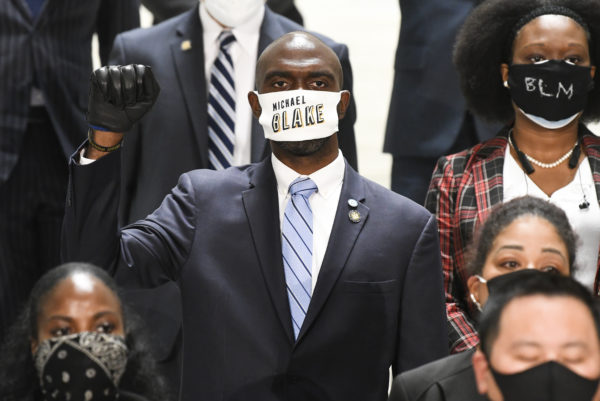
Assemblymember Michael Blake, D-Bronx, stood in Albany on Wednesday with assemblymembers in favor of new legislation for police reform. Photo: Hans Pennink/AP
Critics of the repeal include Republican Sen. Patrick Gallivan — a former sheriff in Erie County, home to the state’s second largest city, Buffalo — who said the overwhelming number of complaints against officers are deemed unfounded.
“I think people are calling for a reform that doesn’t get at any of the problems that we face as a society,” Gallivan said in an interview.
The law gained widespread attention in 2016, when New York City Mayor Bill de Blasio argued it prevented the release of disciplinary records of the police officer involved in the chokehold death of Eric Garner.
Garner’s death — after he refused to be handcuffed for allegedly selling loose, untaxed cigarettes — came at a time of a growing public outcry over police killings of unarmed Black men that gave impetus to the national Black Lives Matter movement.
Garner’s mother, Gwen Carr, last year urged Cuomo and New York state lawmakers to repeal a law that she has said “is harming me and my family.”
Associated Press writers Jim Mustian and Jake Seiner in New York and Michael R. Sisak on Long Island contributed to this report.
SUNSET PARK — “As a resident of Marine Park, one of the great surprises I found biking around Industry City and visiting Japan Village was to discover Bush Terminal Park. I continue to be amazed at the serene hideaways that the city offers in some of the busiest places — and, still, with an iconic view.”
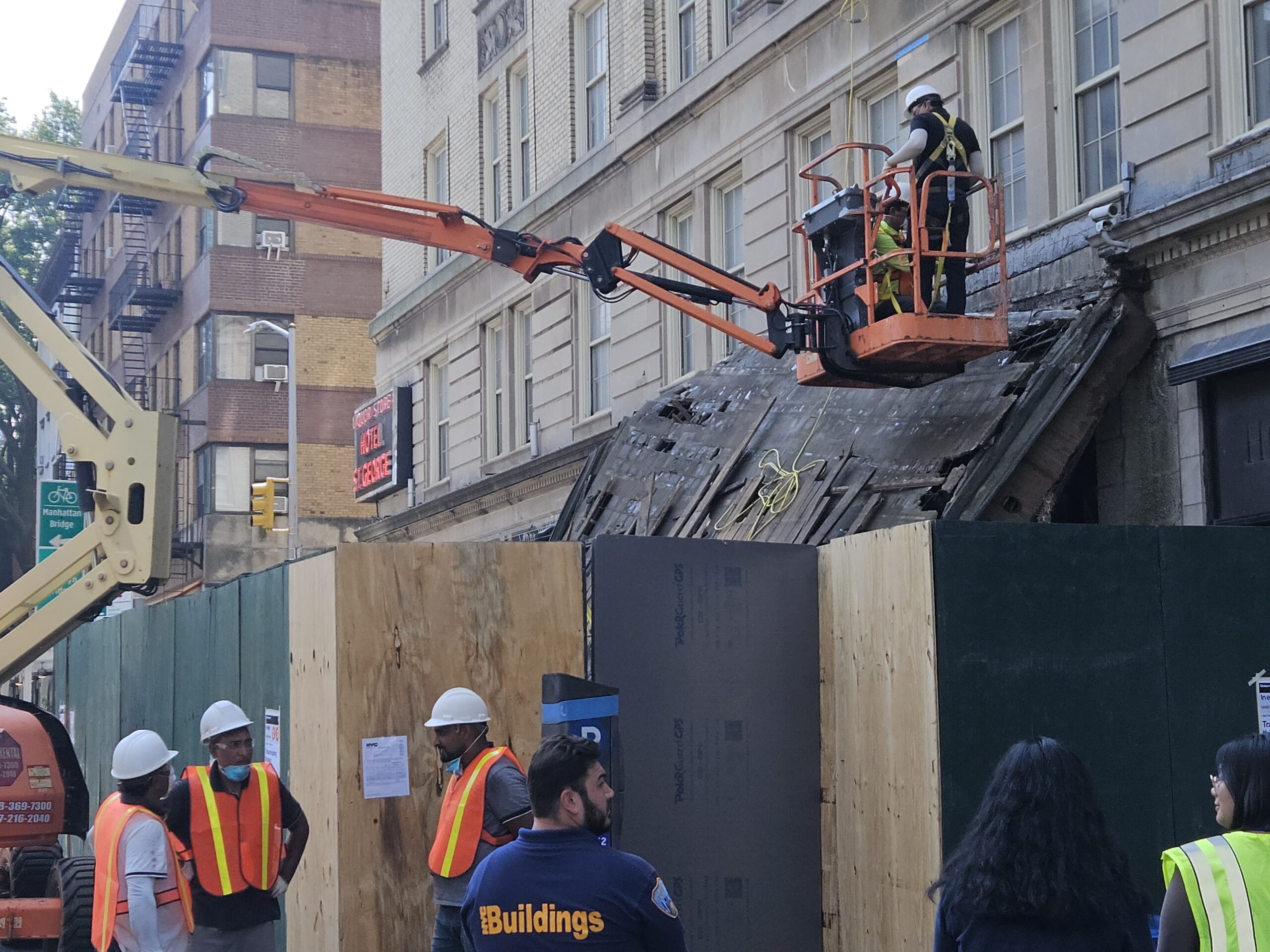
BROOKLYN HEIGHTS — ‘A miracle that no one was killed …’ That’s what neighbors are saying about the collapse of the Hotel St. George marquee. Shown in this photograph are workmen beginning the removal and repair of the historic, old neon sign at the corner, referencing a relic of Brooklyn Heights’ past: the St. George Hotel.
ATLANTIC AVENUE — Exhausted shopper with cluster of bags and goods from mall at Boerum Place stops to look at huge construction site across the street. “Is that REALLY going to be a jail??” Her male companion is reassuring, “Nothing like Rikers … this is 21st Century.”
BROOKLYN HEIGHTS — Overheard in line at one of most popular pastry outlets on Montague Street: “Hope I can get them into a camp …” A mother with two pre-schoolers in tow was showing a friend the Dodge Y flyer for Healthy Kids Day on Saturday, April 18.