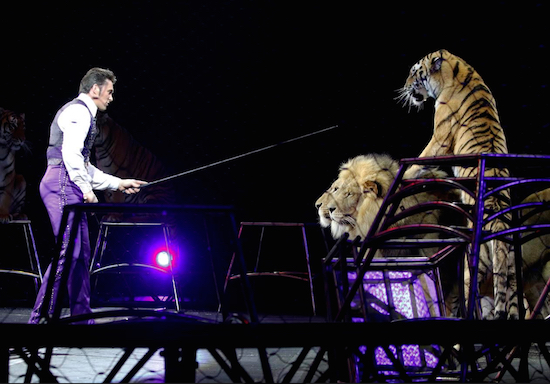
If some New York City officials and animal advocates prevail, there’ll be no more tigers, lions, leopards, monkeys, zebras or even sloths whenever “The Greatest Show on Earth” comes to town.
Two city councilmembers are sponsoring a bill that would make it illegal for Ringling Bros. and other circuses to perform in the city unless they abandon acts featuring “wild or exotic animals for public entertainment or amusement.” Animal advocates say the use of such animals in circus performances amounts to cruelty.
Stephen Payne, a spokesman for Feld Entertainment, the parent company of Ringling Bros, said the proposal “does nothing to advance animal welfare and would deny circus fans the opportunity to see the amazing bond that exists between our human and animal performers.”
Ringling is to arrive at Brooklyn’s Barclays Center in February — minus its elephants, for the first time. If the legislation becomes law, Payne said his circus would avoid New York altogether.
“Where do we leave the animals, outside city limits?” he asked.
He said the circus adheres to strict animal welfare regulations, backed by inspections.
The New York legislation was first introduced about a decade ago by Councilmember Rosie Mendez, a Manhattan Democrat. Another Manhattan Democrat, Councilmember Corey Johnson, recently joined in, saying that “trucking wild animals in and out of the city strictly for entertainment purposes is not a humane way to be treating them.”
A council committee will hold the first hearing on the proposed ban Oct. 20.
The circuses would have to refrain from using classes of animals that include sea lions, ostriches, alligators, penguins, pelicans, armadillos and zebras.
Exempt would be zoos, research facilities, religious celebrations, dog shows and educational events. And so would camels for Manhattan’s Radio City Christmas Spectacular.
“The tide has turned, and the time is ripe for this bill,” said Joyce Friedman, the New York coordinator for The Humane Society of the United States.
She cited growing public awareness of how wild animals are “trained with punishment and pain, bullied to perform unnatural and silly tricks, caged and chained in trains and trailers, and forced to endure months of grueling travel each year.”
Ringling retired its elephants last May, heeding rising popular opposition. That put an end to the herd of pachyderms walking through Manhattan on the way to Madison Square Garden.
The bill is backed by the NYCLASS animal rights group that tried to have Central Park horse carriage rides banned, unsuccessfully.
About 60 municipalities across the country, including Jersey City, N.J., last month, have passed legislation restricting non-domesticated circus animals.
The Montreal-based Cirque du Soleil has never used wild animals.
The Ringling Bros. and Barnum & Bailey Circus — its legal name — has been cited by the federal Department of Agriculture in the past for improper handling of dangerous animals, failing to provide veterinary care and causing physical harm. The company denied any wrongdoing, but paid $270,000 in 2011 to settle the claims.
The UniverSoul Circus has performed in New York but in recent years, city permits to use elephants were denied for alleged failure to follow health regulations. UniverSoul leased animals from exhibitors who also were cited for cruelty violations of the Animal Welfare Act and paid tens of thousands of dollars to settle.
UniverSoul does not acknowledge any wrongdoing, saying, “We strongly oppose any form of cruelty or mistreatment of animals, wild or domestic — and will not tolerate any mistreatment on our circus site.”
A UniverSoul spokesman declined to comment on its operations or the proposed city legislation.