BY SCOTT KLOCKSIN
In June of this year, an 18-wheeler making a turn at Church Avenue and Ocean Parkway struck Patricia Ngozi Agbim, 73, killing her.
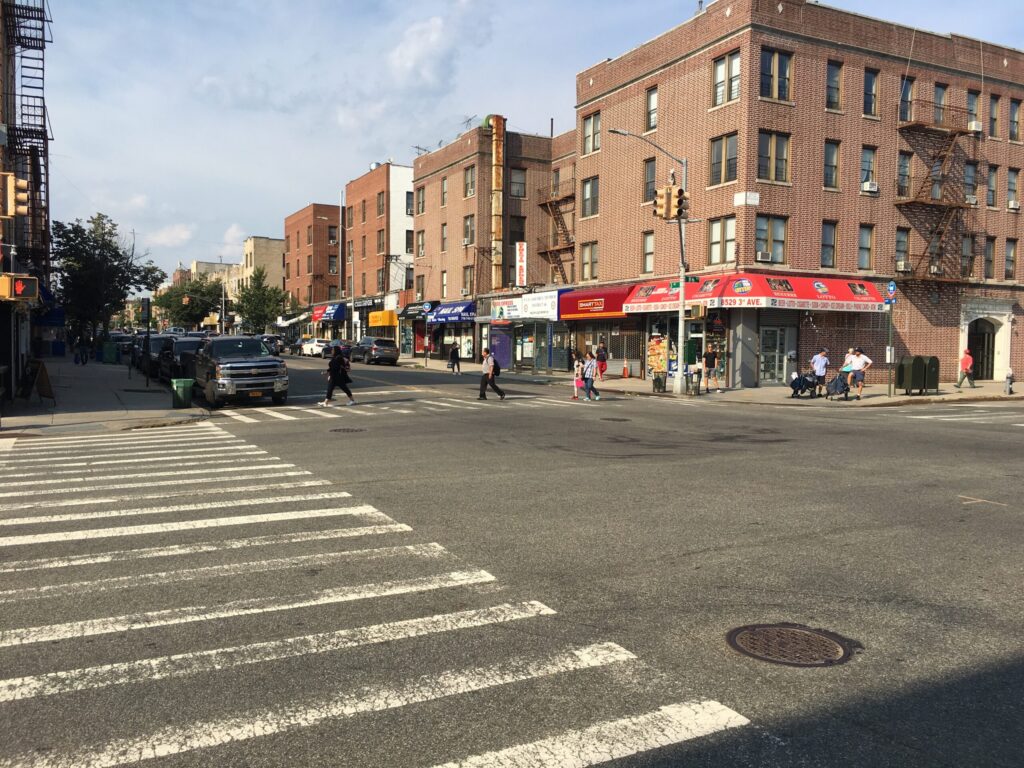
It happened at the Kensington intersection where Ocean Parkway’s six lanes cross Church Avenue and become the stoplight-free Prospect Expressway. Last month, the intersection became the first of 10 along the busy road to be redesigned by the New York State Department of Transportation.
“It feels like it should be a highway,” said driver Anna Monskaya, 25. Monskaya said she drives with the flow of traffic at about 10 MPH over the 30 MPH speed limit on her route from Midwood into Manhattan three or four days a week.
“There are fairly narrow lanes,” Monskaya said, “but you have red lights on every block and a speed limit. You have the urge to speed when you can.”
A State DOT spokesperson knew of no plans for a speed-reduction component in the redesign of the nine other Ocean Parkway intersections that have been identified through a study being conducted by the department. The study is scheduled to be complete by next spring.
A new pedestrian island between the north and southbound lanes of the parkway on the north side of Church Avenue—the same side of the street where Agbim was killed—is intended to give those crossing the wide street a place to wait if they can’t make it across in one traffic light cycle.
Last spring, constituents of Councilmember Brad Lander, whose district includes the intersection, voted to earmark $200,000 for improvements that include re-striped crosswalks and a flashing light to help slow drivers making the right turn from Church Avenue onto the Prospect Expressway. As a state highway, the state DOT is responsible for the layout and construction of the parkway’s intersections, while features like crosswalks and signal boxes are funded through the city’s budget.
The traffic calming strategy at Church and Ocean Parkway is being tested as a model, the state DOT spokesperson said, and will inform the redesign of nine other intersections slated for improvement.
The nearly five-mile length of the parkway was labeled Brooklyn’s most dangerous road by the Tri-State Transportation Campaign, with six fatalities between 2009 and 2011. In the most recent month for which the NYPD has made collision data available—October of this year—the road saw six pedestrians injured. Last month a pedestrian was critically injured by a car where the parkway meets Avenue M.
“[Improving this intersection] has been coming up in our meetings for years,” said Wolf Sender, district manager for Community Board 12, in whose catchment area the controversial intersection is located.
Carole Davis, 67, crosses it daily. She remembers the day Agbim was killed by the truck and is glad something is being done. Still, Davis said, having to get across even half of the behemoth parkway in one green light cycle can be a challenge.
“It’s okay if you get caught in the middle when the light changes,” she said, “but what if you get caught in the street before you even get to the middle? There’s no place to go.”
Countdown signals were installed at 14 intersections along Ocean Parkway in City Councilmember David Greenfield’s district in 2011. The signals can’t help a person walk faster, but the bright red flashing numbers count down the seconds until the light changes.
In 2012, the first full year since the signals were installed, a 73 year-old man struck by a vehicle at Kings Highway was the only pedestrian fatality on Ocean Parkway, according to National Highway Traffic Safety Administration data.
Piggy-backing on the popularity of the signals along the parkway, Greenfield’s office announced last month that $606,000 allocated through the city’s participatory budgeting program will go toward the installation of the signals at 30 intersections throughout the councilmember’s 44th District.
Making the streets safer isn’t as simple as just asking, Sender said. “Our requests go to the city. The responses are usually ‘we have no money for this, we have no money for that, etc.’ But after these accidents,” he said, “the state and the city heard us.”