CITYWIDE — Last year’s New York City mayoral election stood out in several ways, particularly Zohran Mamdani’s rise from a little-known assemblymember to mayor, defeating incumbent Eric Adams and former Gov. Andrew Cuomo.
The exceptional outcome was reflected in unusually high voter engagement, according to arecent report by the Campaign Finance Board, a nonpartisan city agency that runs the city’s public campaign finance system and aims to increase voter engagement.
People vote at Trinity Lutheran Church Tuesday, Oct. 28, 2025, in the Queens borough of New York. Photo: Frank Franklin II/AP
Last year, according to the CFB’s 2025 Voter Analysis Report released this spring, New York City voters registered and turned out to vote in unprecedented numbers for a local election year.
New York voter engagement for presidential elections has consistently outpaced local election cycles, a trend reflected across the country. The 2025 election cycle still saw lower voter turnout than theprevious presidential election, for which 60.2% of eligible New York City residents voted.
Young voters aged 18 to 29 saw a surge in turnout between the 2021 and 2025 general elections. Source: Voter Analysis Report/Campaign Finance Board
In 2025, voter turnout for the general election in which Mamdani was elected mayor reached 41.6% or 2.2 million voters — the highest rate for a city election in over 50 years. In 2021, the general election saw turnout rates of 23.3%.
“Between the 2021 general [election] and the 2025 general, there was almost a 20 percentage point increase in turnout. That’s just huge. That is so many people, and it’s really exciting,” said Demiana Rizkalla, a policy analyst at the CFB who worked on the Voter Analysis Report.
Brooklyn had the highest registration rate for the last local election cycle of any borough. Source: Voter Analysis Report/Campaign Finance Board
The report also showed that last year, Brooklyn led the city for voter registration, as 1,675,259 Brooklynites — 97.3% of eligible voters — registered to vote. Across the city, 94.3% of eligible voters were registered to vote in the 2025 election.
Brooklyn was in the middle of the pack for turnout, while Manhattan had the highest rates of turnout across both the primary and general election. In the general election, 42.7% of registered voters cast a ballot, while Manhattan had nearly 50% turnout.
NYC’s voter turnout still lags nationwide
A rise in voter engagement is always positive. The 2025 Voter Analysis Report “showed how healthy the New York City democracy is and that we really are capable of engaging voters for city elections at levels most commonly associated with federal elections that everybody pays attention to,” said Jadel Munguia, assistant press secretary for the NYC CFB.
Turnout levels were the highest they have been for a local general election in NYC in over 50 years, with Brooklyn’s turnout slightly over the average. Source: Voter Analysis Report/Campaign Finance Board
Despite an encouraging surge of voter participation last year, New York City’s voter turnout for local elections is still low. In the most engaged local election in a half-century, 2.2 million people chose the mayor of a city with around 5.5 million eligible voters.
A paper released in 2024 by the Yankelovich Center for Social Science Research at the University of California, San Diego, examined voter engagement in local elections in the 50 biggest cities in the United States. Using data from the 2021 election, New York City ranked 37th of 50 for voter turnout. Last year’s mayoral election turnout, a major jump from 2021, would still place NYC 18th in that ranking.
San Francisco had the highest voter turnout rates across the nation for local elections in the study, with 79% of registered voters participating in the city’s last mayoral election. It shares one feature with the other cities that make up the 11 highest turnout rates across the country: Their local elections take place in even-numbered years, aligned with national elections.
The Campaign Finance Board administers the public matching funds program for small campaign donations. Mamdani’s campaign heavily utilized this program, receiving around $13 million of matched public funds. Source: Voter Analysis Report/Campaign Finance Board
In 2024, CFB proposed aligning New York City’s local and federal elections to increase engagement and cut back on voter fatigue. This proposal reached NYC voters last year as a ballot measure in the 2025 general election, which was rejected by 52.8% of voters. Mamdani was one of them.
Though this measure would undoubtedly increase voter participation in local elections, opponents argued that local races would see less attention if put on the same ballot as national elections.
A closer look at Brooklyn voters
Historically, voting rates in the city have been highest amongst older and college-educated voters,THE CITY reported last year.According to the CFB, districts with a higher voting rate are more likely to have more white residents and U.S.–born residents. Wealth is also a factor; districts with lower turnout rates are more likely to have lower annual median household incomes.
The Campaign Finance Board identified 15 districts across the city as “priority community districts,” areas that have lower-than-average voter engagement and increased barriers to engagement. Source: Voter Analysis Report/Campaign Finance Board
In Brooklyn, the community districts with the highest turnout rates were Community District 6, representing Park Slope and Carroll Gardens, and Community District 2, which covers Brooklyn Heights and Fort Greene.
The Campaign Finance Board has identified districts across the city with historically low voter engagement and barriers to voting as “priority community districts.”
“We identified priority communities: Voters under the age of 30, newly naturalized citizens, voters with limited English proficiency and voters that are directly impacted by the criminal justice system,” explained Rizkalla.
The 2025 election cycle saw a major surge in young voters, with general election turnout among 18 to 29-year-olds rising from 11.1% in 2021 to 41.9% last year.
Though some priority community districts had registration rates above the city average, on average, they lagged behind it. Source: Voter Analysis Report/Campaign Finance Board
Six priority community districts fall in Brooklyn
Last year, average voter registration and primary and general election turnout in the six Brooklyn priority community districts lagged behind citywide averages.
Barriers to engagement vary across Brooklyn priority districts. “Every New Yorker’s experience is different,” said Rizkalla. “Every neighborhood deals with a different combination of factors that might determine their outcomes when we look at voter and contributor behavior.”
The majority of the CFB’s priority community districts fell behind the citywide average for turnout in the 2025 general election. Source: Voter Analysis Report/Campaign Finance Board
For example,Community District 7, which covers Sunset Park and Windsor Terrace, has high rates of voters with low English proficiency and lower education rates than other parts of the city. In comparison, voters inCommunity District 15, which includes Sheepshead Bay and Gravesend, have higher average education rates and socioeconomic status, and the number of voters born outside of the U.S. is high.
Though the majority of residents inBrooklyn Community District 13, which includes Coney Island and Brighton Beach, are white, median household incomes are below average, most residents were born outside the U.S., and nearly half of voters have limited English proficiency.
To raise participation rates in these districts, the Campaign Finance Board produces educational materials in 14 different languages and works with 116 local community-based organizations in priority community districts.
Voter turnout for the 2025 general election in NYC far surpassed both 2021 rates and turnout for the primary election, in a reversal of usual trends. Source: Voter Analysis Report/Campaign Finance Board
A major way the CFB hopes to engage underrepresented voters citywide is through the city’s matching funds program, which uses public funds to match small-dollar donations $8-to-$1 for the campaigns of candidates who opt in. The program amplifies grassroots support, allowing voters who aren’t independently wealthy to have more spending power in local elections.
Mamdani’s campaign received 52,560 donations under $250 and received $13.1 million in public matching funds through the program. In comparison, Cuomo received 7,772 small contributions and around $8 million in matching funds.
A comparison of voter turnout in NYC local elections across years reveals last year’s mayoral election represented a major surge in engagement. Source: Voter Analysis Report/Campaign Finance Board
Though these efforts have helped increase voter participation across priority districts — every priority district saw an increase in turnout in 2025 compared to 2021 — there are still major gaps to fill.
“Of course, we want this momentum to keep going, we want people to turn out to vote, we want people to exercise their right to vote, and so we are doing our best to continue to reach out to people where they’re at and make sure that happens,” said Rizkalla.
Zohran Mamdani speaks during a victory speech at a mayoral election night watch party, Tuesday, Nov. 4, 2025, in New York. Photo: Yuki Iwamura/AP
SUNSET PARK — “As a resident of Marine Park, one of the great surprises I found biking around Industry City and visiting Japan Village was to discover Bush Terminal Park. I continue to be amazed at the serene hideaways that the city offers in some of the busiest places — and, still, with an iconic view.”
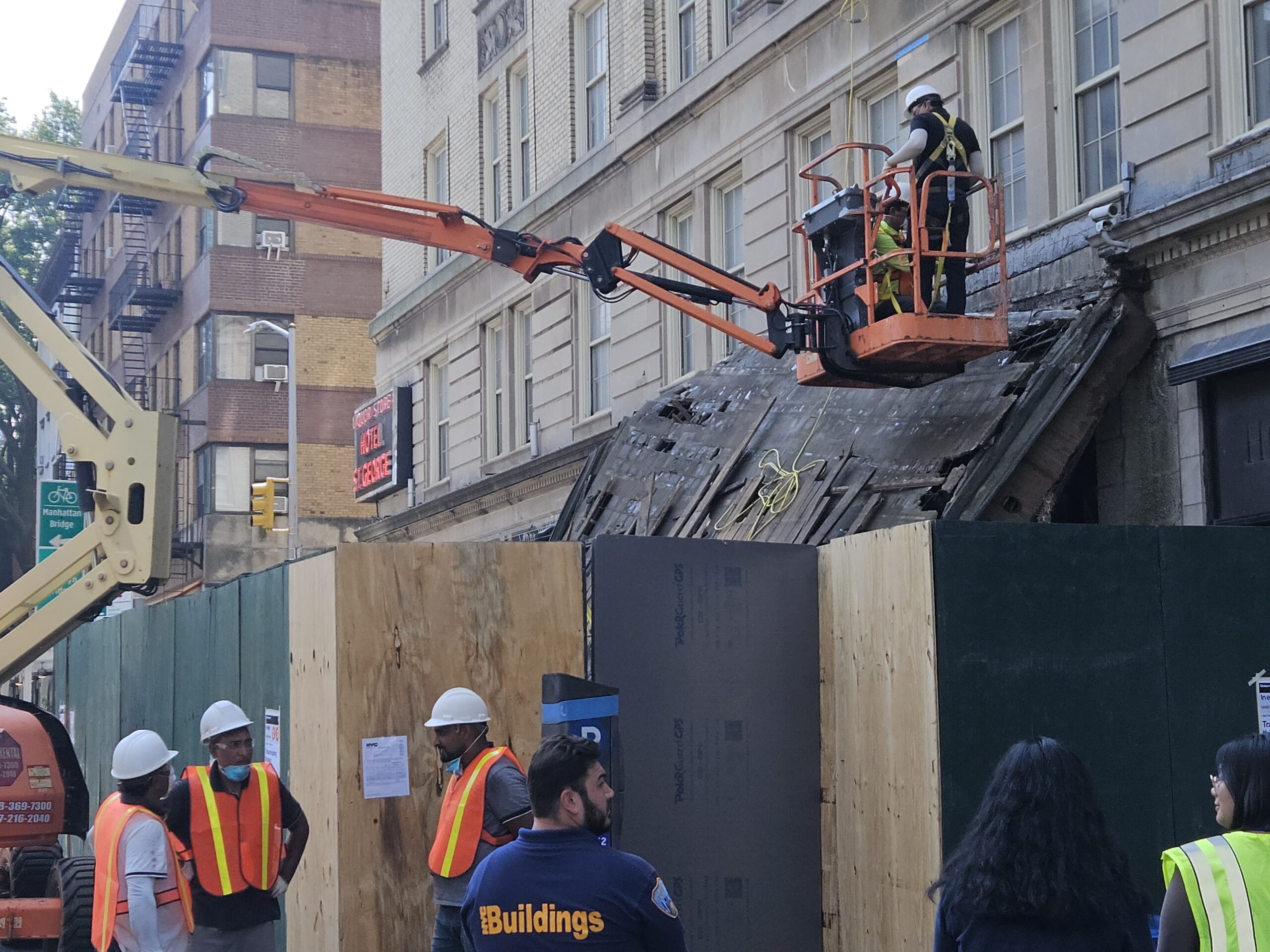
BROOKLYN HEIGHTS — ‘A miracle that no one was killed …’ That’s what neighbors are saying about the collapse of the Hotel St. George marquee. Shown in this photograph are workmen beginning the removal and repair of the historic, old neon sign at the corner, referencing a relic of Brooklyn Heights’ past: the St. George Hotel.
ATLANTIC AVENUE — Exhausted shopper with cluster of bags and goods from mall at Boerum Place stops to look at huge construction site across the street. “Is that REALLY going to be a jail??” Her male companion is reassuring, “Nothing like Rikers … this is 21st Century.”
BROOKLYN HEIGHTS — Overheard in line at one of most popular pastry outlets on Montague Street: “Hope I can get them into a camp …” A mother with two pre-schoolers in tow was showing a friend the Dodge Y flyer for Healthy Kids Day on Saturday, April 18.