More than 1 million NYC tenants may have to bag garbage and man doors by themselves
Strike vote for 34,000 building workers takes place Wednesday
The buildings in this photo, as seen from Cadman Plaza West in Brooklyn Heights, would be affected by the threatened building workers strike. Photo: Mary Frost/Brooklyn Eagle
CITYWIDE — Tenants in residential buildings across New York City might soon have to bag their own garbage and compost, man the front desk and manage deliveries, if the city’s 34,000 unionized building workers vote to go on strike.
Members of 32BJ SEIU will hold a formal strike authorization vote on Wednesday; if a strike is approved, porters, front desk staff, handymen and other workers in most of the city’s residential buildings (with the exception of the Bronx) will walk off the job on April 21 at 12:01 a.m.
Strike captains gathered Thursday in Brooklyn Heights to rally and strategize after the union received what it called “insulting” contract changes from the Realty Advisory Board on Labor Relations, which represents building owners.
32BJ SEIU Strike Captains Edwin Devalle and Hasan “SunnyD” Dibra in front of 101 Clark Street in Brooklyn Heights. Photo: Mary Frost/Brooklyn Eagle
Strike Captain Hasan “SunnyD” Dibra is a concierge at 30 Main St. in DUMBO. He said RAB was trying to install a two-tier system, where new workers would start out with lower pay than current workers did when they started. “We’ve never had that before,” he told the Brooklyn Eagle. “I’m doing this almost 30 years in the city and in Brooklyn, and it’s not something we want. I mean, our families, we’re already struggling as it is.”
Dibra said union members were getting a lot of support from their building tenants. “Residents — ask any of them — they love us. We do what we can above and beyond the call of duty. We’re there for them, and they know this. And, you know, without us and without them, there’s no New York.”
Strike Captain Edwin Devalle, superintendent at 1625 Fulton St. in Bedford-Stuyvesant, added, “We need to get more pay. Our bills are going up, rent is due — and it’s high. And we have families we have to feed.”
Several rank-and-file union members told the Eagle they hoped they wouldn’t have to strike. “Fingers crossed,” said one Brooklyn Heights superintendent.
On Monday, Iecha Vega, a lobby attendant at 101 Clark St. in Brooklyn Heights, was sorting packages, one of her many duties. Photo: Mary Frost/Brooklyn Eagle
Pay, healthcare, benefits
According to a release from the union, RAB’s proposals include: shifting the cost of healthcare onto workers via premium sharing; the introduction of a lower-paid “Tier II” workforce; the expansion of temp workers; the weakening of labor contract enforcement; and the lack of a commitment to pension improvements.
While the union claims that the real estate industry is enjoying “record high rents, high property values and historic low vacancy rates,” RAB said on its website that the industry “is confronting existential threats, including the imposition of 0% rent increases on 1 million rent stabilized NYC apartments, which would severely constrain the industry’s ability to provide wage increases.”
According to Corcoran’s March 2026 NYC Residential Rental Market Report, rents in Brooklyn have indeed reached record highs, with a median rent of $4,296 per month (that includes apartments of all sizes and all Brooklyn neighborhoods). Manhattan rents have also reached a new, all-time high, at $5,000 per month.
A strike would affect roughly 600,000 New York City households, or more than 1 million residents, according to 32BJ SEIU.
32BJ SEIU strike captains gathered with the union’s president, Manny Pastreich (center), on Thursday in front of 101 Clark Street in Brooklyn Heights. Photo: 32BK SEIU
No FedEx, UPS or DHL deliveries
Building managers are warning tenants that FedEx, UPS and DHL will not make deliveries for the duration of the potential strike, as it is likely these vendors will not cross the picket lines. (Food and other small deliveries, in most cases, will be allowed as far as the lobby.) In addition, building renovations will come to a stop and move-ins will be suspended.
One Brooklyn Heights cooperative sent tenants a fact sheet calling on residents to sign up for volunteer assignments if the strike is called. “We will need people to sit at the front desk and able-bodied individuals to pick up garbage and recycling. We also need volunteers to help neighbors that may need assistance,” the communication said. (Volunteers should note that garbage collection takes place three mornings a week between 5:30 – 8:30 a.m.)
While some workers said they were worried that a strike could drag on, Sal, a superintendent at a building on Kings Highway, told the Eagle he believes the odds of the union actually going on strike are low. “I feel strongly we’re going to be winning a decent contract, and it’s going to be agreed upon,” he said.
Sal had a message for tenants: “Support our union. We’re all on your side, and we give you the best of services that we can.”
The last building workers’ strike, which lasted 12 days, took place in 1991. A strike was averted in April 2022 when workers reached a deal with RAB which included a post-COVID-19 raise and 100% employer-paid health care.
SUNSET PARK — “As a resident of Marine Park, one of the great surprises I found biking around Industry City and visiting Japan Village was to discover Bush Terminal Park. I continue to be amazed at the serene hideaways that the city offers in some of the busiest places — and, still, with an iconic view.”
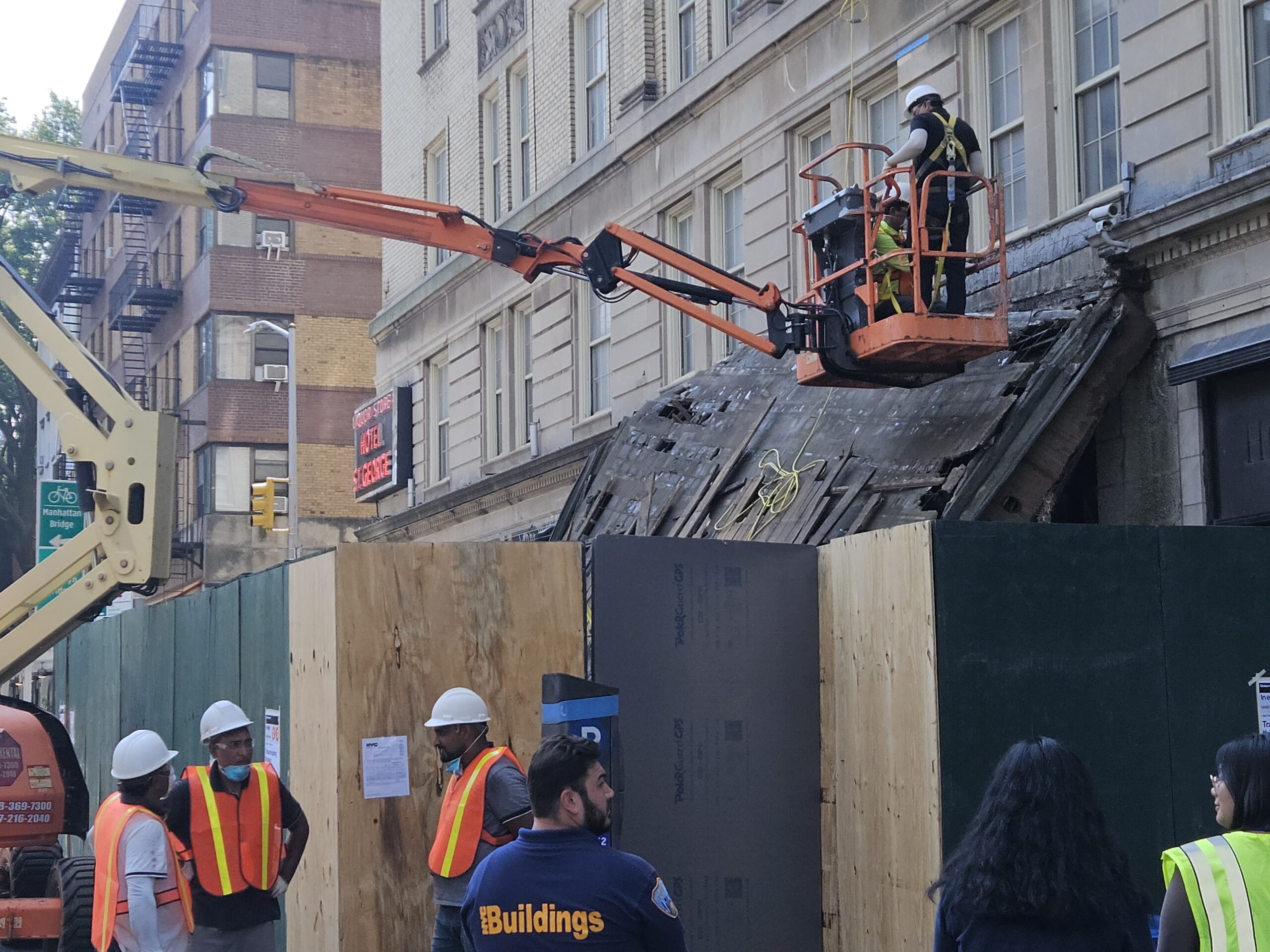
BROOKLYN HEIGHTS — ‘A miracle that no one was killed …’ That’s what neighbors are saying about the collapse of the Hotel St. George marquee. Shown in this photograph are workmen beginning the removal and repair of the historic, old neon sign at the corner, referencing a relic of Brooklyn Heights’ past: the St. George Hotel.
ATLANTIC AVENUE — Exhausted shopper with cluster of bags and goods from mall at Boerum Place stops to look at huge construction site across the street. “Is that REALLY going to be a jail??” Her male companion is reassuring, “Nothing like Rikers … this is 21st Century.”
BROOKLYN HEIGHTS — Overheard in line at one of most popular pastry outlets on Montague Street: “Hope I can get them into a camp …” A mother with two pre-schoolers in tow was showing a friend the Dodge Y flyer for Healthy Kids Day on Saturday, April 18.