Premium Content: Water bottles contain thousands of microplastics — what are the alternatives?
Plastic bottles and other garbage are seen next to a beach near Rome. We breathe, eat and drink tiny particles of plastic. But are these minuscule specks in the body harmless, dangerous or somewhere in between? Photo: Andrew Medichini/AP
By Mandie-Beth Chau
August 19, 2024
Copy Link
Email
Facebook
X
LinkedIn
WhatsApp
Telegram
Pinterest
Print
A study from January 2024 found that plastic bottles slough off over 100,000 micro- and nano-plastics (MNPs) per liter of water. Even avoiding plastic bottles as a water source, water straight from the tap or from a filtration system is still contaminated with microplastics.
Microplastics are defined as being 1 micrometer to 5 millimeters in length, and nanoplastics are defined as being less than 1 micrometer. 90% of the plastics found in water were considered nanoplastics, thanks to a new way of observing, categorizing and measuring plastic particles in a Columbia University study.
Naixin Qian, a Columbia physical chemist, zooms in on an image generated from a microscope scan, with nanoplastics, microscopic plastic pieces, appearing as bright red dots in New York on Monday, Jan. 8, 2024. A new study found the average liter of bottled water has nearly a quarter million invisible pieces of nanoplastics, detected and categorized for the first time by a microscope. Photo: Mary Conlon/AP
Humans ingest the microplastic through the air, food and water they consume, and many of the sources of plastics are far removed from individual control; For example, vegetables often grow in soil contaminated with plastics from factories, contaminated water or other sources of pollution. Yet there are some common habits that add unnecessary plastic to one’s diet, such as plastic water bottles, plastic cutting boards and other household items made from plastic.
There are alternatives that can reduce, though not eliminate, the effects of MNPs. Water is a major source of plastic for human consumption, and addressing the plastic pollution in water could significantly reduce the negative health effects on both humans and the planet.
The inside of an optical box reveals the components that organize the light from laser beams to identify nanoplastics, microscopic plastic pieces, in New York on Monday, Jan. 8, 2024. A new study found the average liter of bottled water has nearly a quarter million invisible pieces of nanoplastics, detected and categorized for the first time by a microscope. Photo: Mary Conlon/AP
“Forever chemicals” in water
Another source of dangerous plastic pollution in drinking water is from per- and poly-fluorides (PFAS), also known as “forever chemicals” because they never degrade. PFAS entered the environment through chemical and product manufacturing, and are now mostly banned in the U.S.
Environmental Protection Agency (EPA) released a lifetime drinking water advisory in 2022 for four PFAS: perfluorooctanoic acid (PFOA), perfluorooctane sulfonic acid (PFOs), perfluorobutane sulfonic acid and its potassium salt (PFBS) and hexafluoropropylene oxide (HFPO) dimer acid and its ammonium salt (“GenX” chemicals).
“People on the front-lines of PFAS contamination have suffered for far too long. That’s why EPA is taking aggressive action as part of a whole-of-government approach to prevent these chemicals from entering the environment and to help protect concerned families from this pervasive challenge,” said EPA Administrator Michael S. Regan when the advisories were released, referencing what became the PFAS National Primary Drinking Water Regulation in April 2024.
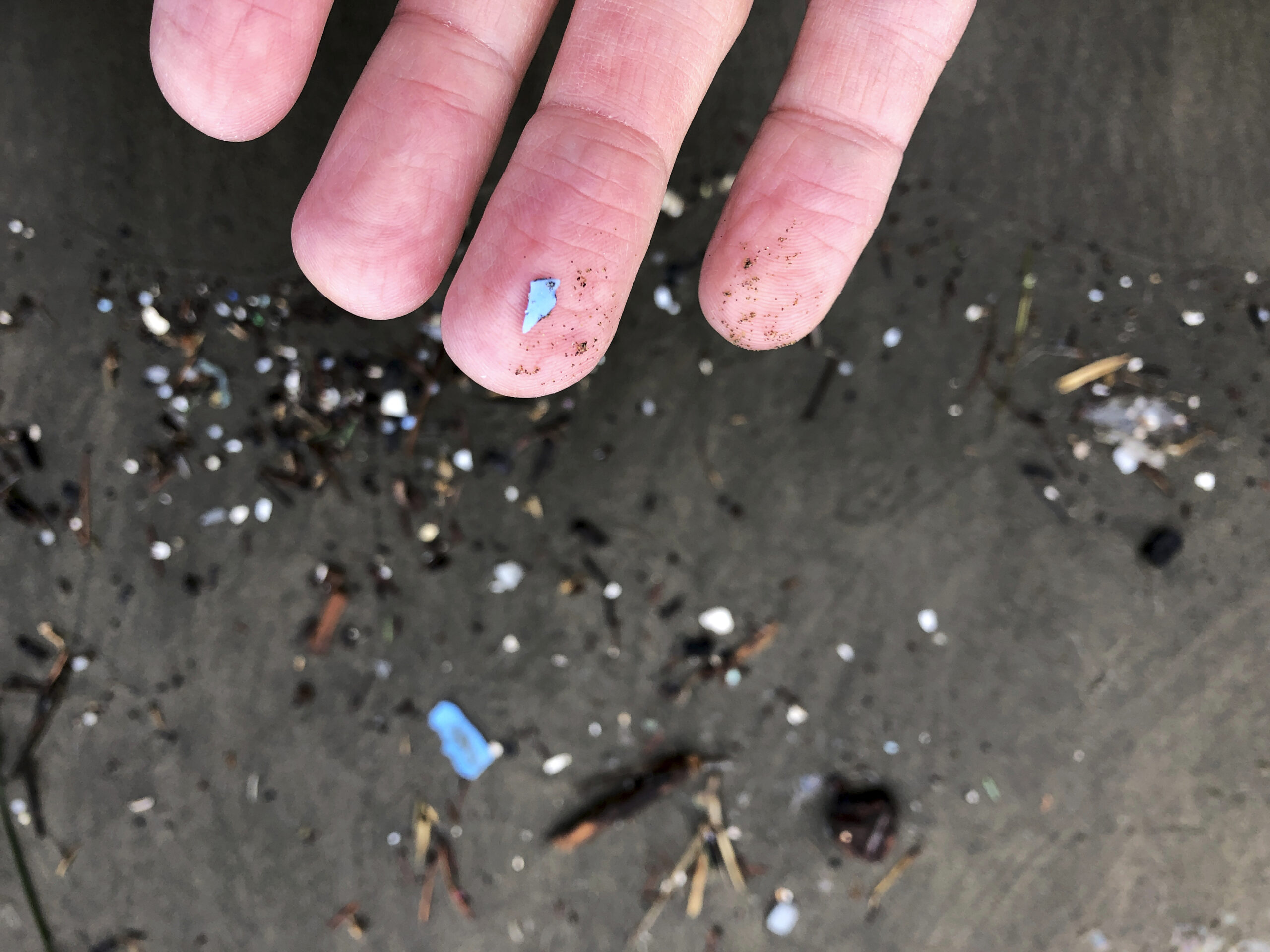
This photo shows microplastic debris that has washed up at Depoe Bay. Photo: Andrew Selsky/AP
EPA announced $1 billion in bipartisan infrastructure funding to test drinking water for PFAS and projects to address contaminated water sources, especially in small or disadvantaged communities with fewer resources and limited access to clean water. While the EPA addresses and researches remedies for the PFAS-contaminated water, what can individuals do to better regulate their exposure to plastics in water?
Filtered water and plastic alternatives
Even when avoiding plastic water bottles, other drinking water options still contain unknown amounts of plastic, including water filtration systems and tap water, but there are some options that are better than others.
Popular options for water filter attachments or pitchers are often made of plastic or are incapable of filtering out MNPs, even if they can filter out other chemicals and contaminants. Distillation, or boiling water, can eliminate nearly 90% of microplastics. Using a glass or metal water pitcher or filtration system is also healthier than using plastic ones.
According to the National Institute of Health, “Microplastic removals were highest for the device with the smallest pore size membrane filters, while the device that only incorporated granular activated carbon and ion exchange resin exhibited poor performance, including effluent microplastic concentrations exceeding those in the influent under certain conditions. Devices that incorporate physical treatment barriers including membrane filtration are suitable for microplastic removal from drinking water.”
Plastic waste sits on a freshly cultivated field in Nauen, Germany. Scientists in Austria say they’ve detected tiny bits of plastic in people’s stool for the first time. Photo: Ferdinand Ostrop/AP
When tested, some filter systems removed microplastics to varying success rates, further evidence that research remains ongoing on this topic. Most research reflects that tap water and a filtration system, such as distillation, is most effective at reducing plastics in drinking water, along with reducing plastic utensils and dishes when storing or cooking with water.
Brooklyn’s water
Brooklyn gets its drinking water from the New York City Watershed Program, which is the largest unfiltered water system in the U.S. It gathers water from rain and snowfall in 19 reservoirs and three lakes, and New Yorkers frequently regard their water as the best, even crediting the quality of bagels and pizza dough to the city’s water.
A swan stands between dumped plastic bottles and waste at the Danube river in Serbia. A new study says Earth has pushed past seven out of eight scientifically established safety limits and into “the danger zone,” not just for an overheating planet that’s losing its natural areas, but for well-being of people living on it. The study, published May 31, 2023, for the first time includes measures of “justice,” which is mostly about preventing harm for groups of people. Photo: Darko Vojinovic/AP
Brooklyn’s water comes from the Catskills and Delaware watersheds, although at one point in history Brooklyn had high-quality drinking water. According to the city, “water was hauled from Brooklyn in the early 1700s. Brooklyn had an excellent supply of fresh groundwater, but it was not enough to meet New York City’s needs.”
SUNSET PARK — “As a resident of Marine Park, one of the great surprises I found biking around Industry City and visiting Japan Village was to discover Bush Terminal Park. I continue to be amazed at the serene hideaways that the city offers in some of the busiest places — and, still, with an iconic view.”
BROOKLYN HEIGHTS — ‘A miracle that no one was killed …’ That’s what neighbors are saying about the collapse of the Hotel St. George marquee. Shown in this photograph are workmen beginning the removal and repair of the historic, old neon sign at the corner, referencing a relic of Brooklyn Heights’ past: the St. George Hotel.
ATLANTIC AVENUE — Exhausted shopper with cluster of bags and goods from mall at Boerum Place stops to look at huge construction site across the street. “Is that REALLY going to be a jail??” Her male companion is reassuring, “Nothing like Rikers … this is 21st Century.”
BROOKLYN HEIGHTS — Overheard in line at one of most popular pastry outlets on Montague Street: “Hope I can get them into a camp …” A mother with two pre-schoolers in tow was showing a friend the Dodge Y flyer for Healthy Kids Day on Saturday, April 18.