Kim Stanley Robinson expresses ‘angry optimism’ about climate change at Pioneer Works
The sci-fi writer talked space, utopias and climate change with Janna Levin for the latest installment of the ‘Science and Fiction’ series
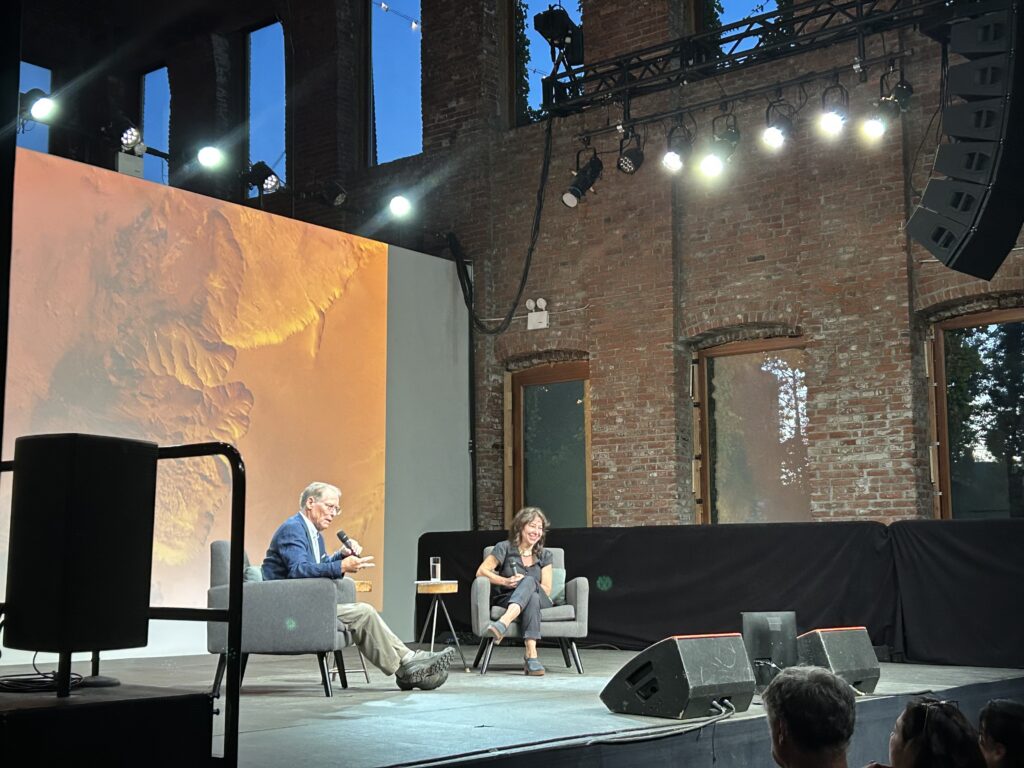
Kim Stanley Robinson, renowned science-fiction writer who more recently has turned his focus from space to life on a hotter Earth, spoke on June 16 with Janna Levin at Pioneer Works in Red Hook. Photo: Ella Spungen/Brooklyn Eagle
RED HOOK — Kim Stanley Robinson, best known for writing science fiction, is devoted to Earth and its people.
On Tuesday, June 16, the author addressed a sold-out crowd at Pioneer Works on utopias, space exploration and how humans can survive climate change for the latest installment of the center’s “Science and Fiction” series.
Pioneer Works straddles art and science, and its “Science and Fiction” lecture series is one way it brings the disciplines together, hosting artists and thinkers who create work at that intersection, including past speakers Werner Herzog, N.K. Jemisen and Darren Aronofsky.
Science fiction author Kim Stanley Robinson. Photo: Christopher Michel/Wikimedia Commons
“Science and Fiction” is hosted by Janna Levin, director of Sciences at Pioneer Works, professor of physics and astronomy at Barnard College and co-editor-in-chief of the Pioneer Works Broadcast magazine. She studies and writes about black holes and cosmology, the study of the origins and evolution of the universe.
Robinson has often turned to Levin throughout his career to write the novels that some call “hard sci-fi,” a genre that adheres closely to real-life science. Robinson calls it realism.
“One of the ways that I can make you believe in my science fiction future is that nothing in it contradicts your sense of what’s real and what’s possible,” he told Levin.
That promise is true for Robinson’s novels, which explore every planet in the solar system and some beyond. “No faster-than-light travel, no aliens that speak English 10 minutes after you meet them,” he said.
A sold-out audience attended the free conversation between Kim Stanley Robinson and Janna Levin at Pioneer Works on June 16. Photo: Ella Spungen/Brooklyn Eagle
His novels speculate on the near future on Earth and the climate crisis, Levin said, adding another layer of realism to his work. Robinson’s most recent novel, “The Ministry for the Future,” published in 2020, follows a fictional United Nations tasked with advocating for future generations amid worsening climate change.
“You take many global perspectives to tell the story of a very impactful climate crisis, an emergency that is completely imaginable from where we’re sitting right now,” said Levin. “You’re not extrapolating in any absurd ways.”
Kim Stanley Robinson and Janna Levin discussed the possibilities for humanity on Mars, drawing from Robinson’s “Red Mars” trilogy. “It’s a good story; it’s not a good plan,” Robinson said. Photo: Ella Spungen/Brooklyn Eagle
Robinson doesn’t shy away from the terrifying realities of the climate crisis. “Ministry” opens with a harrowing depiction of a mass heat death event in India and is honest about the inappropriateness of the current political mechanisms for reducing emissions. Robinson doesn’t see his speculative climate novels as simply warnings for the future; they’re also roadmaps forward, however imperfect.
“It’s not just a warning sign, because we know we’re in danger,” he told Levin. “It says we could get through this even without a master plan, even just clutching our way forward and doing the best we can, everybody working together or even not together. We still might get to a good outcome in this century, and people are hungry for that story.”
Robinson’s “New York 2140” imagines a city after 50 feet of sea level rise, “which means we’d be about 30 feet underwater right here, as you saw during Hurricane Sandy,” Robinson said as he gestured at the Red Hook venue. “Sometimes science fiction is allegory. It’s not a prophecy, and it’s not actually even realistic, except in the details, but in the overarching story, it’s a way of talking about where we are and what we need to do to win.”
A sold-out audience attended the free conversation between Kim Stanley Robinson and Janna Levin at Pioneer Works on June 16. Photo: Ella Spungen/Brooklyn Eagle
Robinson counts himself among literature’s few utopian science fiction writers. He cited Ursula K. Le Guin, a group that uses science fiction to imagine a better kind of world, as his first inspiration, but the utopias of both Le Guin and Robinson are imperfect.
“In ‘The Ministry for the Future,’ I kept it so close to the present and kept it so messy that you can barely call it a utopian novel,” Robinson said. “Except in the sense that if we get through the 21st century without a mass extinction event and the collapse of civilization, that’s our utopia.”
It’s not particularly cheery, but this utopian vision is still a form of optimism. “I believe in an angry optimism,” he said. “I believe you can beat people like with a club with a positive vision of how things could be, and I believe you can remonstrate against pessimism and doomism, especially when coming from the most affluent 10% of the humans on Earth. It’s not appropriate, as a response, to be pessimistic.”
Kim Stanley Robinson, renowned science-fiction writer who more recently has turned his focus from space to life on a hotter Earth, spoke on June 16 with Janna Levin at Pioneer Works in Red Hook. Photo: Ella Spungen/Brooklyn Eagle
“We’re in the middle of a terrific race against very stupid and malignant people, but in the middle of the race is not when you say, ‘Oh my god, we lost.’ It’s in the middle of the race that you just carry on,” he added.
His gritty commitment to imagining how humans can survive their own destruction led Robinson to transition from sci-fi writer to public speaker and climate consultant in the years since publishing “Ministry.” He spoke at COP26, COP30 and the UN’s Summit of the Future in 2024.
His crudely optimistic vision of “living right with the biosphere” is political and technical.
The fact that renewable energy options are now cheaper than fossil fuels means we no longer have to pay a “green premium” for future generations, he said. He hopes that people will soon be able to make a living drawing carbon down out of the atmosphere.
Kim Stanley Robinson and Janna Levin discussed the possibilities for humanity on Mars, drawing from Robinson’s “Red Mars” trilogy. “It’s a good story; it’s not a good plan,” Robinson said. Photo: Ella Spungen/Brooklyn Eagle
Robinson is also a self-proclaimed eco-socialist and a card-carrying member of the Democratic Socialists of America. He is outspoken against “malignant” political forces working against the interests of people and the planet. He especially supports agreements like “30 by 30” — 30% of the Earth’s surface to be saved for wild animals by 2030 — which think beyond humans.
Despite the writer’s apparent love of far-off planets, he entertains no possibilities that space is a backup option for humans. “We co-evolved with this planet,” Robinson said. “We can’t make containers good enough to keep us alive like Earth keeps us alive.”
Kim Stanley Robinson, renowned science-fiction writer who more recently has turned his focus from space to life on a hotter Earth, spoke on June 16 with Janna Levin at Pioneer Works in Red Hook. Photo: Ella Spungen/Brooklyn Eagle
Levin asked Robinson what it would take for the global community to mobilize in a way that avoids total ecological and societal collapse.
“One of my teachers at COP, [Prince Zeid bin Ra’ad bin Zeid al-Hussein], said to me, ‘You don’t have to be in a plane crash to recognize that being in a plane crash should be a bad thing.’ He’s just reminding me that we can imagine the catastrophe, we don’t have to experience it,” said Robinson.
“We are already beginning to respond to a future catastrophe that we are on a trajectory toward that is still changeable by social action. Being a storyteller, it seems like we need to tell the story better,” he said. “You don’t want a plane crash.”
SUNSET PARK — “As a resident of Marine Park, one of the great surprises I found biking around Industry City and visiting Japan Village was to discover Bush Terminal Park. I continue to be amazed at the serene hideaways that the city offers in some of the busiest places — and, still, with an iconic view.”
BROOKLYN HEIGHTS — ‘A miracle that no one was killed …’ That’s what neighbors are saying about the collapse of the Hotel St. George marquee. Shown in this photograph are workmen beginning the removal and repair of the historic, old neon sign at the corner, referencing a relic of Brooklyn Heights’ past: the St. George Hotel.
ATLANTIC AVENUE — Exhausted shopper with cluster of bags and goods from mall at Boerum Place stops to look at huge construction site across the street. “Is that REALLY going to be a jail??” Her male companion is reassuring, “Nothing like Rikers … this is 21st Century.”
BROOKLYN HEIGHTS — Overheard in line at one of most popular pastry outlets on Montague Street: “Hope I can get them into a camp …” A mother with two pre-schoolers in tow was showing a friend the Dodge Y flyer for Healthy Kids Day on Saturday, April 18.