Property dispute forces redesign of $2B flood wall for Battery Park City
The project needs permission from two condo buildings to build in private areas of the waterfront neighborhood.
Wagner Park was redeveloped as part of the Battery Park City resiliency project, July 22, 2026. Photo: Samantha Maldonado/The City Reporter
By Samantha Maldonado, The City Reporter
July 27, 2026
Copy Link
Email
Facebook
X
LinkedIn
WhatsApp
Telegram
Pinterest
Print
Part of an embattled flood protection project in Lower Manhattan will need a redesign after local condo owners and a state entity couldn’t reach a deal on access to private areas during construction — keeping public space closed for longer and delaying a climate resilience effort that’s been in the works for more than a decade.
The $2 billion project is meant to protect against coastal storms, sea level rise and stormwater flooding and has its origins in the damage the area sustained during Hurricane Sandy in 2012. But it hit another snag this month after the state Battery Park City Authority and two condo buildings near the project site could not agree on the terms of property easements required for flood wall construction to move forward.
The BPCA needs easement agreements from five residential buildings along the waterfront to build the wall. But the authority and two of the buildings, Liberty House and Liberty Terrace, failed to settle on a deal after more than a year of negotiations.
BPCA officials said they will now pursue a partial redesign of the project to avoid crossing property lines, though they noted this will delay construction, cost more and keep parts of the waterfront esplanade closed for longer than anticipated.
A rendering shows the south esplanade section of the Battery Park City resiliency project. Rendering: Battery Park City Authority
The condo boards cited outstanding concerns about the project’s design they said posed risks for their buildings and residents, and counteroffered proposals for a compensation agreement.
Raju Mann, president and CEO of the authority, said the situation is “really unfortunate for lots of reasons.
“We reached a point where we need to deliver this project, and this redesign will extend construction time and close public space for longer,” he said.
Climate change concerns
The Battery Park City Resilience Project was designed after Hurricane Sandy to protect the neighborhood from future coastal storms and 2.5 feet of predicted sea level rise from climate change by about 2050. It’s part of the larger Lower Manhattan Coastal Resiliency plan, a necklace of flood protection projects in various stages around the island’s southernmost tip.
The south part of the project runs about a half-mile along the waterfront, from the Museum of Jewish Heritage to Bowling Green. It called for elevating Wagner Park, building a new pavilion there and installing a flood protection system with exposed and buried flood walls and flip-up gates. That phase of the project is slated to be completed in September.
The other part of the project, known as the North/West Battery Park City Resiliency Project, runs north for more than a mile, to Tribeca, with a continuous flood barrier. Part of the barrier will be a flood wall to replace an existing wall behind apartment buildings, while other parts will be open gates that become flood barriers when needed. Some construction work began late last year and is scheduled to finish around 2030 under the existing design.
More money, more oversight
BPCA has for more than a year been negotiating with Liberty House, Liberty Terrace and other entities with private property it would need to access below-ground work for the flood wall. The authority imposed deadlines on the two condo buildings to come to finalized agreements this summer, according to twoletters to the condos’ lawyer obtained by The City Reporter.
BPCA already came to easement agreements with three residential buildings nearby: the Regatta, Gateway Plaza and Hudson Tower. The arrangement, Mann said, included covering any increases in insurance costs, placing air and noise monitors on the buildings and compensating each complex with an undisclosed dollar figure tied to the duration of construction and number of apartments in each building.
The boards of Liberty Terrace and Liberty House wanted more money and risk mitigation measures from BPCA, as well as certain design changes and independent oversight of the project, according to condo documents reviewed by The City Reporter. The records described adverse impacts the buildings’ residents could face, including tree loss and worse noise and air quality during construction, among other concerns.
Liberty House overlooks the Battery Park City resiliency project, July 22, 2026. Photo: Samantha Maldonado/The City Reporter
Liberty House’s board of managers told The City Reporter in a statement it is committed to moving forward with the project in a way that fulfills fiduciary obligations to the condo. The statement indicated the board could not approve a deal BPCA presented because of unresolved “engineering, structural and building protection concerns” related to the project.
Board members from Liberty Terrace did not respond to requests for comment.
Tammy Meltzer, chair of Manhattan Community Board 1 and a resident of a building that came to an easement agreement with BPCA, said she understands the frustration of skeptical residents who have wanted more influence over the project.
“We’re going to be living with this for five years,” she said. “We need resiliency. … Extraordinary projects need extraordinary mitigation when they are at your home.”
A history of snarls
Without the agreements for the easements, BPCA can’t start construction in front of those two buildings. The work was scheduled to begin next summer.
The redesign, which BPCA said it is in the process of figuring out, will prolong the construction timeline beyond the roughly two and a half years initially expected. How much that will cost in money and time is yet to be determined, Mann said.
It’s not the first snafu the authority has faced over the resiliency project. In 2022, the South Battery Park City Resiliency Project sparked concerns from some neighbors who decried the destruction of Wagner Park, a beloved green space overlooking the water.
A group of neighbors known as the Battery Park City Neighborhood Association filed a lawsuit in late 2022 challenging the project, but the suit was unsuccessful and the project continued. Wagner Park was rebuilt and reopened to the public last summer.
Then in September, the association and Battery Alliance, another local group, filed another lawsuit aiming to stop the north part of the project. A judge dismissed that suit in late June, though the plaintiffs have filed court papers saying they intend to appeal.
SUNSET PARK — “As a resident of Marine Park, one of the great surprises I found biking around Industry City and visiting Japan Village was to discover Bush Terminal Park. I continue to be amazed at the serene hideaways that the city offers in some of the busiest places — and, still, with an iconic view.”
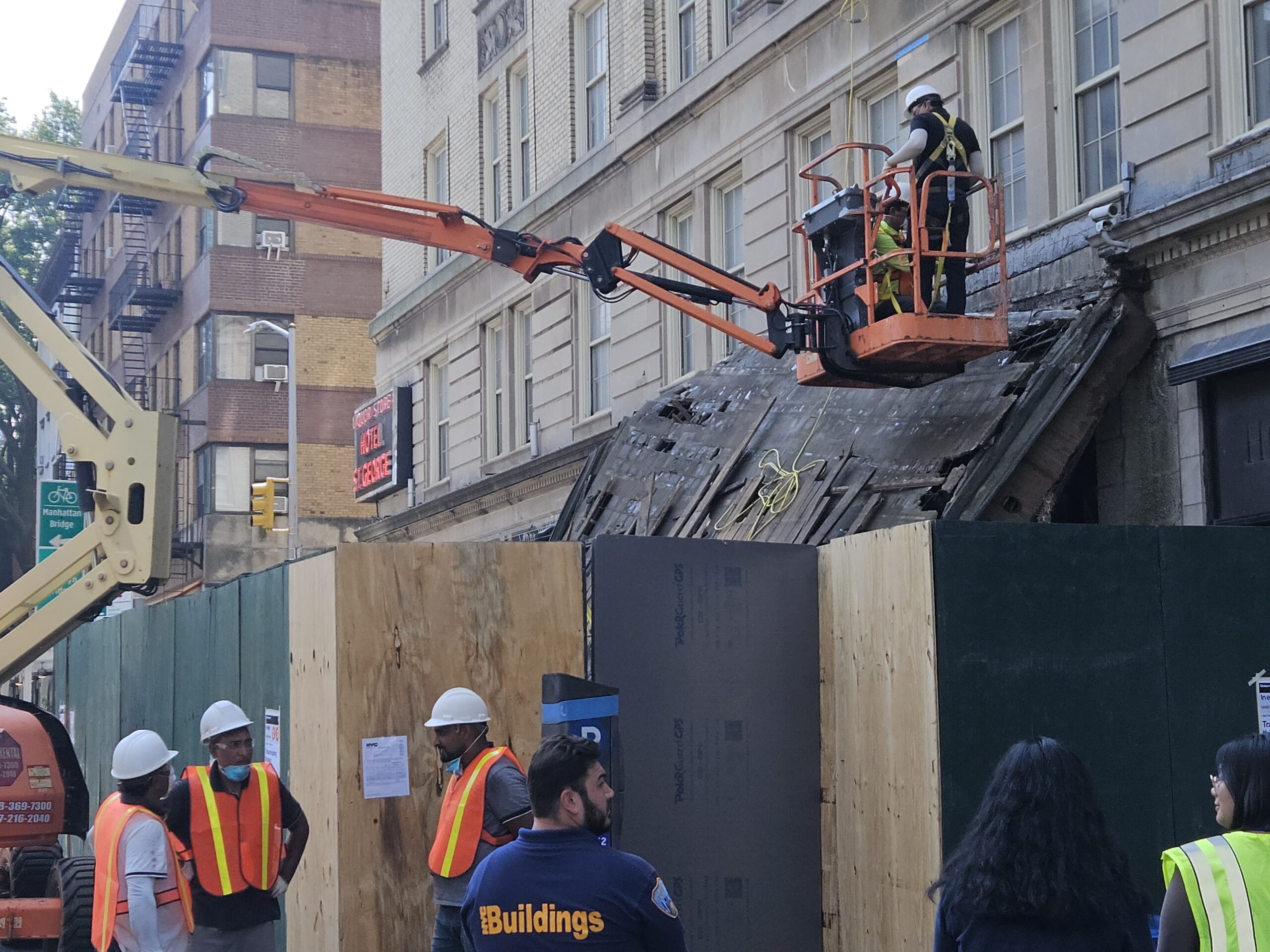
BROOKLYN HEIGHTS — ‘A miracle that no one was killed …’ That’s what neighbors are saying about the collapse of the Hotel St. George marquee. Shown in this photograph are workmen beginning the removal and repair of the historic, old neon sign at the corner, referencing a relic of Brooklyn Heights’ past: the St. George Hotel.
ATLANTIC AVENUE — Exhausted shopper with cluster of bags and goods from mall at Boerum Place stops to look at huge construction site across the street. “Is that REALLY going to be a jail??” Her male companion is reassuring, “Nothing like Rikers … this is 21st Century.”
BROOKLYN HEIGHTS — Overheard in line at one of most popular pastry outlets on Montague Street: “Hope I can get them into a camp …” A mother with two pre-schoolers in tow was showing a friend the Dodge Y flyer for Healthy Kids Day on Saturday, April 18.