✰PREMIUM Brooklyn panel takes on climate change adaptation
Final panel on climate change at Center for Brooklyn History, moderated by NPR reporter Rebecca Hersher, discussed how humans can adapt to climate change
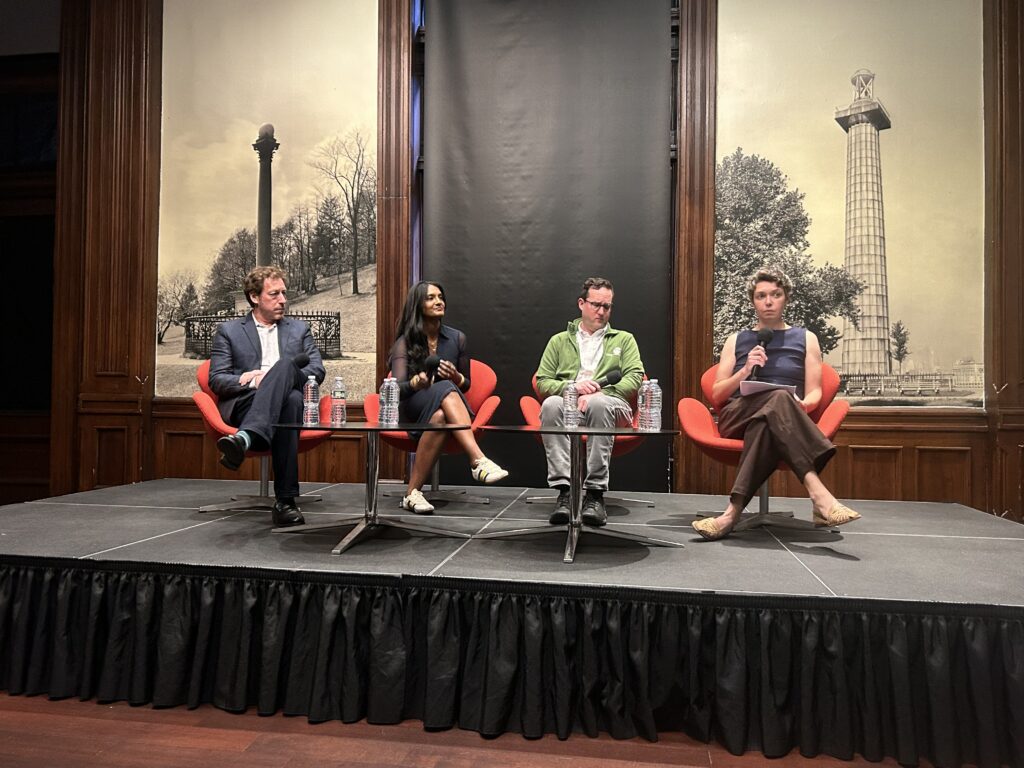
Nadia Seeteram, second from left, led New York State’s first proactive buyout program, incentivizing New Yorkers whose homes are at risk of climate-related flooding to move inland. Photo: Ella Spungen/Brooklyn Eagle
BROOKLYN HEIGHTS — On Monday night, NPR climate reporter Rebecca Hersher was joined at the Center for Brooklyn History by three climate experts for a conversation about solutions to the climate crisis for the last of its three-part series “Confronting Climate Change.”
“This is the part where we get to focus on our own agency,” said Hersher. “There are so many things that we can do.”
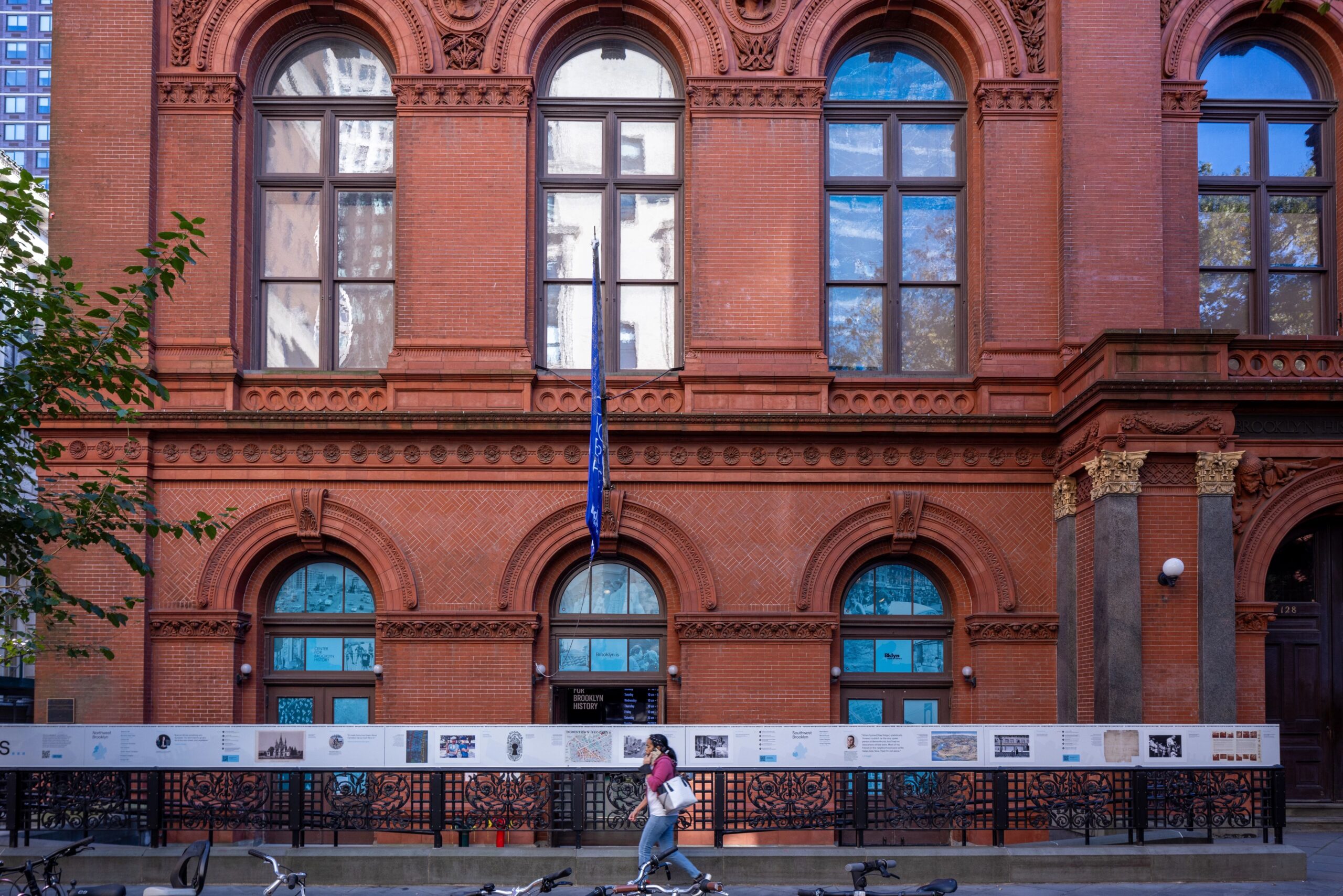
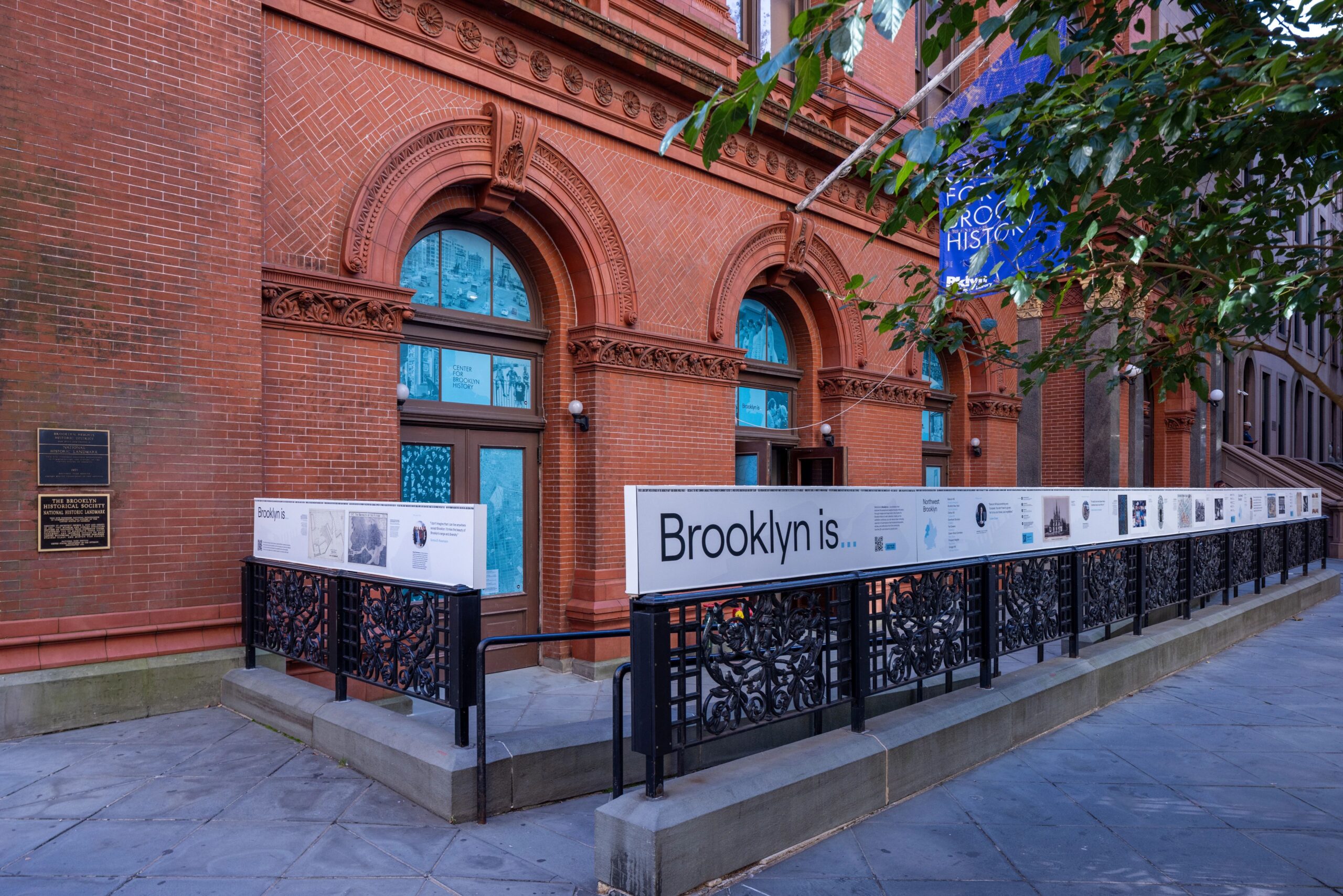
The Center for Brooklyn History reopened its redesigned space to the public in fall 2023 with the exhibit “Brooklyn is…” Photo: Gregg Richards
The first two discussions, also moderated by Hersher this spring, explored the science of climate change and the drivers of climate denial.
This week’s talk, “Solutions — From Innovation to Action,” turned to the topic of mitigating climate change and adapting to its effects, which are already being felt globally.
The three panelists were Michael Burger, a climate lawyer who leads the Sabin Center for Climate Change Law at Columbia University; Nadia Seeteram, an adaptation scientist who until recently was the director of buyouts for New York State; and Jesse M. Keenan, a scholar of climate adaptation and urbanism whose recent book “North” focuses on climate mobility and migration.
The panelists of “Solutions — From Innovation to Action” on Monday, from left: Michael Burger, Nadia Seeteram, Jesse M. Keenan and moderator Rebecca Hersher. Photo: Ella Spungen/Brooklyn Eagle
Climate solutions can be tackled from a number of angles. Last month, for example, landscape ecologist Eric Sanderson spoke at CBH about working with nature to make the city more resilient to climate change. This conversationfocused on legal, policy and infrastructure solutions for reducing greenhouse gas emissions and adapting to climate change.
Conversations around climate change usually imply individual action. The panelists argued that collective action and bigger picture solutions are more effective.
“I want to set aside all the little changes that we can make individually and focus on the big changes,” said Hersher. “How do we reduce greenhouse gas emissions now?”
Burger echoed her sentiment. “One of the questions I most often get is, ‘What can I do?’ The truth is, you can do things, but climate change is a systemic problem, and the source of greenhouse gas emissions is system-wide. It’s not based on individual things.”
Center for Brooklyn History. Photo: Gregg Richards
All panelists emphasized that the barriers to solving climate change aren’t scientific or technological but political and social.
Hersher promised a hopeful conversation, emphasizing how many solutions we currently have, but the Trump administration’s aggressive rollback of climate and environmental legislation and dismantling of public climate science agencies like the National Oceanic and Atmospheric Administration hung over the panel.
Burger mentioned that global, national, state and local legislation can set emissions frameworks and regulations to slow climate change. The U.S. doesn’t currently have such legislation nationally.
Jesse M. Keenan, second from right, a leading scholar of urbanism and climate adaptation, spoke on Monday’s panel about climate migration and mobility. Photo: Ella Spungen/Brooklyn Eagle
Biden’s 2022 Inflation Reduction Act tackled climate change by investing in clean energy infrastructure, but much of the IRA has been significantly scaled back by Trump’s “Big Beautiful Bill.”
Much of the Trump administration’s efforts around climate legislation will be struck down in court, Burger said, but he admitted that the president can outpace legal action.
“There’s not one legal theory that’s going to address all of these attacks on science,” he said, “but there is, without question, a very dedicated community of lawyers and advocates who are going to court on a regular basis.”
The conversation turned to statewide and local solutions, which have come into focus as this administration quickly rolls back years of climate action.
Keenan identified the built environment, which he said represents approximately 40% of all greenhouse gas emissions, as fruitful ground for climate solutions.
“Our work at the IPCC over the years showed that one of the biggest things that we can do is actually just live in smaller spaces. I’m speaking to a crowd in Brooklyn — we can all understand what that means,” he said.
He cited decreasing home sizes across the U.S. and trends toward electrification and developments in public transit.
In a city already impacted by climate change — this week’s extreme heat is a timely reminder — the conversation turned quickly to how to adapt to a hotter planet.
Climate migration, both proactive and in response to climate disasters, is one way that individuals may adapt to unsustainable environments.
Michael Burger, left, runs the Sabin Center for Climate Change Law at Columbia University, and currently consults on several cases suing fossil fuel companies for damages related to climate change. Photo: Ella Spungen/Brooklyn Eagle
Though Keenan emphasized that there is no such thing as a “climate haven,” or a place that will be safe from the impacts of climate change, he said that he is already seeing people, especially those with wealth and mobility, make trade-offs with climate risk to move somewhere they deem safer. Others have less of a choice.
“It’s not just the moment that you lose your home to a flood or a fire, a moment of episodic disaster; climate now is being priced into our mortgages, our rents, our utility bills, our property taxes,” he said. “It’s not uncommon for people to have an energy bill in the Sun Belt that’s greater than their rent or their mortgage bill. There’s many examples now where windstorm insurance or fire insurance is much greater than people’s mortgage payments on average.”
“These costs are exacerbating our existing cost burdens, and that is indirectly shaping people’s human mobility as well,” Keenan continued. “It’s not just the moment of disaster; it’s the stress as it proliferates into the economy.”
Seeteram’s work with New York State’s Blue Buffers buyout program helps people move out of current or soon-to-be dangerous areas.
In a buyout, the government offers to buy homes and relocate the homeowners. They often occur after properties are damaged in a disaster. After Hurricane Sandy, the State bought damaged properties at their pre-damage market rate.
Blue Buffers is the first proactive program. It targets high-risk homes based on National Flood Insurance Program data.
After a property has been bought out, the lot will be cleared and maintained as open space forever.
The program, which has a $250 million budget, faces some challenges — some homeowners won’t want to leave, and New York real estate can get expensive — but Keenan argued programs like it were critical to building a livable future.
“We can’t fully monetize all of the benefits of adaptation, particularly in the context of human health or environmental quality. Do we just have to throw money at the problem so that people can live longer?” Keenan asked. “It’s a fundamental conversation about what it means to invest as a public.”
The Center for Brooklyn History. Photo: Gregg Richards
The experts rallied against the idea that tackling climate change would be too expensive, with Burger expressing concerns that Democrats would begin rolling back climate action to address the affordability crisis.
“The idea that addressing the climate crisis is too costly, well, compared to what? As we can see, the cost of not doing so is extremely costly. The levelized cost of solar and wind is on par with or lower than natural gas at this point in time,” he said.
“The argument that it’s too expensive to do renewables is, according to investment firms, false. There are a lot of holes one could punch in the affordability argument.”
SUNSET PARK — “As a resident of Marine Park, one of the great surprises I found biking around Industry City and visiting Japan Village was to discover Bush Terminal Park. I continue to be amazed at the serene hideaways that the city offers in some of the busiest places — and, still, with an iconic view.”
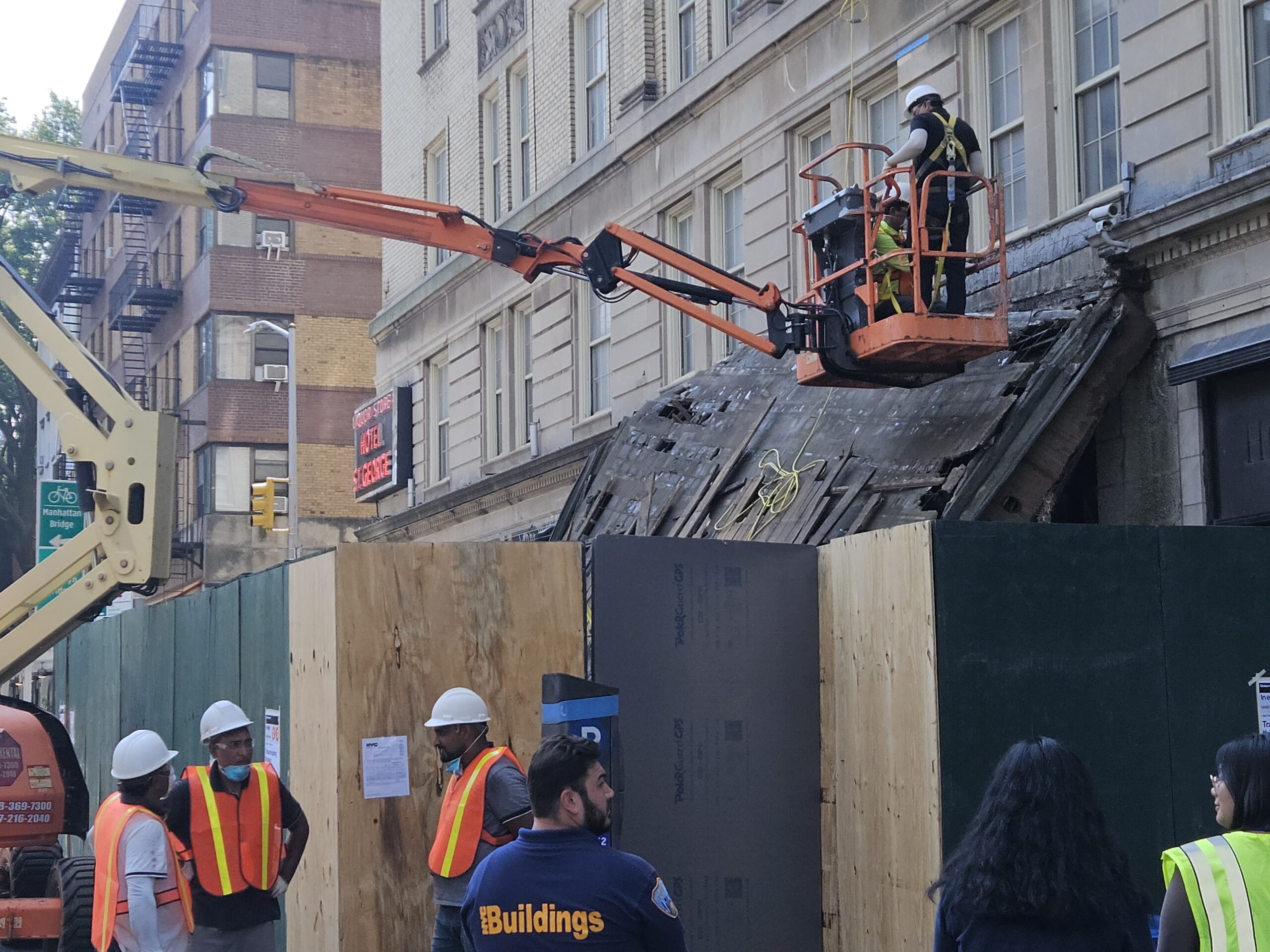
BROOKLYN HEIGHTS — ‘A miracle that no one was killed …’ That’s what neighbors are saying about the collapse of the Hotel St. George marquee. Shown in this photograph are workmen beginning the removal and repair of the historic, old neon sign at the corner, referencing a relic of Brooklyn Heights’ past: the St. George Hotel.
ATLANTIC AVENUE — Exhausted shopper with cluster of bags and goods from mall at Boerum Place stops to look at huge construction site across the street. “Is that REALLY going to be a jail??” Her male companion is reassuring, “Nothing like Rikers … this is 21st Century.”
BROOKLYN HEIGHTS — Overheard in line at one of most popular pastry outlets on Montague Street: “Hope I can get them into a camp …” A mother with two pre-schoolers in tow was showing a friend the Dodge Y flyer for Healthy Kids Day on Saturday, April 18.