Deportation orders soar in NYC as Trump ‘mega master’ hearings accelerate
A new report finds removal orders for people who missed hearings more than doubled in New York City in June, as a new tactic of hastily scheduled court dates rolled out.
Families looked for immigration courtrooms inside 26 Federal Plaza, July 20, 2026. Photo: Ben Fractenberg/The City Reporter
By Gwynne Hogan, The City Reporter
July 21, 2026
Copy Link
Email
Facebook
X
LinkedIn
WhatsApp
Telegram
Pinterest
Print
Inside a New York City immigration courtroom at 26 Federal Plaza on Friday morning, 90 people had cases before a single immigration judge. People described hastily making plans to get to court, some from hundreds of miles away, having learned about their new hearing date only days in advance.
By the end of the morning, dozens of people still hadn’t shown up and the judge ordered them removed from the country.
These removal orders of immigrants who didn’t show up to court reached record heights in June nationwide and more than doubled in New York City last month, according to a new report released by bklg.org, a nonprofit that analyzes immigration court data to help immigration attorneys keep on top of their clients’ cases. The increase occurred during the first few weeks of a new Trump administration effort to speed up deportations through large-scale court proceedings known as “mega master” hearings.
In June, 4,447 people were ordered removed by immigration judges in the city “in absentia,” meaning they’d missed their hearings, the report found. That was more than double the number in May when 2,189 were ordered removed in absentia.
The analysis found the surge echoed a rise in absentia removal orders across the country. There were 53,808 such orders nationally in June, a 55% jump from a month earlier. Mega master hearings ramped up in cities including Chicago and Boston beginning in May.
In absentia removal orders have been increasing annually since 2021, as the number of people crossing the U.S. border and the number of deportation cases rose, but June showed a dramatic jump and surpassed any month on record, going back to the late 1990s when the government started keeping track.
People walked out of an immigration court waiting room inside of 26 Federal Plaza, July 20, 2026. Photo: Ben Fractenberg/The City Reporter
The mass immigration hearings picked up in New York City in early June, The City Reporter reported at the time. They were dubbed mega masters because a single judge could be assigned a docket of more than 100 cases a day, about double a regular master calendar docket before.
In addition to the large number of cases, many of these hearings were scheduled just weeks in advance and replaced hearings people might have had on the books months or years away.
The City Reporter observed one such mega master hearing where, on a docket of 121 cases, 39 people and their family members were ordered removed for failing to show up to court. In some instances, family members’ cases were linked.
Bklg.org’s report found that across the country, hearings were scheduled around 180 days in advance going back several years. But in May that dropped to 98 days in advance, and by June that had fallen again to a median of 42 days before hearings.
The federal government is required by law to send written notices of any new hearing dates by mail, but many attending these hearings told The City Reporter they’d only learned of the date change because they happened to check the Executive Office for Immigration Review’s online portal or another similar app that helped them monitor their cases. People who miss hearings in deportation proceedings are subject to automatic removal orders, clearing the way for the government to deport them.
Once a person has been ordered to be removed in absentia, they can file a motion to reopen their case and argue they didn’t get proper notice of their hearing date. But that’s another uphill battle in court for immigrants facing deportation, many of whom don’t have lawyers.
“People are getting these last-minute changes on the portal, oftentimes not actually getting the paper notice saying that they have the hearing,” said Benjamin Remy, an immigration attorney at the nonprofit New York Legal Assistance Group. “I’ve seen people arrive late and just say, ‘Hey, I checked this morning and it said I had court, so I had to run in. I had to leave work. I had to leave my family. I had to find childcare.’”
Immigration advocates have been urging anyone in deportation proceedings to double-check EOIR’s portal daily to monitor their case for any changes.
‘Steamrolled by the system’
Advocates contend the mega master hearings are another attempt by the Trump administration to chip away at immigrants’ due process rights.
“It seems really targeted to kick people off the minimal existing pathways to [legal] status by pulling the rug out from under them,” said Amelia Neumayer, program director of South Brooklyn Sanctuary, which runs a small clinic to help people file asylum applications. Thirty-one of the group’s clients had hearing dates that were abruptly moved up by months, to June and July, and most of those people didn’t get notices in the mail, she said.
“People are just confused and steamrolled by the system,” Neumayer said.
Federal agents walk past a family waiting for an immigration court hearing at 26 Federal Plaza, Oct. 7, 2025. Photo: Ben Fractenberg/THE CITY
Kathryn Mattingly, a spokesperson for EOIR, didn’t comment on the nationwide surge of in absentia removal orders, but pointed to earlier statements the agency made when mega master hearings expanded last month that touted the Trump administration’s attempts to reduce the immigration court backlog.
“EOIR prioritizes the timely completion of all cases, including those of unaccompanied alien children, and makes scheduling adjustments as needed to ensure cases do not languish,” she said in a statement. “Unnecessary delay hurts both aliens with meritorious claims and the American public who wish to see aliens with non-meritorious claims removed as quickly as possible.”
Mega master hearings are one of the latest changes in a tumultuous year and a half for the nation’s immigration enforcement system under President Donald Trump. That period has been marked by mass firings of immigration judges, and ICE agents targeting immigrants in the hallways of court for arrest as well as on the streets.
Dozens of cases, hundreds of miles
On Friday morning, several dozen people managed to make it to a courtroom inside 26 Federal Plaza for their mega master hearing where Immigration Judge Thanos Kanellakos appeared virtually from a courtroom in Maryland, overseeing a docket of 90 cases.
Most of the people who made it to court had traveled hundreds of miles from Tennessee, Georgia, North Dakota and Illinois to attend. Many had filed change of address forms — required within five days anytime someone moves — telling the court they no longer lived in New York, but hadn’t filed a subsequent motion to change venue to switch their deportation case to a court closer to their new home. The latter filing is a step many people without lawyers often don’t realize they’re supposed to take, immigration attorneys said.
Several people at court told The City Reporter they’d had a court date scheduled months or even years away when they happened to double-check the online portal recently and learned they had a new hearing scheduled a few days away.
“It shouldn’t be this way. This is a disaster,” Erika Valero, 35, said in Spanish. She’d moved from New York to Chicago since her last hearing and learned a week ago she had a new, earlier hearing date on Friday. She’d quickly bought plane tickets for herself and her daughter, spending more than $1,000 on the last-minute trip, she said. The two slept in the airport Thursday night ahead of their morning hearing.
Valero’s appearance in court lasted just a few minutes after she filed a motion to change her deportation case to an immigration court in Chicago.
“Now I have to go running to the airport,” she said.
‘People’s rights are not being respected’
Juan Guaregua, a 38-year-old from Venezuela, had flown to New York from Texas with his wife and young child the night before his hearing on Friday morning. He’d previously had a court date scheduled in 2028, but saw on the online portal and received a letter telling him his court date had changed. He’d tried calling the court to get the date pushed back or his appearance switched to a Texas court — with no luck.
Guaregua said all he wanted was a fair chance to present his asylum claim to the court.
“I ask that my rights be respected and that my asylum application be evaluated fairly and impartially,” he said. “People’s rights are not being respected, but every day I ask God to guide us.”
After a few hours Friday morning, Judge Kanellakos had made it through the people who’d come to court. A legal assistant then rattled off a list of 56 who hadn’t.
“That’s a lot. Sorry, judge,” the assistant said.
“It’s not your fault. You showed up,” replied Judge Kanellakos, who ran down the list, ordering them removed from the country.
SUNSET PARK — “As a resident of Marine Park, one of the great surprises I found biking around Industry City and visiting Japan Village was to discover Bush Terminal Park. I continue to be amazed at the serene hideaways that the city offers in some of the busiest places — and, still, with an iconic view.”
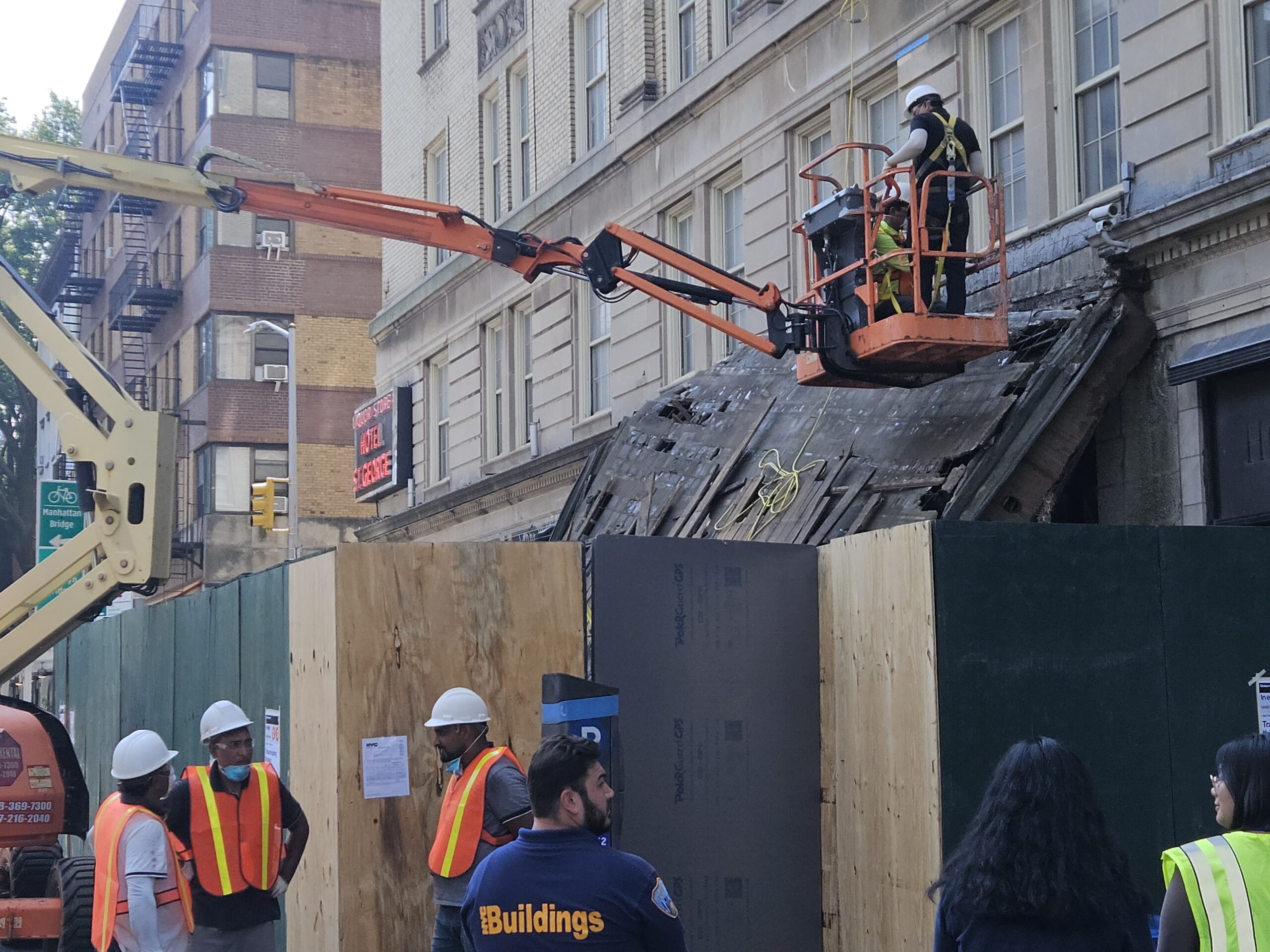
BROOKLYN HEIGHTS — ‘A miracle that no one was killed …’ That’s what neighbors are saying about the collapse of the Hotel St. George marquee. Shown in this photograph are workmen beginning the removal and repair of the historic, old neon sign at the corner, referencing a relic of Brooklyn Heights’ past: the St. George Hotel.
ATLANTIC AVENUE — Exhausted shopper with cluster of bags and goods from mall at Boerum Place stops to look at huge construction site across the street. “Is that REALLY going to be a jail??” Her male companion is reassuring, “Nothing like Rikers … this is 21st Century.”
BROOKLYN HEIGHTS — Overheard in line at one of most popular pastry outlets on Montague Street: “Hope I can get them into a camp …” A mother with two pre-schoolers in tow was showing a friend the Dodge Y flyer for Healthy Kids Day on Saturday, April 18.