Brooklyn Heights street co-named for ‘radical saint’
‘Dorothy Day Way’ sign unveiled on Pineapple Street
From left: Councilmember Lincoln Restler; Martha Hennessy, granddaughter of Dorothy Day, and Alex Avitabile, a board member of the Dorothy Day Guild. Photo: Mary Frost/Brooklyn Eagle
BROOKLYN HEIGHTS — Antiwar activist, champion of the poor, social justice worker and Catholic radical Dorothy Day (1897-1980) was born at 71 Pineapple St. in Brooklyn Heights.
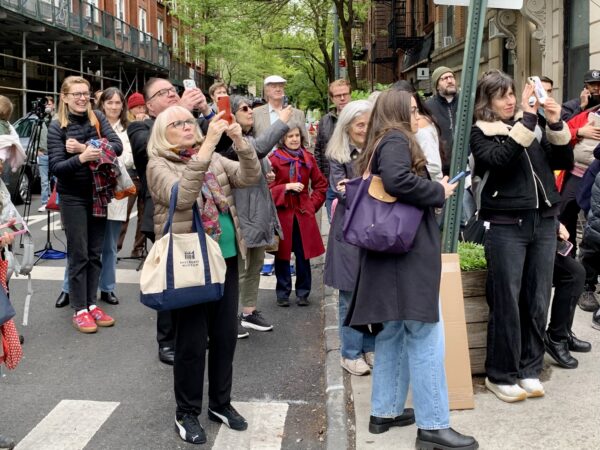
On Saturday, before a crowd of supporters, the intersection of Pineapple and Henry streets was officially dedicated as “Dorothy Day Way,” just a few steps from her birthplace.
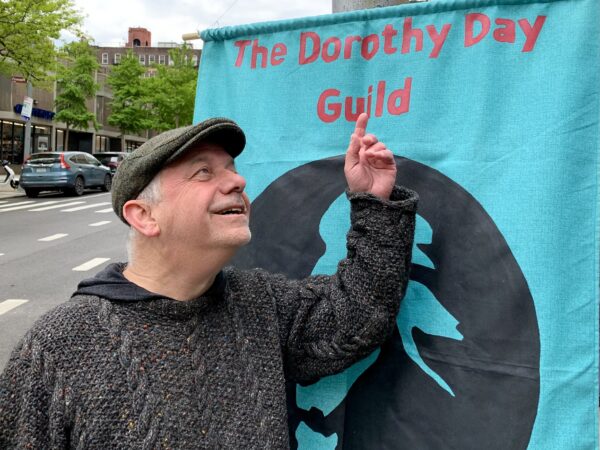
Day’s granddaughter, Martha Hennessy; Kevin Ahern, who leads the Dorothy Day Center; Dorothy Day Guild board member Alex Avitabile; Councilmember Lincoln Restler and local clergy were among those who celebrated her legacy and her message, which seems as fresh today as it did in the 1930s.
The wrapper comes off the sign revealing “Dorothy Day Way” in Brooklyn Heights. Photo: Mary Frost/Brooklyn Eagle
Hennessy said that message included love of enemy. “We are all one of another. We are all part of the mystical body of each other, and we must remember that,” she said. “And of course, my very last message is, stop the killing and abolish nuclear weapons.”
“I really hope that in having the street sign up here in Brooklyn Heights, at Pineapple and Henry, people will walk by every day and look up and think about her phenomenal ways,” Restler said.
Hennessy and Restler, who, as councilmember, sponsored the street co-naming, unveiled the new street sign together as the crowd applauded.
A crowd took photos as the new street sign — “Dorothy Day Way” — was revealed. Photo: Mary Frost/Brooklyn Eagle
‘Radical saint’
An activist, socialist and journalist, Day converted to Catholicism at the age of 30, but never lost her radical edge. The FBI considered her to be subversive. She co-founded the Catholic Worker Movement with Peter Maurin, and also started The Catholic Worker newspaper, which is still in publication today.
Catholic Workers live in voluntary poverty, perform manual labor, feed and clothe the poor, and oppose violence and war. There are more than 150 Catholic Worker Houses around the world, according to the organization.
Two decades after her death, Day was recommended by the Archdiocese of New York and the U.S. Conference of Catholic Bishops as a candidate for sainthood — a step that earned her the appellation “Servant of God,” in Catholic parlance.
Kevin Ahern, founding director of the Dorothy Day Center. Photo: Mary Frost/Brooklyn Eagle
‘We want people to be inspired’
“When we name something after an exemplary person, we want people to be inspired by that life,” Ahern said. “And we don’t have to look too far to see a world that is in need of inspiration, a world that is in need of the witness that Dorothy gave us.”
The Brooklyn Catholic community has long been a pioneer in street ministry, backing labor unions and serving immigrants, Msgr. Ray Roden said.
He pointed out Day was particularly opposed to the use of nuclear weapons. In her book, “The Duty of Delight: The Diaries of Dorothy Day,” she described a U.S. government civil defense exercise in 1955 that involved the hypothetical detonation of a nuclear weapon in Brooklyn, resulting in the instantaneous deaths of millions.
This reinforces the idea that the use of nuclear weapons “is absolutely insane,” Roden said.
Msgr. James Vlaun, CEO and president of Catholic Faith Network. Photo: Mary Frost/Brooklyn Eagle
‘The saint I never met’
Msgr. James Vlaun, CEO and president of Catholic Faith Network, described an incident that he said forever changed his life.
Vlaun regularly attended Friday night meetings at Maryhouse, a Catholic Worker hospitality house in Manhattan, during his seminary years, he said. One night someone got up at the end of the meeting and said, “Let’s pray for Dorothy, because she is no longer going to be here, she’s dying.”
Afterwards Vlaun went up to the man and said he felt bad because he never got a chance to meet Day. “And he looked at me like I was crazy,” Vlaun said. “He said to me, ‘How could you not have met her? You’ve been here every week for months and years,” as had Day.
When Vlaun asked the man where Day had been sitting, he replied, “You know that old lady who sat by the garbage pail in the blue sweater? That was Dorothy Day.”
A longtime fan of Dorothy Day is delighted with the street co-naming. Photo: Mary Frost/Brooklyn Eagle
“I always talk about this woman, the saint that I never met, because I wasn’t looking for that kind of person,” Vlaun said. “I was looking for alabaster and marble, and rosaries and lights. … Dorothy is a constant reminder to me of the saints in my midst, and she has helped focus my eyes to see the holiness of people around us. She’s changed my perspective on priesthood and life.”
According to the Religion News Service, 17 boxes of documents — from Day’s 50,000 news articles and diary entries to her FBI file — have been sent to the Vatican for review on the way to possible sainthood.
The Dorothy Day Guild supports and advances the cause for Day’s canonization. The cause, however, is opposed by some of her fans, who say Day herself shunned the suggestion she was a saint, and would rather supporters spend the time and resources required for canonization to helping the poor, according to the Catholic Worker Movement website.
The address of the birthplace of “radical saint” Dorothy Day, 71 Pineapple St., is shown here. Photo: Mary Frost/Brooklyn Eagle
SUNSET PARK — “As a resident of Marine Park, one of the great surprises I found biking around Industry City and visiting Japan Village was to discover Bush Terminal Park. I continue to be amazed at the serene hideaways that the city offers in some of the busiest places — and, still, with an iconic view.”
BROOKLYN HEIGHTS — ‘A miracle that no one was killed …’ That’s what neighbors are saying about the collapse of the Hotel St. George marquee. Shown in this photograph are workmen beginning the removal and repair of the historic, old neon sign at the corner, referencing a relic of Brooklyn Heights’ past: the St. George Hotel.
ATLANTIC AVENUE — Exhausted shopper with cluster of bags and goods from mall at Boerum Place stops to look at huge construction site across the street. “Is that REALLY going to be a jail??” Her male companion is reassuring, “Nothing like Rikers … this is 21st Century.”
BROOKLYN HEIGHTS — Overheard in line at one of most popular pastry outlets on Montague Street: “Hope I can get them into a camp …” A mother with two pre-schoolers in tow was showing a friend the Dodge Y flyer for Healthy Kids Day on Saturday, April 18.