Premium Content Valerio Arena brings gluten-free, fast-casual to Dekalb Market
Valerio Arena. Photo courtesy of Valerio Arena
By Alice Gilbert
July 26, 2024
Copy Link
Email
Facebook
X
LinkedIn
WhatsApp
Telegram
Pinterest
Print
As an Italian, getting an unexpected diagnosis of celiac was a “big shock” for Valerio Arena. Bread and other gluten-containing foods are at the center of Italian cuisine, and, suddenly unable to consume them, Arena looked for alternatives. As it turns out, there are a lot of naturally gluten-free grains, and they’re much more wholesome than the ultra-processed products that overcompensate for a lack of gluten with lots of additional sugar and preservatives. This discovery led him to found Twentyonegrains, which opened in Midtown and the Financial District as a fast-casual lunch option for the corporate sector. Now, they’re debuting in Brooklyn with a stall in Dekalb Market, where they’ll serve customers on this side of the river.
Tell me about yourself and your path to opening Twentyonegrains.
I worked in the hospitality and food industry for over two decades between London, the Caribbean and Spain. I ended up in New York, mostly working for big companies and Michelin-star restaurants. One day, while on a trip to Russia with my wife, I started to feel very sick. I went to the doctor, and they diagnosed me with Celiac disease. There are many worse things to be diagnosed with. It’s an autoimmune disease that does not allow you to eat anything that has gluten in it.
I had to solve this problem and, I thought, make it fun for everybody else. There is a huge gluten-free population these days. It’s not a myth anymore — it’s real. I used to think it was a joke, but I realized it was serious. Looking at my genealogical tree, thanks to my diagnosis, we found out my mother and grandfather had it, too. I grew up in Sicily. In Italy, a meal wasn’t a meal without a piece of bread.
I started to develop a solution to this problem. The fast-casual concept was getting big — I remember ByChloe was booming at the time. A friend asked me if I had ever gone to this type of restaurant, and I thought it was crazy— just paying, sitting down and eating. But once I tried it out, I knew this was it. I went to Andrew [Hutsell, CEO of Twentyonegrains] with a piece of paper and said, “I want to do this.”
We started in food halls in Midtown and downtown because we thought they were so interesting. I had also built a food hall in Miami, so I knew about this world. We wanted to work with all of these grains that were naturally gluten-free: quinoa, millet, oats. Little by little, we evolved.
Buffalo cauliflower wrap. Photo courtesy of Valerio Arena
What is so compelling about a food hall?
We opened in the midst of COVID-19, so it was easy to put together a restaurant in a place where the infrastructure already existed. You are your own unique place in a food hall, alongside a lot of other professionals.You need to shine for what you do; no one can do what you do. It’s competitive. You see your clients coming in and going to your neighbors the next day, which makes sense (no one wants to eat the same thing every day), but some of our clients have to stick with us in order to be safe. You learn from a lot of your neighbors, and you also get a lot of support from the market in terms of construction and marketing.
There are so many gluten-free products that are just replacements for gluten-containing products, and a lot of them are not necessarily healthier, or even healthy, period. How does gluten-free intersect with health?
We are going for a naturally gluten-free diet. We are not trying to create a mix of mystery flours. We are using what nature is giving us. We used to make our own bread without yeast, but unfortunately, it was operationally too much. Now, we’re in contact with bakers in Europe and Italy, where gluten-free baking is taking off. We would like to take advantage of that. We’re totally against all the products that are gluten-free but are not, ultimately, very healthy.
Do your customers mostly have celiac or a gluten allergy, or are they just curious about your food?
The concept of being gluten-free started as the cherry on top of the cake. If you know we’re gluten-free, you can be looking for something safe to eat and find us that way. Then there are regular clients who know, and they just love it. Some of them don’t even know! We’re trying to capture a large variety of customers. I see tourists, especially in Midtown, who find us, and when I see their faces, I can relate to that. When I travel, unable to eat a normal meal, it’s relieving to find something I can eat.
You have a connection to the music scene as well. Tell me more about that.
I lived for a few summers in Ibiza. Andrew and Evan [CEO and his brother who co-runs the business] were DJing a lot of parties for fun, and they got pretty big. That’s how we connected in the first place. We always propose food halls to do parties, but, of course, that can be tricky when you share the space.
Photo courtesy of Valerio Arena
What is next for Twentyonegrains?
We’re very excited to open in Dekalb Market. It’s a place that’s not even up-and-coming; it’s already up. For our brand, it’s the perfect step. We started in corporate Midtown, then moved to FiDi, which was a bit more funky and residential. We’ve been monitoring the DUMBO and Downtown Brooklyn area for a while. We started introducing things like the Buffalo Cauliflower and Spicy Chicken Caesar, which are two of our best-selling items. It’s a bit more relaxed, and it’s a perfect time and place for us to shine.In Midtown, there’s a three-hour rush when people need to feed themselves. We try to be fun, but you can only be so much fun during corporate lunch. In Brooklyn, we can be fun.
SUNSET PARK — “As a resident of Marine Park, one of the great surprises I found biking around Industry City and visiting Japan Village was to discover Bush Terminal Park. I continue to be amazed at the serene hideaways that the city offers in some of the busiest places — and, still, with an iconic view.”
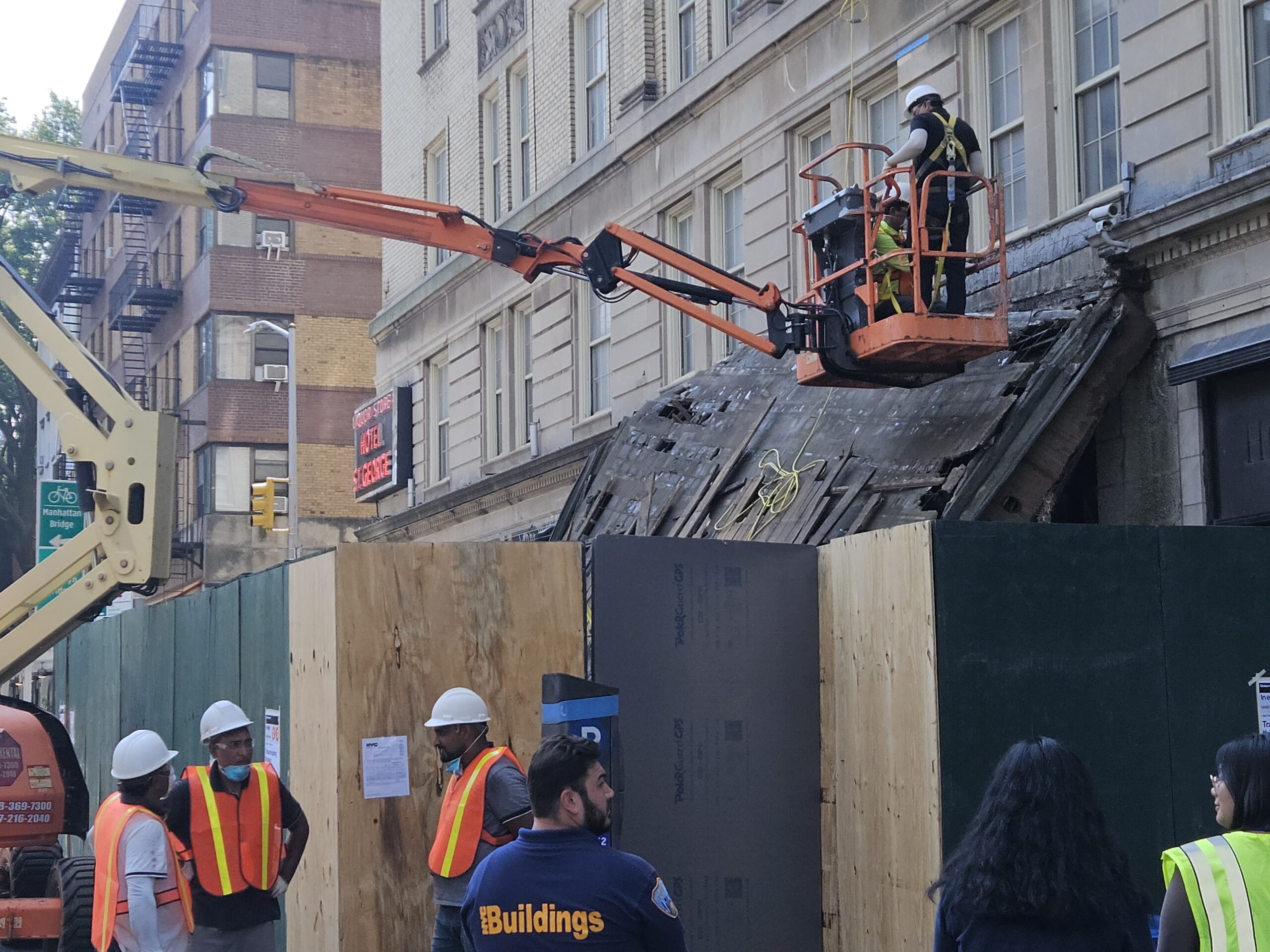
BROOKLYN HEIGHTS — ‘A miracle that no one was killed …’ That’s what neighbors are saying about the collapse of the Hotel St. George marquee. Shown in this photograph are workmen beginning the removal and repair of the historic, old neon sign at the corner, referencing a relic of Brooklyn Heights’ past: the St. George Hotel.
ATLANTIC AVENUE — Exhausted shopper with cluster of bags and goods from mall at Boerum Place stops to look at huge construction site across the street. “Is that REALLY going to be a jail??” Her male companion is reassuring, “Nothing like Rikers … this is 21st Century.”
BROOKLYN HEIGHTS — Overheard in line at one of most popular pastry outlets on Montague Street: “Hope I can get them into a camp …” A mother with two pre-schoolers in tow was showing a friend the Dodge Y flyer for Healthy Kids Day on Saturday, April 18.