After delaying college for two years because of the COVID-19 pandemic, Jaden Todd wasn’t sure a four-year school was the right place to start.
“I was extremely concerned that I forgot how to learn,” he said.
Community college appealed as a stepping stone, but he also had heard stories of students who had to start over when they transferred because their credits didn’t count at the new school.
Todd, 21, was relieved to wind up at Northern Virginia Community College’s ADVANCE program, a partnership with George Mason University that put him on a clear path to his goal of a bachelor’s degree in computer science.
Such established arrangements between two- and four-year colleges and universities have shown promise in helping more community college students go on to earn bachelor’s degrees, according to data released Thursday by U.S. Education Department.
Only 13% of federal financial aid recipients who enrolled in community college in 2014 received a bachelor’s degree within eight years, the data found.
Hundreds of thousands of those who enroll annually at the more affordable two-year schools plan to transfer to a four-year program at a college or university, but obstacles get in the way. Frequently, students lack the guidance they need to navigate the transfer, and their credits don’t transfer the way they planned.
Colleges in New Jersey, New York and Illinois graduated the most transfer students, with schools in South Dakota, Delaware, Indiana and New Mexico recording the lowest numbers.
“One of the things that I think has really played a pivotal role in transfer student success is our goal to make as much information transparent,” said Alicia Alvero, associate vice chancellor for academic and faculty affairs at the City University of New York.
CUNY, which includes Kingsborough Community College in Brooklyn, relies on an online transfer explorer, known as T-Rex, that makes it easier for students to see which of their courses will transfer between campuses, Alvero said.
The State University of New York is experimenting with artificial intelligence to let students map courses between any of the community and four-year campuses in the system, said Dan Knox, a director at the National Association of System Heads, an organization of 48 public higher education systems across the country formed to advance innovation in higher education.
“At SUNY, that’s 30 community colleges and … 64 campuses in total, so the choice sets in a system that large for students are just overwhelming,” Knox said.
“It’s just very tough to map all that out manually,” he said.
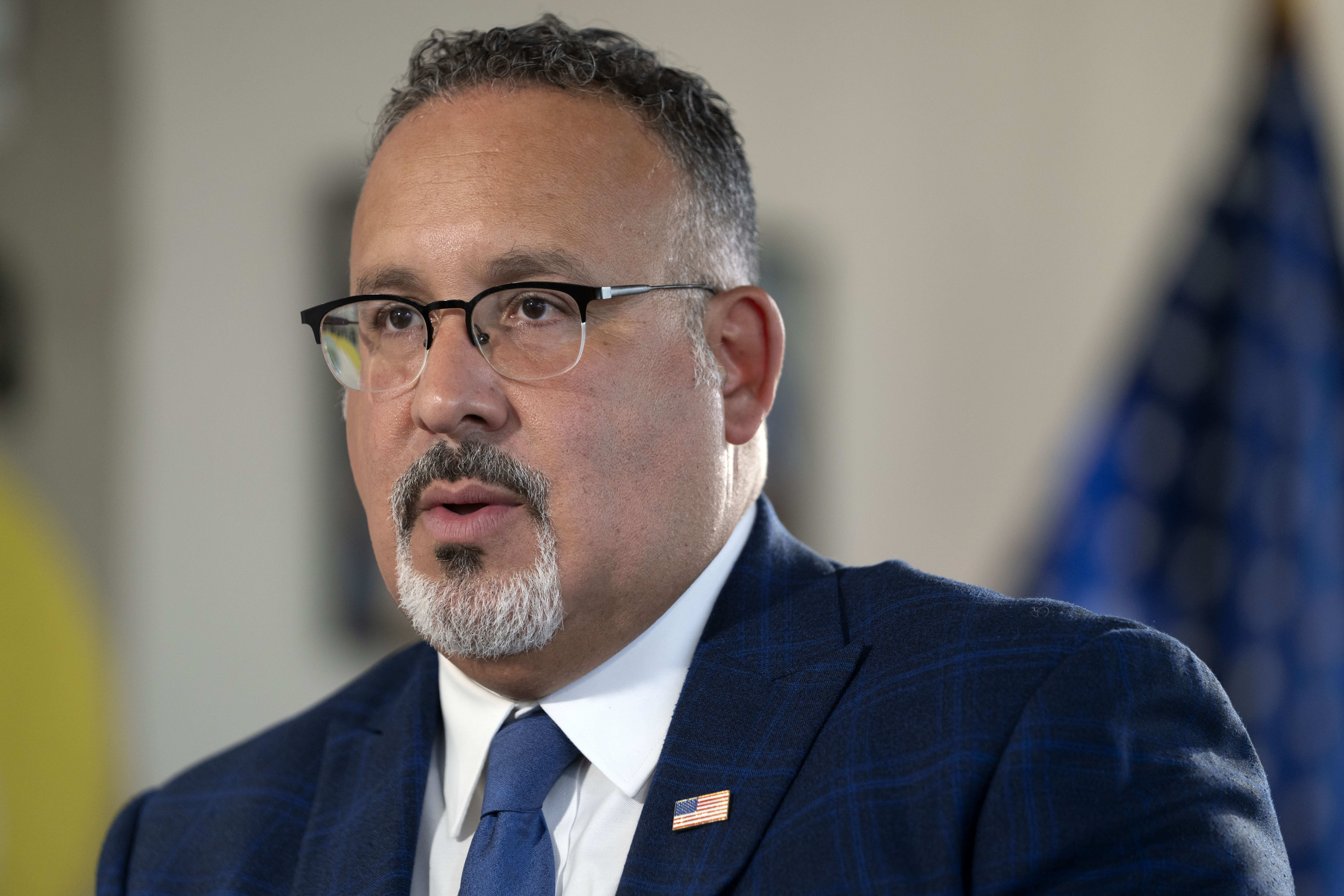
“Our current higher education system stacks the deck against community college students who aspire to earn four-year degrees,” U.S. Education Secretary Miguel Cardona said ahead of a gathering of 200 higher education leaders convened Thursday by his department to examine state and school transfer policies.
The new data tracked roughly 620,000 federal financial aid recipients. The outcomes are especially concerning for Black, Hispanic and low-income students, who are more likely to start at community colleges.
Colleges in New Jersey, New York and Illinois graduated the most transfer students, with schools in South Dakota, Delaware, Indiana and New Mexico recording the lowest numbers.
“One of the things that I think has really played a pivotal role in transfer student success is our goal to make as much information transparent,” said Alicia Alvero, associate vice chancellor for academic and faculty affairs at the City University of New York.
CUNY relies on an online transfer explorer, known as T-Rex, that makes it easier for students to see which of their courses will transfer between campuses, Alvero said.
The State University of New York is experimenting with artificial intelligence to let students map courses between any of the community and four-year campuses in the system, said Dan Knox, a director at the National Association of System Heads, an organization of 48 public higher education systems across the country formed to advance innovation in higher education.
“At SUNY, that’s 30 community colleges and … 64 campuses in total, so the choice sets in a system that large for students are just overwhelming,” Knox said.
“It’s just very tough to map all that out manually,” he said.
The Education Department data also found widely varying results when it looked at pairings between two- and four-year institutions in each state to evaluate how often community college students graduated from the four-year institutions they would most likely attend.
Among the highest-performing pairings were those with established partnerships designed to ease the transfer process, like the one at George Mason.
Todd, a 2020 high school graduate in Woodbridge, Virginia, said he liked that the co-enrollment program set from the start the classes he would take in community college and at George Mason. He’d heard of others paying thousands for tuition only to lose credits and find themselves behind when they transferred.
“I mean, I could spend $15,000 a year and want to try another college out,” he said.
Researchers said evaluating why certain pairings do better than others would help improve transfer systems as a whole. The findings are expected to guide higher education leaders who are struggling with declining enrollment and students concerned about adding to the $1.77 trillion in student loan debt.
“We have never before had national data that look at how well students do when they move among colleges and universities,” said James Kvaal, undersecretary of education, “so this study we’ve done, looking at people who get student aid, is really groundbreaking and has shed new light onto the role that both community colleges and four-year colleges play in helping their students get that college degree.”
The summit also is expected to address statewide policies such as assigning codes to courses to create consistency across schools and guaranteed admission for certain students.