Brooklynites reclaim the waterfront for City of Water Day
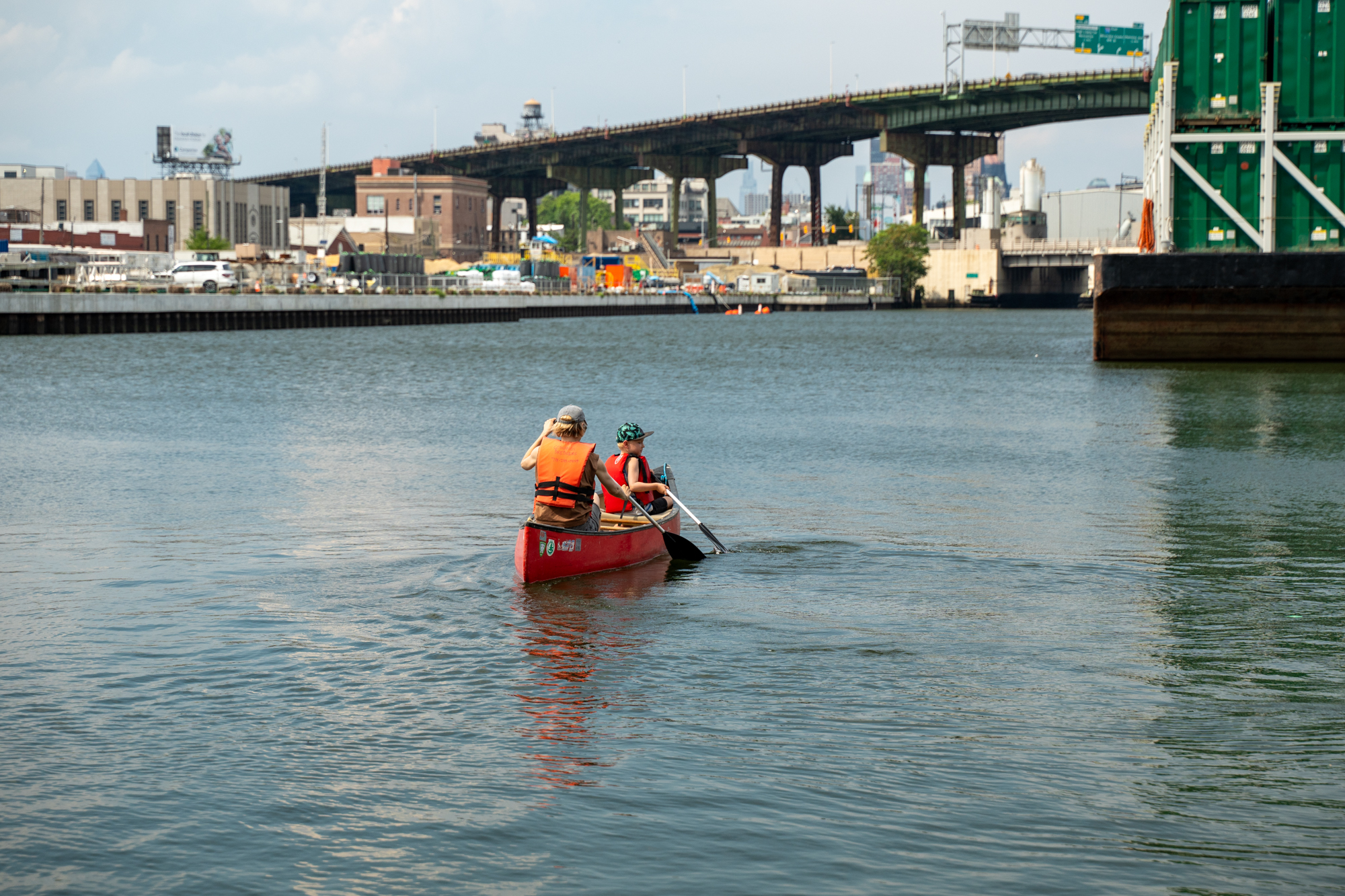
Eventgoers paddling in the Gowanus Canal last Saturday, July 15, 2023. Photo: Nicole Vergalla for the Gowanus Dredgers
By Lucien Clough
July 17, 2023
Copy Link
Email
Facebook
X
LinkedIn
WhatsApp
Telegram
Pinterest
Print
Last Saturday was the 16th annual City of Water Day, a day of activism, appreciation and remediation organized by the Waterfront Alliance and the New York-New Jersey Harbor and Estuary Program. Events spanned all 520 miles of New York City’s waterfront and aimed to educate the public on the waterways through park cleanups, free paddling, interactive science experiments, and more.
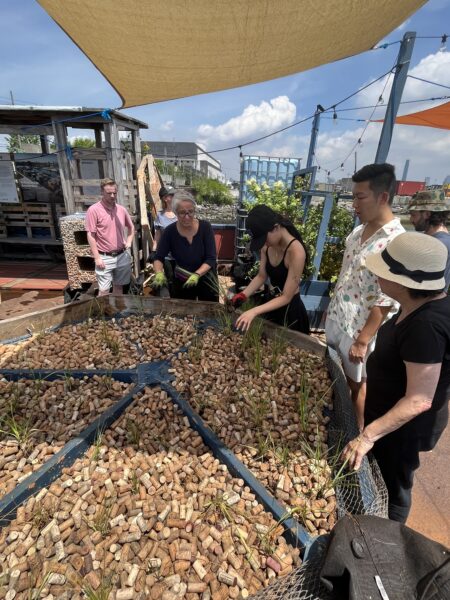
The RETI Center off Columbia Street hosted an event surrounding the construction and launch of floating gardens, complete with music, drinks and enchiladas. Volunteers worked together to assemble hexagonal gardens made of recycled wood, fishnets and thousands of donated corks, which they then placed in the water, where they will remain for anywhere up to two years.
Tim Gelman-Sevcik, the executive director of the RETI Center, said in an interview with the Brooklyn Daily Eagle that this is their way of proactively fighting climate change. “What we’re doing with our floating gardens is putting the marsh grasses back in place … As opposed to trying to pull out the existing infrastructure that’s there, we’re trying to add on to it in the easiest, quickest, way possible — on a small scale, but with the idea that it can be replicated by others or by us.”
Boaters wait to get in the water at a dock, life jackets required. Photo: Nicole Vergalla for the Gowanus Dredgers
The garden design is already on its sixth iteration, with plans for more. “We have a Silicon Valley mindset of ‘fail fast and often,’ because we’re doing something we’ve never seen other people do, which is putting floating gardens into brackish water,” he said.
The center has plans of turning these gardens into kits that people can assemble across the city, with the long-term goal of creating a “Blue City,” or a growing, living environment assembled out of many gardens on the water. “We’re expecting that there will be, at scale, improvements to the water quality: increased biodiversity, carbon capture in the plants, phytoremediation … We immediately see wildlife once the gardens go into the water: seagulls and ducks — a great blue heron was here last year on one of the gardens for months at a time,” said Gelman-Sevcik.
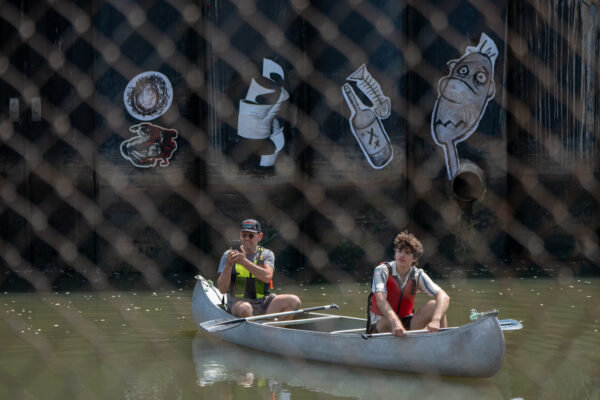
A pair of canoers come to a stop in the canal beneath graffiti art. Photo: Nicole Vergalla for the Gowanus Dredgers
Ultimately, Gelman-Sevcik hopes that events like these get people involved in the fight against climate change. “The more people do and the closer they get to the environment the more they empathize with it and connect to it. Getting hot, dirty, and sweaty is a really great way of getting involved. Rather than being remedial, we’re trying to be proactive in our engagement.”
This idea of a grassroots movement to reclaim New York City’s waterways was echoed by many working at the events across the borough. “The more awareness and engagement and appreciation for water, the more we use it and understand it and care for it, the better we’re gonna be prepared for climate change and sea level rise and all the issues that are going to become very evident in the coming decades,” Gary Francis, captain of the Gowanus Dredgers Canoe Club, said in an interview with the Eagle.
Aquatic activity enthusiasts enjoy the waters of the canal, July 15, 2023. Photo: Nicole Vergalla for the Gowanus Dredgers
“What we’re trying to do is get people to care about their environment, and get them to use that as a lever in the way they activate and vote and get involved in the political process.” The club was providing free canoe and kayak rentals up the Gowanus Canal, where paddlers could relax and enjoy a mix of sea shanties, folky classics and electronic music performed live from Bond Street.
Unfortunately, amidst the oysters, crabs and Empress trees that decorated the canal were hundreds of dead fish, suffocated by the Combined Sewer Overflow’s release of sewage waste into the canal — a poignant reminder of the work to be done in infrastructure rebuilding and water cleanup.
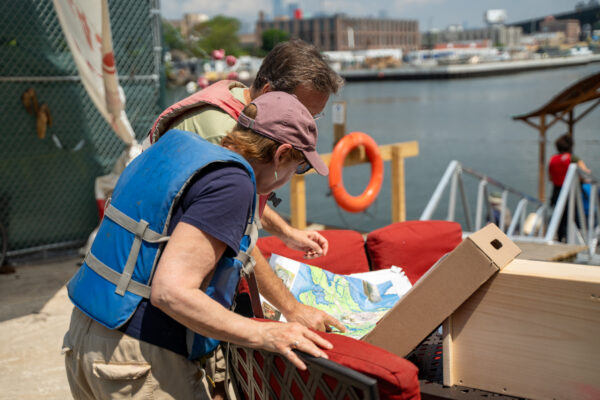
Eventgoers inspect a map at the shore of the canal. Photo: Nicole Vergalla for the Gowanus Dredgers
The Billion Oyster Project was active in Domino Park, educating the public on the importance of wildlife in the harbor. “When I was growing up here, the water was always dark and gray and gross, and I didn’t think that things were alive under the surface. It’s really valuable for people to be able to see how much life there is and how colorful and beautiful it is,” said Dr. Anna Weiss, a community science program manager at the project. Members were displaying live oysters and talking to kids about how these shellfish filter the water, increase biodiversity, and act as natural floodwalls.
Weiss also spoke on getting people active in their waterfront communities. “Once you’re going out to the water and learning to love it … you’re gonna want to go out and advocate, asking for cleaner water, asking for solutions and becoming involved at that level,” she said. She urged all to “go out and find a favorite water body.”
Ducks float by the tug boats in the Gowanus Canal. Photo: Nicole Vergalla for the Gowanus Dredgers
Yet, the celebration doesn’t have to stop after City of Water Day. “We are a city that’s surrounded by water — we are a water city, and appreciating it gives us a sense of place,” said Lisa Bloodgood, director of horticulture and stewardship at the North Brooklyn Parks Alliance. Water appreciation can look like many things, whether it is volunteering, voting, or simply enjoying the waterfront.
“I love using the metaphor of the estuary because we’re all connected by these waterways,” Bloodgood adds. “Maybe you’re in Newtown Creek, maybe you’re in the Gowanus Canal, but we’re all connected by the waterways, from the rivers and into the ocean.”
A canoer’s view from the water in Gowanus. Photo: Lucien Clough/EagleThe creation of hexagonal gardens made of recycled wood, fishnets and thousands of donated corks, July 2023. Photo: Lucien Clough/Eagle
SUNSET PARK — “As a resident of Marine Park, one of the great surprises I found biking around Industry City and visiting Japan Village was to discover Bush Terminal Park. I continue to be amazed at the serene hideaways that the city offers in some of the busiest places — and, still, with an iconic view.”
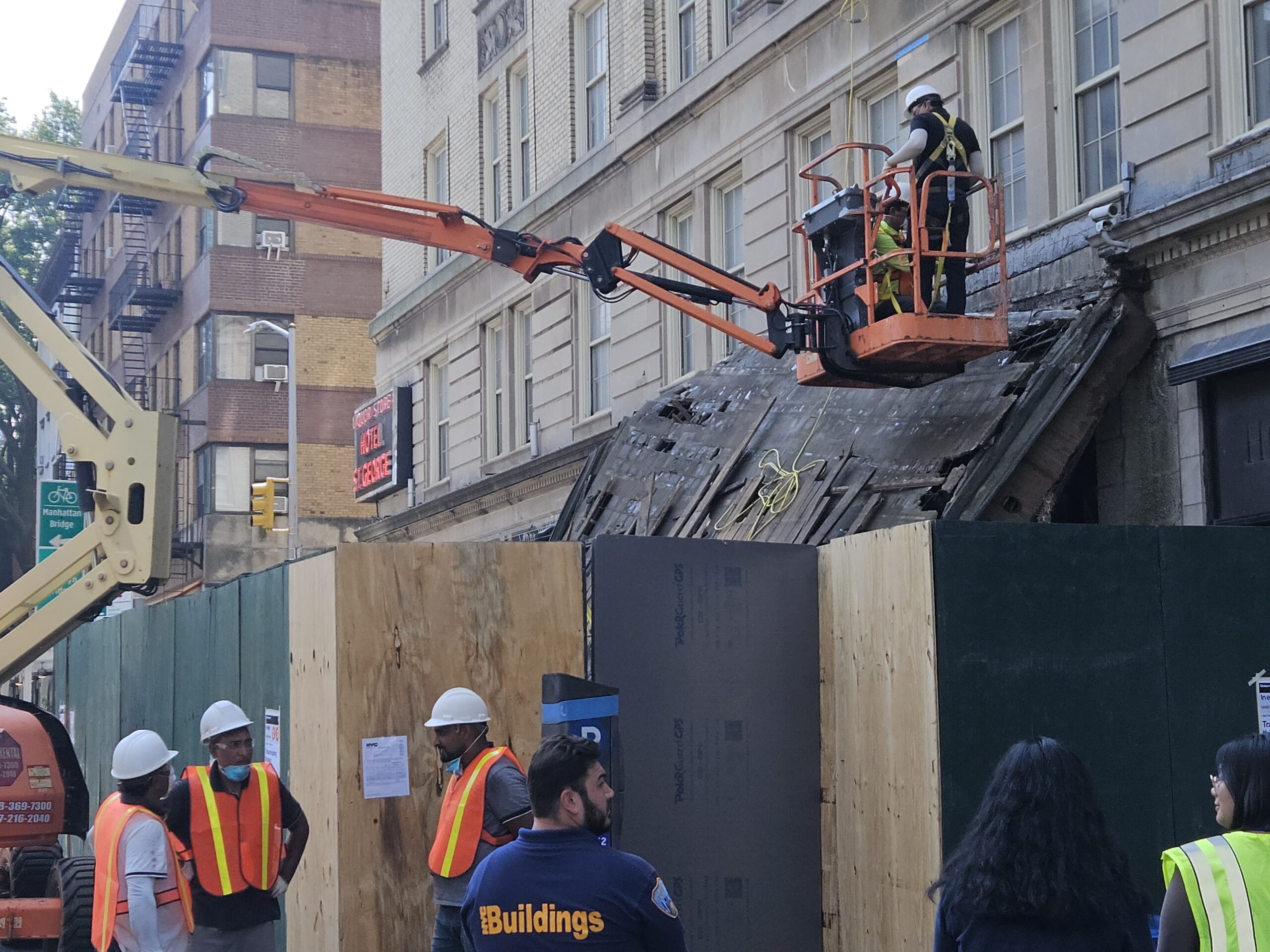
BROOKLYN HEIGHTS — ‘A miracle that no one was killed …’ That’s what neighbors are saying about the collapse of the Hotel St. George marquee. Shown in this photograph are workmen beginning the removal and repair of the historic, old neon sign at the corner, referencing a relic of Brooklyn Heights’ past: the St. George Hotel.
ATLANTIC AVENUE — Exhausted shopper with cluster of bags and goods from mall at Boerum Place stops to look at huge construction site across the street. “Is that REALLY going to be a jail??” Her male companion is reassuring, “Nothing like Rikers … this is 21st Century.”
BROOKLYN HEIGHTS — Overheard in line at one of most popular pastry outlets on Montague Street: “Hope I can get them into a camp …” A mother with two pre-schoolers in tow was showing a friend the Dodge Y flyer for Healthy Kids Day on Saturday, April 18.