If you’re traveling from Brooklyn to Manhattan on the A or C line and plan to transfer to the Lexington Avenue subway (4 or 5 lines) at Fulton Street, you’re in for some serious overcrowding on the 4 and 5 platform.
And if you have trouble walking or get out of breath easily, you’ll have a problem with having to go up and down multiple staircases to get from one platform to another.
That situation, and others, may get better when the $1.4 billion Fulton Center in Lower Manhattan opens in June 2014. The structure, which will serve 11 lines, is already partially completed.
Like Atlantic Avenue in Brooklyn, Fulton Street in Manhattan is a transfer station for many different lines. These lines are poorly connected mainly because they were built, before the 1940 subway unification, by different entities – the Independent lines (later known as the IND), Brooklyn-Manhattan Transit (BMT) and Interborough Rapid Transit (IRT).
“Essentially,” says Kevin Ortiz, a spokesman for MTA New York City Transit, “what the new Fulton Center will do is provide a seamless connection between 11 lines. If you remember how the station used to be configured, having to go up and then down through the C-train station from the 2 to the 4, it wasn’t very friendly.
“What the project does moving forward is to eliminate that, to improve access through improved mezzanines. We’ve put in new staircases and new entrances.”
He also said that “This is a project that is going to serve 300,000 customers who go through one of the lines, also adding street-level ADA-accessible entrances.”
When a new corridor under Dey Street is completed, the R train will also be linked to the complex, providing yet more alternatives for Brooklyn riders. For example, Brooklyn riders on the 2, 3, 4 or 5 who want to get to Herald Square can now transfer to the uptown R.
Conversely, Brooklynites riding the R to Manhattan (after the Montague Street tunnel is back in service) who want to get to 8th or 9th avenues will be able to transfer to the uptown E train, also by a new connection.
Getting back to that uptown Lexington Avenue platform, the new configuration will include new access points for the station, so it won’t be as crowded, according to the MTA.
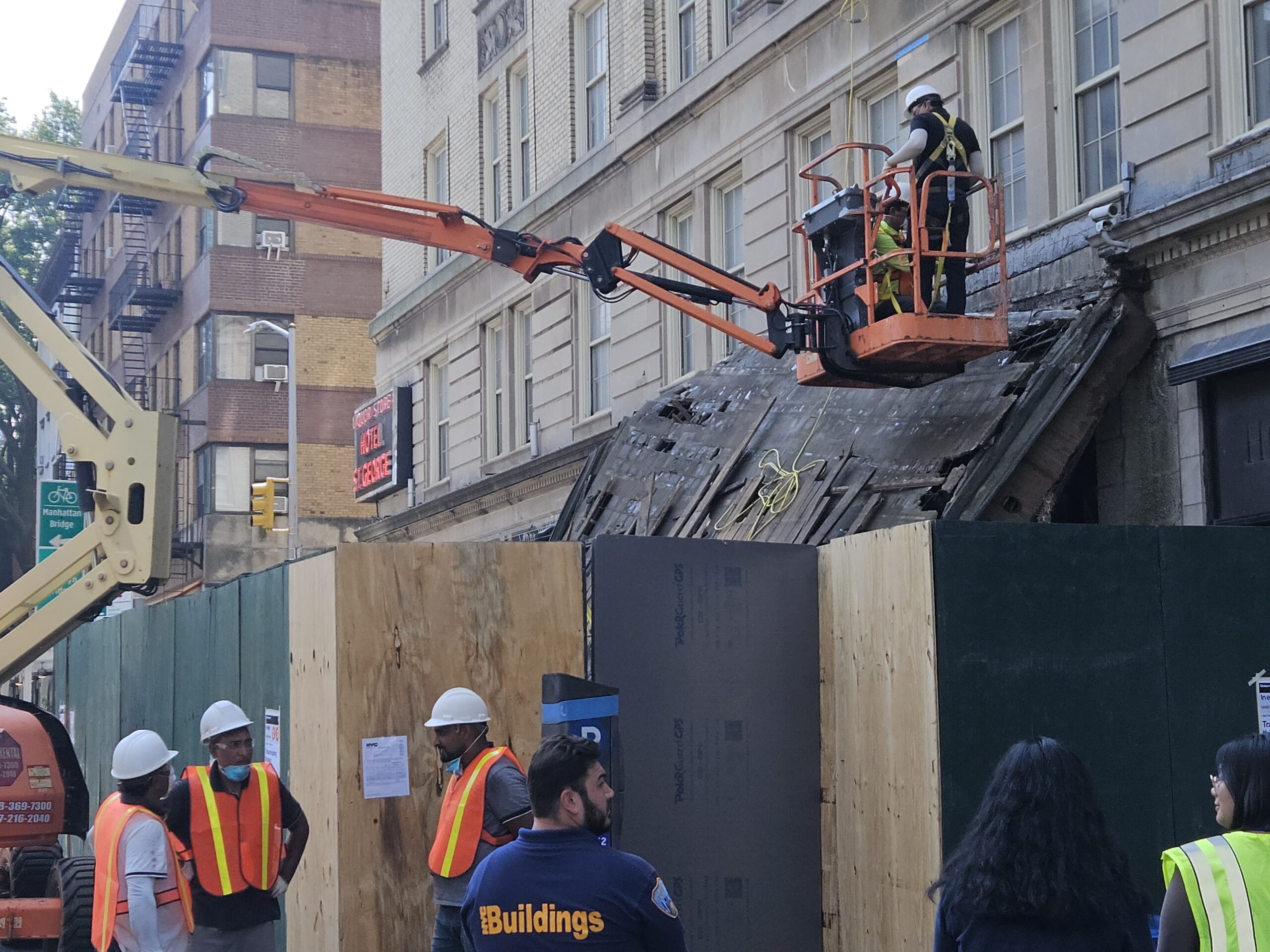
Some of the new mezzanines are already in use, and some of the new decorative tilework has already been installed. However, several of the complex’s escalators and elevators are still not ready and are located behind temporary barriers, workers on the site told this reporter recently.