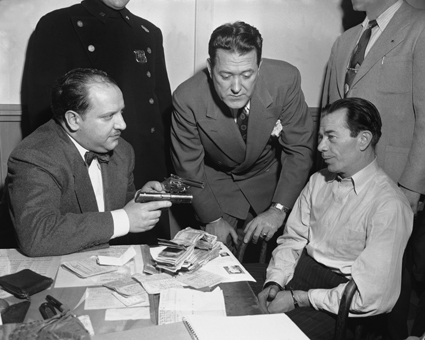
The criminal career of bank robber Willie “The Actor” Sutton ended in Brooklyn on Feb. 18, 1952. He was apprehended by police after being recognized on the subway by a young clothing salesman named Arnold Schuster.
Sutton was on his way from Union Square back to Brooklyn, where he had been staying in a room at 340 Dean St., when Schuster, who had boarded the train at DeKalb Ave., recognized the famous criminal. Schuster followed him when they exited the train and flagged down two policemen.
The capture made headlines across the country and Schuster was called a hero. But the young man soon paid dearly for fingering “Slick Willie.” Schuster was murdered 17 days later, shot in each eye and in the groin while walking near his home in Borough Park. No one was ever convicted of the murder, though city lore has it that it was at the order of a mob boss who hated “squealers.”
Sutton, who had been born in Brooklyn near Prospect Park in 1901, robbed banks for decades, beginning in the late 1920s. His first robbery was reportedly at the age of 9, however, when he broke into a grocery store and took $6 from the register. Sutton claimed to have stolen $2 million during the course of his career.
Though he was arrested many times, and ultimately spent 33 years of his 79-year life in prison, he also successfully escaped prison three times, using elaborate schemes, such as painstakingly sculpting a likeness of his head out of bits of plaster and laying it on his cot so that guards would think he was still safely incarcerated rather than running to freedom. 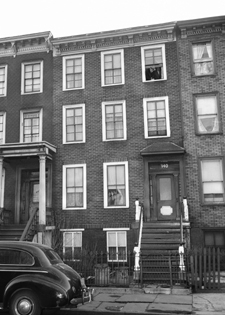
When Sutton was captured in Brooklyn in 1952, he had been on the run since his last escape from prison, in Pennsylvania in 1947 (in which he and other prisoners fled dressed as prison guards.) He was put on the FBI’s Most Wanted List in 1950.
After his Brooklyn arrest, he was sent to Attica prison, from which he was released in 1969, sick with emphysema.
He died on Nov. 2, 1980, in Florida. His body was sent back to Brooklyn and he was buried in the Sutton family plot at Holy Cross Cemetery.
Once when a reporter asked Sutton why he robbed banks, he famously retorted, “Because that’s where the money is.” Sutton later said these were not his words, but it didn’t stop him from releasing a book titled Where the Money Was, which was written with Edward Linn and published in 1976. He also co-authored the book I, Willie Sutton.
In its obituary of Sutton, the New York Times described his robbery technique:
“Although early in his career he robbed jewelry stores, it was banks that presented irresistible challenges to him. Often, according to the police, he would leave a bank with a cheering admonition for his frightened victims: ‘Don’t worry, the insurance will cover this.’
“The bank-robbing technique he evolved, beginning in the early 1930s, has been widely copied. First, he would study a bank carefully until he learned how many employees worked there, when they arrived for duty and what their duties were.
“He invariably entered the bank after the arrival of the first employee, usually a porter or guard, then welcomed the other employees at gunpoint. When the manager arrived, he would warn him that his employees would be the first to be shot if there was trouble. The robber and his helper or helpers were always gone before the bank opened for public business.”
Sutton was known as “The Actor” because he often perpetrated his hold-ups disguised as a bank guard, window cleaner, maintenance man, policeman, etc.
The Times obituary also described how this technique evolved: “He was walking down Broadway one day and, at a bank, noticed that the guards looked not at the faces but at the uniforms of messengers and armored-car guards arriving at the bank. Dressed as a Western Union messenger, he got into the bank, and handed a fake telegram to a guard. ‘As soon as both his hands were occupied, I merely reached down and lifted his revolver out of its holster,’ Mr. Sutton later recalled.”
—Phoebe Neidl