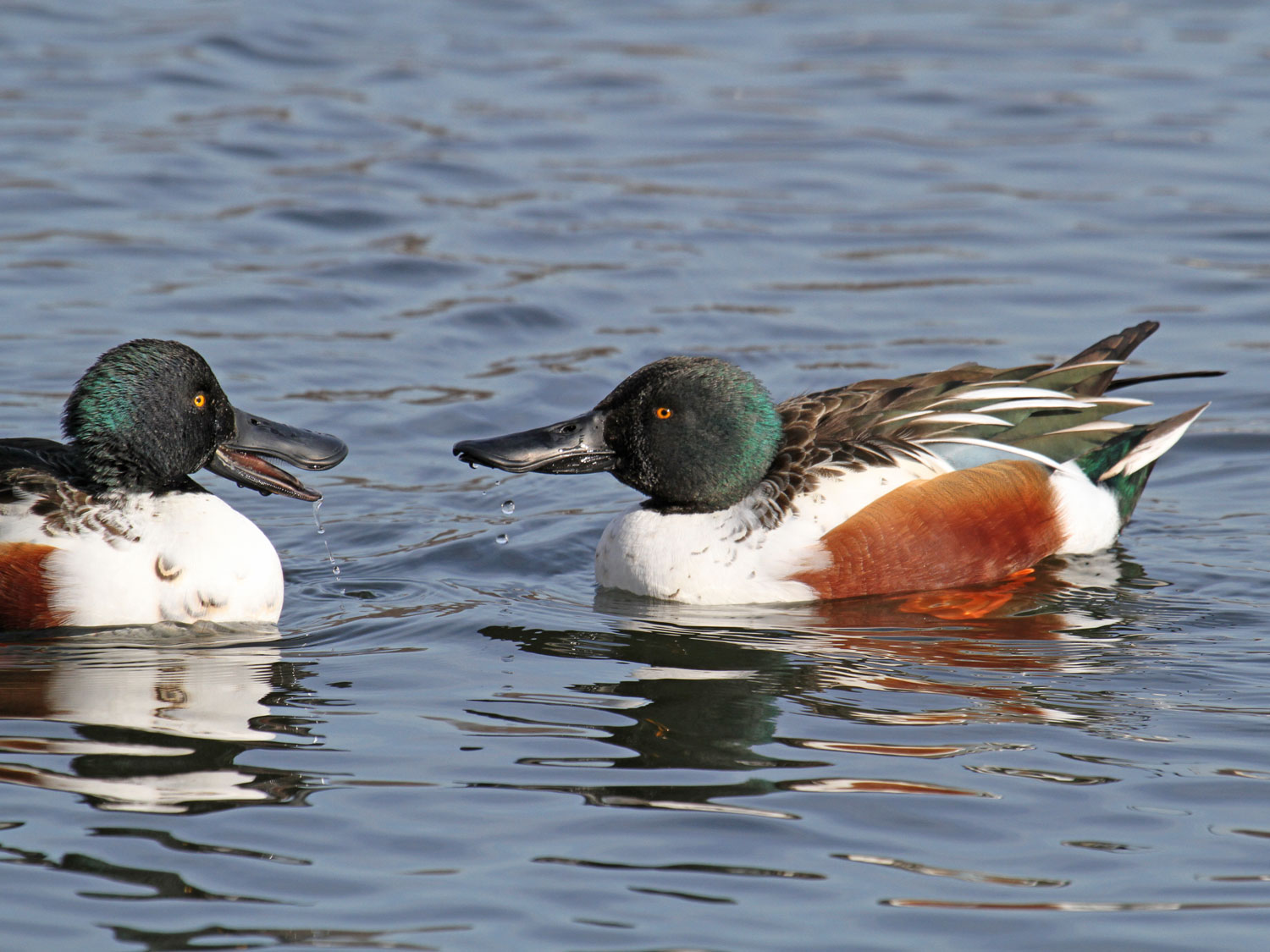
Today, Brooklyn Bird Watch features the Heather Wolf photo of the Northern Shoveler. The Northern Shoveler is an interesting member of the dabbling duck family and is distinguished by a uniquely large bill, shaped as its name implies, like a shovel. It is a colorful duck that sometimes at a glance is mistaken for the Mallard. As the Cornell Lab says, if the bill doesn’t catch your eye, the male’s block-like color palette sure will, with its bright white chest, rusty sides, and green head. The female is no less interesting with a giant orange bill and mottled brown plumage.
An interesting element of the bill is that it has about 110 comb-like projections (called lamellae) along the edges, acting like a colander, through which it filters out tiny crustaceans and seeds from the water. Primarily, birds are usually all business: Sometimes shovelers will gather in a group and swim together in a circle and create a small whirlpool, or vortex, that stirs the muddy bottom and causes tiny zooplankton (their most common food source) to rise to the surface. And as Wikipedia points out, the adaptation of their “shovel” so to speak, gives them an advantage over other dabbling ducks because they don’t have to compete for food resources most of the year. They prefer mud-bottomed marshes rich with invertebrate life.
The Northern Shoveler likes to nest in grassy areas away from open water. The nest is simple, a shallow depression on the ground usually lined with plant material and feathers. The males are very territorial during breeding season. Males also engage in elaborate courtship behaviors, both on the water and in the air; sometimes as many as a dozen males will pursue a single female, and despite their stoutness, shovelers are skillful fliers.
The Northern Shoveler is the second bird in the Brooklyn Bird Watch series so far that uses defecation as a defense tactic. When it is forced to fly away from the nest the female Shoveler will defecate on her eggs, apparently to discourage predators. Statistics say the tactic works: the Conservation Status (population) of the Northern Shoveler is of “least concern”.
At the Bird Watching Headquarters the Northern Shoveler is listed as the 5th most frequently found dabbling duck in New York, and the Cornell Lab’s eBird site says there were over 2 million observations recorded of the Northern Shoveler in Kings County alone, even when the bird virtually disappears from May through late August.