BOERUM HILL — Neighbors who have been enduring the construction of Brooklyn’s 18-story borough-based jail for the past three years are exhausted.
Now they are hoping that a bill introduced by Councilmember Lincoln Restler on Thursday will bring some relief.
Since 2022, Boerum Hill and Downtown Brooklyn residents have been trying to live their lives through late-night noise, vibrations, dust and unsafe traffic conditions as the city builds the 1,040-bed facility at 275 Atlantic Ave. at Boerum Place, the site of the former Brooklyn Detention Center.
Brooklyn’s borough-based jail construction site, seen from the State Street side. Photo: Mary Frost, Brooklyn Eagle
It’s one of four planned borough-based jails, and it’s running two years behind schedule. Rikers Island was originally slated to close in 2027, and the Brooklyn jail will not be completed until at least 2029.
While conditions were even worse when the former Detention Center was being demolished, neighbors are still enduring “endless after-hours variances, six days a week — and when concrete pours take place, that’s seven days a week, sometimes on repeated weekends,” Howard Kolins, acting executive director of the Atlantic Avenue Local Development Corporation and president of the Boerum Hill Association, told the Brooklyn Eagle. New York Police Department vehicles needing access to the arraignment courthouse still drive and park on sidewalks and in intersections, and construction trucks idle around the clock.
In April, local representatives, including Restler, Rep. Dan Goldman, state Sen. Andrew Gounardes and Assemblymember Jo Anne Simon, fired off a letter to Deputy Mayor for Operations Jeff Roth and other top administration officials, demanding action.
Improvements since then are “minor at best,” Kolins said.
Councilmember Lincoln Restler. Photo: Mary Frost, Brooklyn Eagle
Now Restler is taking a new approach. On Thursday, he introduced a bill that would require the city to establish a construction coordinator for all the borough-based jail projects. The coordinator would serve as the point of contact for local residents, businesses and elected officials, review work permits, and designate community liaisons to be physically present at each construction site.
The appointee would also work with city agencies to develop mitigation plans to address problems such as excessive noise, traffic congestion, street closures and parking access related to the jails’ construction.
“I strongly support the closure of Rikers Island — but the construction of the borough-based jail plan needs to be better planned to limit negative community impacts,” Restler told the Eagle on Thursday. “Our community in Downtown Brooklyn experiences loud construction for at least 17 hours daily. We need accountable leadership at City Hall to work with our communities to make the borough-based jail project a success.”
The new, 18-story Brooklyn jail will not be completed until at least 2029. Photo: Mary Frost, Brooklyn Eagle
Hope for ‘real teeth’
Kolins is cautiously optimistic.
“What’s been frustrating from the beginning is that no single agency or contractor is responsible,” he said. Contractors working with the New York City Department of Design and Construction “don’t seem to look beyond their own square block to see what the effects will be … There’s no collective viewpoint.” Residents have been bringing issues to the construction liaison, who passes the complaints to DDC and Tutor Perini, but steps are not taken “proactively” in coordination with the other involved agencies, such as the Department of Transportation.
“Of course, there are construction impacts,” Kolins said. “Work needs to take place, and electrical hookups or water hookups or various things need to happen. However, community members will look at the drawings and say, ‘Oh, you’re going to close Smith Street for how long? Have you spoken to the people at the NU Hotel? Or FedEx, because that’s where their truck pulls up. Oh, and by the way, it’s a bus route.’ And there’s dead silence.”
Kolins added, “We appreciate Lincoln’s effort here, and we look forward to having real teeth for this project and all the other boroughs to make this initiative tolerable for the local community. This person cannot get on board soon enough, and my only question back to Lincoln would be, what authority does this person have? Because of this alphabet soup of agencies.”
Traffic comes to a halt on State Street when police deliver a detainee to Brooklyn Criminal Court. Photo: Mary Frost, Brooklyn Eagle
‘Unmitigated adverse effects’
Kolins used lingo straight out of an Environmental Impact Statement — “unmitigated adverse effects” — in describing what he expected down the road as a result of changes made to the original design due to budget problems.
Initially intended to accommodate 886 detainees, in 2023 the city gained 174 additional slots by eliminating “therapeutic beds” for detainees with mental illnesses or substance abuse issues. “I learned that at any given time, of the jail population, half the people have health problems. And of those, half have mental health problems,” Kolins said.
Brooklyn’s borough-based jail construction site as seen from Atlantic Avenue and Boerum Place. Photo: Mary Frost, Brooklyn Eagle
The initial plan for the jail also included two underground tunnels connecting the site to the Brooklyn Criminal Court building, keeping State Street clear, and 292 underground parking spaces. However, one tunnel was eliminated and the number of parking spaces was reduced to 100 — for authorized vehicles only, not for staff parking.
A year ago, the city said “in a footnote” that it expected 144 staff vehicles during the daytime Monday through Friday, Kolins said. “So 144 cars is four blocks of Atlantic Avenue. Wow — as if that has no unmitigated adverse effects.”
Meanwhile, “The folks who live immediately adjacent may have cracks in their apartments from the hammering, from the takedown of the building, and you have to believe that the dust is not toxic … you have to hope,” he said.
SUNSET PARK — “As a resident of Marine Park, one of the great surprises I found biking around Industry City and visiting Japan Village was to discover Bush Terminal Park. I continue to be amazed at the serene hideaways that the city offers in some of the busiest places — and, still, with an iconic view.”
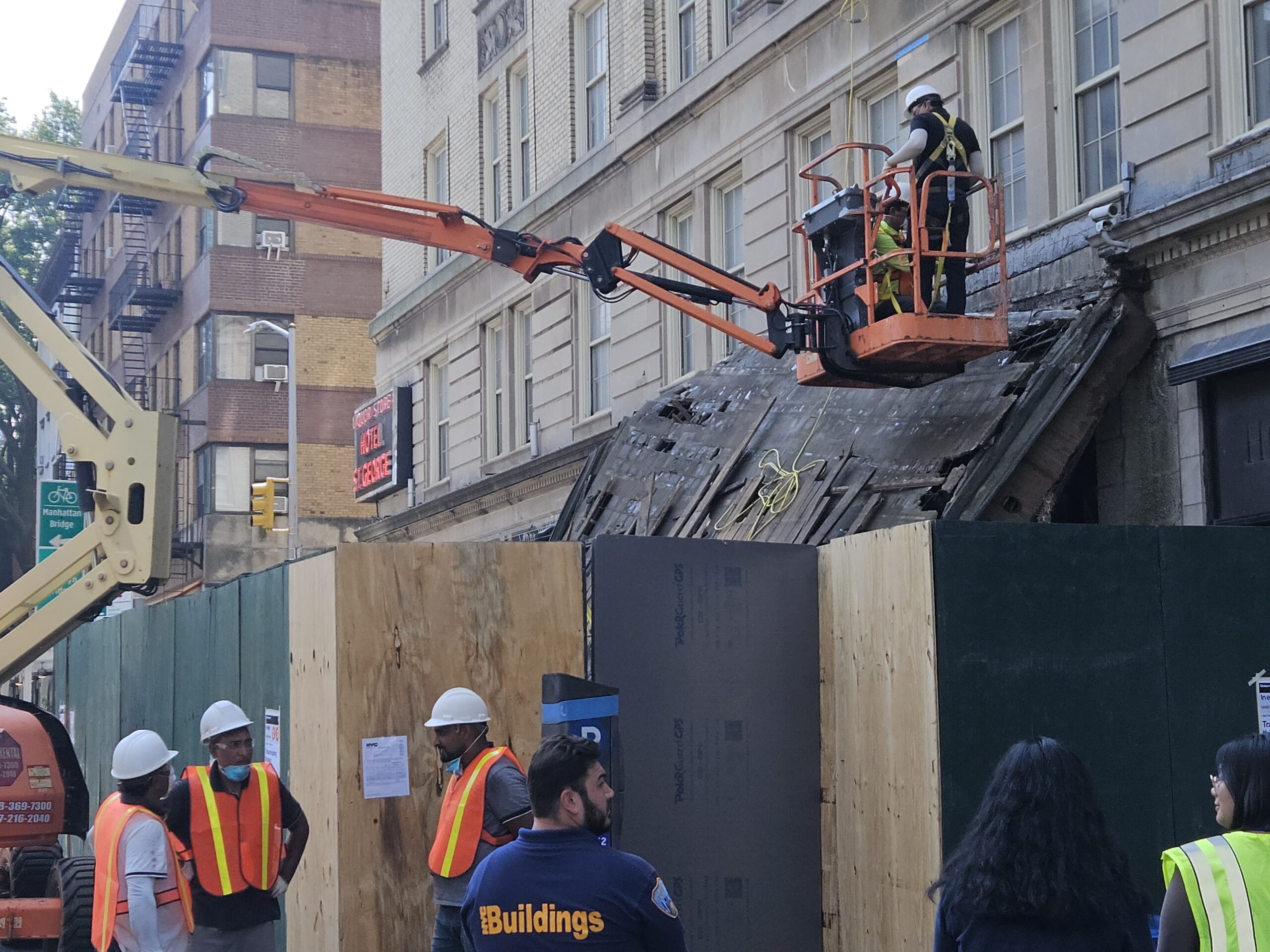
BROOKLYN HEIGHTS — ‘A miracle that no one was killed …’ That’s what neighbors are saying about the collapse of the Hotel St. George marquee. Shown in this photograph are workmen beginning the removal and repair of the historic, old neon sign at the corner, referencing a relic of Brooklyn Heights’ past: the St. George Hotel.
ATLANTIC AVENUE — Exhausted shopper with cluster of bags and goods from mall at Boerum Place stops to look at huge construction site across the street. “Is that REALLY going to be a jail??” Her male companion is reassuring, “Nothing like Rikers … this is 21st Century.”
BROOKLYN HEIGHTS — Overheard in line at one of most popular pastry outlets on Montague Street: “Hope I can get them into a camp …” A mother with two pre-schoolers in tow was showing a friend the Dodge Y flyer for Healthy Kids Day on Saturday, April 18.