Many NYC high schools are off limits to students with disabilities
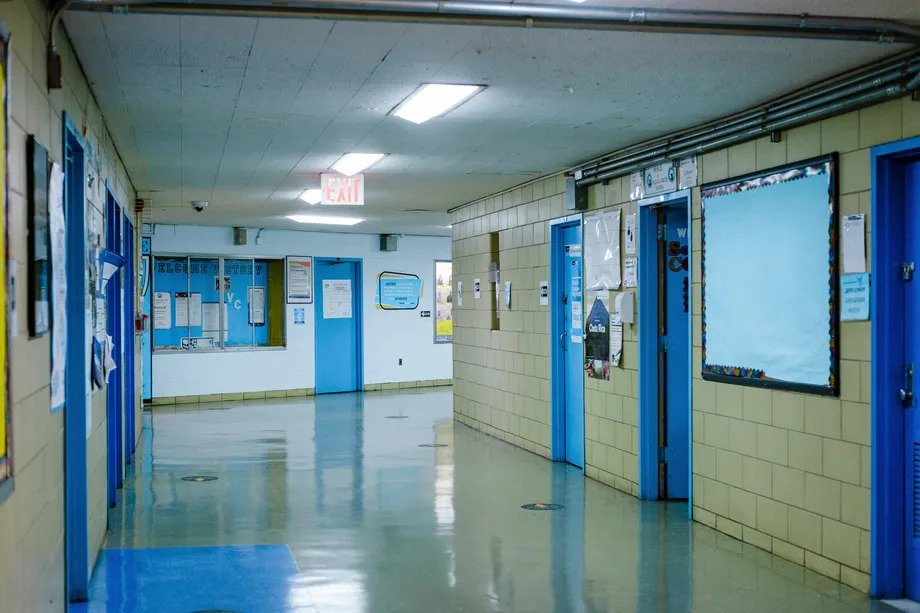
Brooklyn High School for Excellence and Equity is considered only partially accessible for students with physical disabilities because the hallway doors are too narrow and the cafeteria isn’t accessible.
Photo by Gabriella Bhaksar/Chalkbeat
By Christina Veiga, Chalkbeat New York
March 3, 2022
Copy Link
Email
Facebook
X
LinkedIn
WhatsApp
Telegram
Pinterest
Print
Going to high school in New York City is supposed to be full of choices.
Students in the nation’s largest school district can apply to more than 700 programs, picking from schools large or small, close to home or in another borough. There are career and technical schools, schools that offer college courses, and schools dedicated to the performing arts.
For students with disabilities, however, the options often feel limited. Picking a high school means finding not just the right fit in terms of academics and interests, but a whole host of other questions, too, about whether their needs will be met.
Students with limited mobility often find the buildings themselves are inaccessible, with bathroom stalls that are too narrow, ramps used to toss garbage, and entire floors off limits because there’s no elevator. For other students with disabilities, families feel they are turned away because school staff signal they can’t or won’t serve their child’s specific needs, which may require a dedicated aide, support from a trained special education teacher, or medical attention.
Last year, nearly 18,000 eighth graders with disabilities were poised to transition to high school. Many of them won’t end up graduating: Only 58% of students with disabilities earned a diploma in 2021, compared with 81% of citywide.
“I’m angry,” said Francine Almash, who is searching for a high school for her son, who has dyslexia.
She also represents families who have children with disabilities as a member of the Citywide Council on High Schools, an advisory group at the education department. Despite her intimate knowledge of the school system and fierce advocacy for her son, she has felt at a loss for information about which programs would be a good fit.
“How do I select 12 schools that might serve him? How do I select one?” Almash asked.
Getting through the door
With the click of a mouse, it became clear just how limited the high school options would be for Alan Aja’s son.
In the city’s online directory of high schools, Aja checked the box that would only show campuses that are fully accessible for students with physical disabilities, eliminating a chunk of the city’s high schools from contention.
Aja’s son has mobility challenges, which means that his family is looking for a school that’s not only a good academic fit, but one where he can reach the water fountains and ride an elevator, or at least climb staircases that aren’t too steep. He needs a school that is close, and on the smaller side, because traveling too far or traversing a large campus is taxing.
While students with mobility needs do get preference for seats in schools that are accessible, they still might have few options. After months of searching, Aja’s family has managed to find two schools that they think fit the bill for their son.
“Those who believe in choice need to explain to me why that inequity exists,” Aja said. “Parents shouldn’t have to click on a box. It should be a guaranteed right.”
The accessibility of New York City school buildings, some of which date back a century, is “abysmally low,” federal investigators declared in 2015. Since then, advocates say the city has made steady progress in opening up access to more buildings.
Currently, 73% of high schools are accessible, according to the School Construction Authority. But that includes buildings that are considered “fully” or only “partially” accessible. Even those considered partially accessible may be off limits to students if they can’t use the bathrooms, for example, or a wheelchair can’t fit through a doorway to get to their classes.
The city’s current capital plan, which runs through 2024, includes $750 million in upgrades that include widening doorways, ensuring that auditorium stages are accessible, and installing automatic door openers, ramps, and lifts. With work underway, 57 more elementary, middle, and high school buildings will be fully accessible, and three more will be partially accessible.
On top of considering the physical access a student may have in a building, students with disabilities also may have to meet competitive admissions standards at “screened” schools — selective schools that may require essays, interviews, auditions, and weigh academic records like grades.
Students with disabilities “not only have to meet those screening thresholds that their more typical peers have to meet, but then there needs to be the perfect overlay of physical accessibility,” said Maggie Moroff, who works on special education issues for Advocates for Children. “We know often that families make choices: ‘All right, this is the perfect school for my child except she can’t get into the library, or she’s going to eat lunch in the faculty lounge.’”
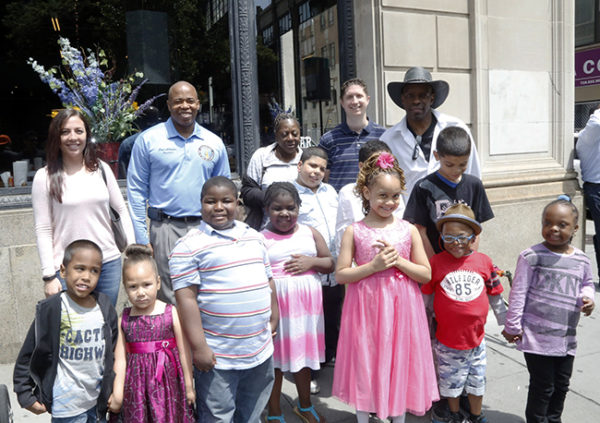
Autistic and disabled children from PS53K in Brooklyn performed at then-Borough President Eric Adams’ Lunchtime Concert Series outside Borough Hall in 2015. The singer’s name is Tiffany. Eagle file photo in 2015.
Feeling shut out
When Jennifer Choi’s son was admitted to one of the city’s prestigious specialized high schools last year, everyone around her assumed he would enroll.
But her son, who has autism, first needed to know whether the school offered the special education class settings that are supposed to be guaranteed on his individualized education program, or IEP.
He sent an email to the school staff and waited for a response. When none came, he reached out to the central education department, setting off another back-and-forth with the school.
The run-around was a red flag to Choi, who runs a consulting firm for families with disabilities.
“They’re supposed to say, ‘If it’s on your IEP, I’ll do it.’ It’s not a choice. But it took so long,” Choi said. “Do I want him to go to a school that’s not going to welcome him?”
He enrolled at a different school, one that has an administrator dedicated to serving students with disabilities.
Families say they run into this problem frequently: School staff tell students with disabilities that they cannot be accommodated. This isn’t supposed to happen. The New York City education department assures parents that “every high school is expected to welcome and serve students with disabilities.”
In reality, city officials know that isn’t always the case. Parents on the Citywide Council on Special Education pressed one of the city’s top enrollment officials about the issue at a November meeting.
“In terms of schools turning away kids… we, too, hear that,” Sarah Kleinhandler, the education department’s chief for enrollment, told the council.
“We, of course, don’t support that. And we leverage the structures that are in place to ensure that those students are welcomed in our schools,” she said. When officials hear about those cases, she said, they refer it to superintendents at the district and executive levels.
Part of the problem, parents and advocates say, is how the education department identifies students with disabilities in the application process.
The education department gives an admissions preference to students with disabilities. The preference is based on how many students with disabilities are enrolled in a borough.
When students apply to schools, they are identified as having a disability only when more than 20% of their class schedule consists of special education. A student could have an IEP that requires small group tutoring four times a week, a full-time paraprofessional, and physical and occupational therapy, and still not meet that threshold, Choi said.
Paullette Healy, an advocate and member of the Citywide Council on Special Education, said she helped more than a dozen families with this very issue in the last admissions cycle. Often, she said, students needed their own paraprofessional that schools said they could not provide, or medically fragile children’s needs could not be met by staffers already on-site. Families also had trouble getting schools to implement safety measures to keep their child from wandering from campus.
SUNSET PARK — “As a resident of Marine Park, one of the great surprises I found biking around Industry City and visiting Japan Village was to discover Bush Terminal Park. I continue to be amazed at the serene hideaways that the city offers in some of the busiest places — and, still, with an iconic view.”
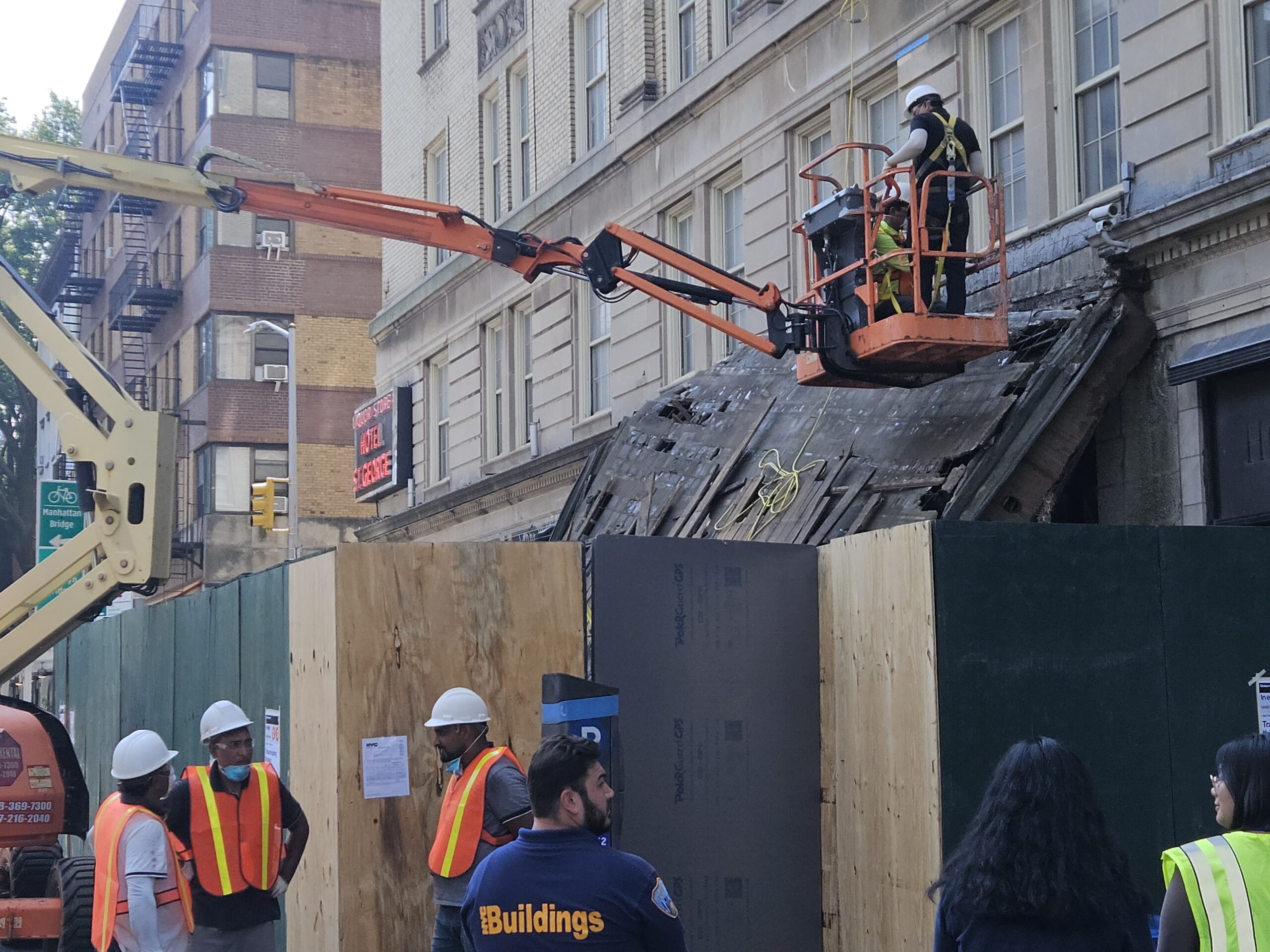
BROOKLYN HEIGHTS — ‘A miracle that no one was killed …’ That’s what neighbors are saying about the collapse of the Hotel St. George marquee. Shown in this photograph are workmen beginning the removal and repair of the historic, old neon sign at the corner, referencing a relic of Brooklyn Heights’ past: the St. George Hotel.
ATLANTIC AVENUE — Exhausted shopper with cluster of bags and goods from mall at Boerum Place stops to look at huge construction site across the street. “Is that REALLY going to be a jail??” Her male companion is reassuring, “Nothing like Rikers … this is 21st Century.”
BROOKLYN HEIGHTS — Overheard in line at one of most popular pastry outlets on Montague Street: “Hope I can get them into a camp …” A mother with two pre-schoolers in tow was showing a friend the Dodge Y flyer for Healthy Kids Day on Saturday, April 18.