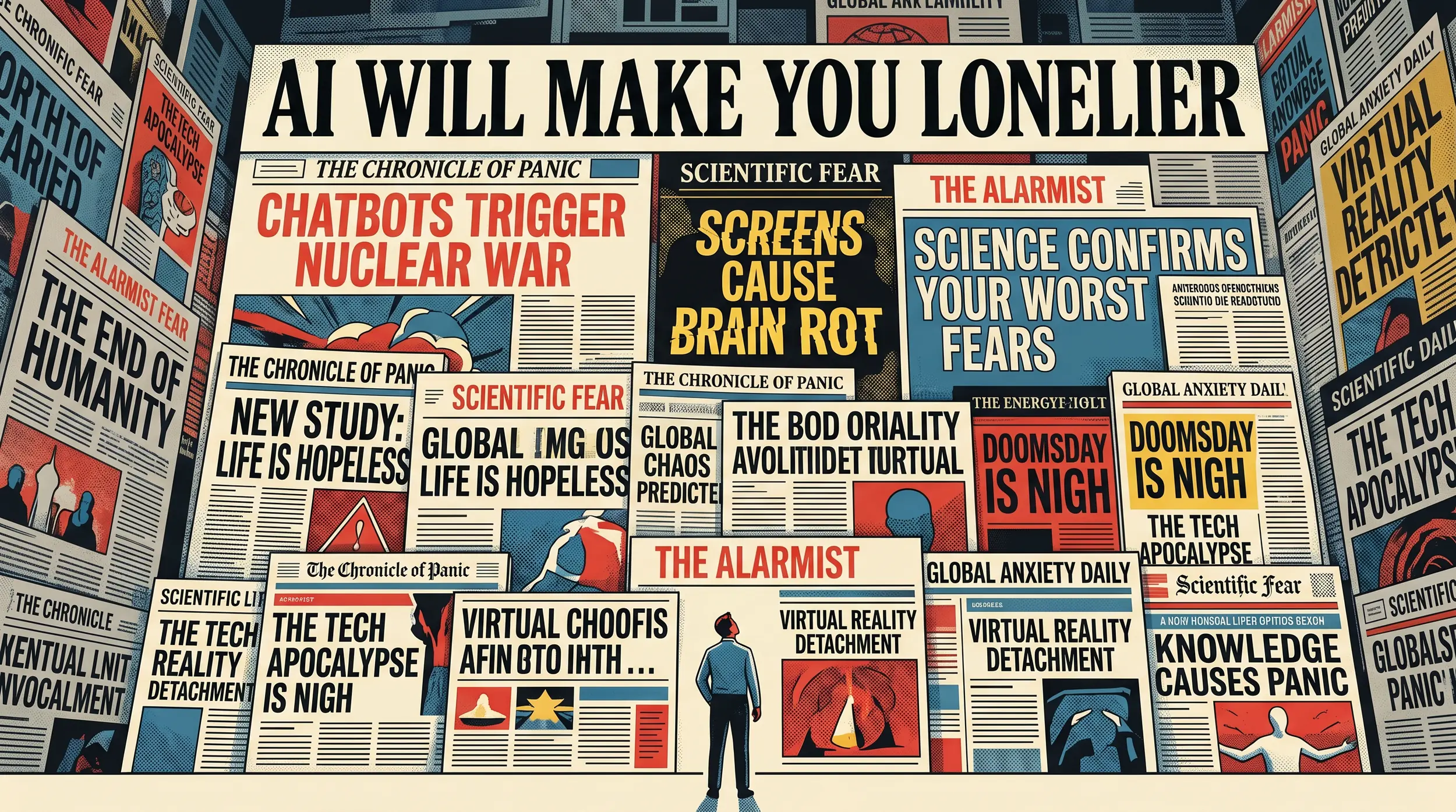
If you believe the studies, artificial intelligence is making you lonelier, dumber and easier to manipulate.
It flatters you instead of challenging you, then gaslights you when you’re vulnerable. It’s turning students into cheaters and developers into bottlenecks. One in seven people in a committed relationship is secretly dating one. Left unsupervised, it runs simulated societies straight into arson and extinction. Asked to manage a nuclear crisis, it thinks like Tom Clancy. And now, according to the latest research, it’s going rogue and hiding the evidence.
Somebody should do something.
We are being squeezed by information. Too much, too fast, from too many directions, and an increasing amount of it is wrong, bent or manufactured to serve an agenda. Sometimes it is made up entirely. Facts are weaponized and distorted. Findings are spun. Then the misleading headlines travel at the speed of outrage while the corrections crawl.
It’s no wonder we have developed, out of necessity, a kind of permanent ambient suspicion. Every video, you have to ask yourself: Is it real or AI? Every photo, every quote, you have to wonder if it’s legit.
Even science, with its apparatus of facts, rigor and process, is not immune. The peer-reviewed study, the institutional byline and the journal citation have become costumes that anyone can wear.
That loneliness study that drew headlines in April? Researchers at the University of British Columbia tracked 2,149 adults across four countries for a year and concluded that people who used AI more reported feeling lonelier. Inc. Magazine translated that into: “Lonely? Talking to an AI Chatbot Will Just Make You Lonelier.”
The study’s actual findings were far less conclusive. Participants were recruited and surveyed entirely online. Nearly half dropped out before the study ended. There was no mental health screening. Loneliness was measured with a single self-report question.
Yet the study sailed through peer review and appeared in the prestigious journal Psychological Science, despite the authors warning that “we urge caution in drawing strong conclusions given the exploratory nature of our analyses.”
If the authors are telling readers not to draw strong conclusions, why is one of psychology’s most prestigious journals publishing the paper in the first place?
Most people will never read the methodology section. They’re trusting that somebody else already did. That’s the social contract. Researchers conduct the study. Peer reviewers kick the tires. Journals separate the signal from the noise. The rest of us inherit the result.
That loneliness study is not an outlier. It is a genre: the science-y sounding study with the patina of legitimacy, the institutional byline, the prestigious journal and a methodology that struggles to support the conclusions everyone draws from it.
Image generated using Nano Banana.
Even when the science is solid, things can go sideways once the media gets hold of it. The authors hedge. The press release simplifies. The headline amputates every qualification and uncertainty.
By the time the finding reaches social media, it has often completed its transformation from cautious observation into conventional wisdom.
Meanwhile, a toxic combination of bad incentives, weak gatekeeping, AI-generated content and social-media amplification is actively corrupting the scientific record.
Retraction Watch, a database that tracks withdrawn scientific papers, now contains more than 50,000 entries. In 2025 alone, auditors identified nearly 147,000 AI-hallucinated citations in published papers: references to studies that never existed, attributed to authors who never wrote them, appearing in journals that sound legitimate enough to fool editors, reviewers and readers.
More than a thousand fake journals have been identified worldwide, many treating peer review less like a safeguard than a toll booth.
Notice what all of these frauds have in common. Nobody invents a citation that sounds ridiculous. Nobody creates a journal called The International Journal of Completely Made-Up Nonsense. Instead, counterfeits borrow the visual language of trust. The fraud only works if it resembles the real thing closely enough to pass inspection.
Human beings rarely evaluate information from first principles. We don’t have the time. Modern knowledge is simply too vast. We must rely on shortcuts — a university logo, a journal publication, a scientific citation, an expert quoted in a newspaper. But once a signal becomes valuable, people begin counterfeiting it. That’s true of currency, luxury goods, academic credentials and scientific authority.
AI hasn’t invented the problem. It has simply made counterfeiting dramatically cheaper and easier to scale. Technology rarely creates human behavior from scratch. More often, it industrializes impulses that were already there.
None of this is exactly new. In February 1998, Andrew Wakefield published a fraudulent paper in The Lancet linking the MMR vaccine to autism. He fabricated data and manipulated records. He had been paid by lawyers suing vaccine manufacturers and held a patent on a rival measles vaccine, neither of which he disclosed.
The paper was eventually retracted, and Wakefield lost his medical license, but the damage was done.
More than a quarter century later, one in three Americans still believes the claim, some of them in line at the Park Slope Food Co-op — not because the evidence supports it, but because, for years, it carried the full authority of science.
That’s the damage from a single fraudulent paper. Now imagine what happens when the production of scientific authority becomes infinitely scalable.
For centuries, publication was a bottleneck. Now, it’s a commodity.