At the end of 1999, I obtained a leaked book proposal for a secret invention so classified that its creator, the engineer and entrepreneur Dean Kamen, had given it a code name: Ginger.
Investors who’d seen it had signed NDAs thick enough to choke on, but enough had slipped out to send Silicon Valley into a frenzy.
Steve Jobs said it was bigger than the personal computer. John Doerr, who had backed Amazon and Google, called it more important than the internet. Jeff Bezos put in money. Kamen raised $90 million at a $600 million valuation for a product nobody outside his lab had seen.
The coverage was inescapable. Ginger was on the cover of magazines. It was the subject of breathless speculation in every existing business and technology outlet. What was it? A cold fusion device? A new form of transportation? A machine that could end fossil fuels? The guessing was half the story, and the guessing was everywhere. I wanted in.
After cross-referencing patents, trademarks and domain registrations, I learned that Ginger was a self-balancing electric scooter. I wrote the story for Inside magazine and broke the news on the “Today” show with Katie Couric the same morning the article hit. For a week, it felt like every news outlet on earth wanted to talk to me. It was, by any measure, one of the biggest tech scoops of the year.
Then the Segway launched. People tried it. They felt ridiculous. It topped out at 12.5 miles per hour and cost $5,000. Cities banned it from sidewalks. Mall cops adopted it as their signature vehicle, which told you everything you needed to know. In 2020, the company quietly shut down production.
Being first only matters if the story matters, and the story stopped mattering.
I’ve been thinking about Ginger lately, because the word “AI” is doing exactly what “Ginger” did in 1999. It doesn’t describe anything specific. It signals everything desirable. Slap it on a product and watch the valuation climb. For a surprising number of companies, the technology underneath almost doesn’t matter. The word is the product.
This is what AI can actually do right now: write and debug code, synthesize vast bodies of research in seconds, translate languages with near-human fluency, detect tumors in medical imaging, model climate systems, accelerate drug discovery, tutor students, assist lawyers, help writers work through drafts, and power the tools that scientists, doctors and engineers use every day.
It is genuinely, consequentially transformative.
This is not the Segway. This is the internet.
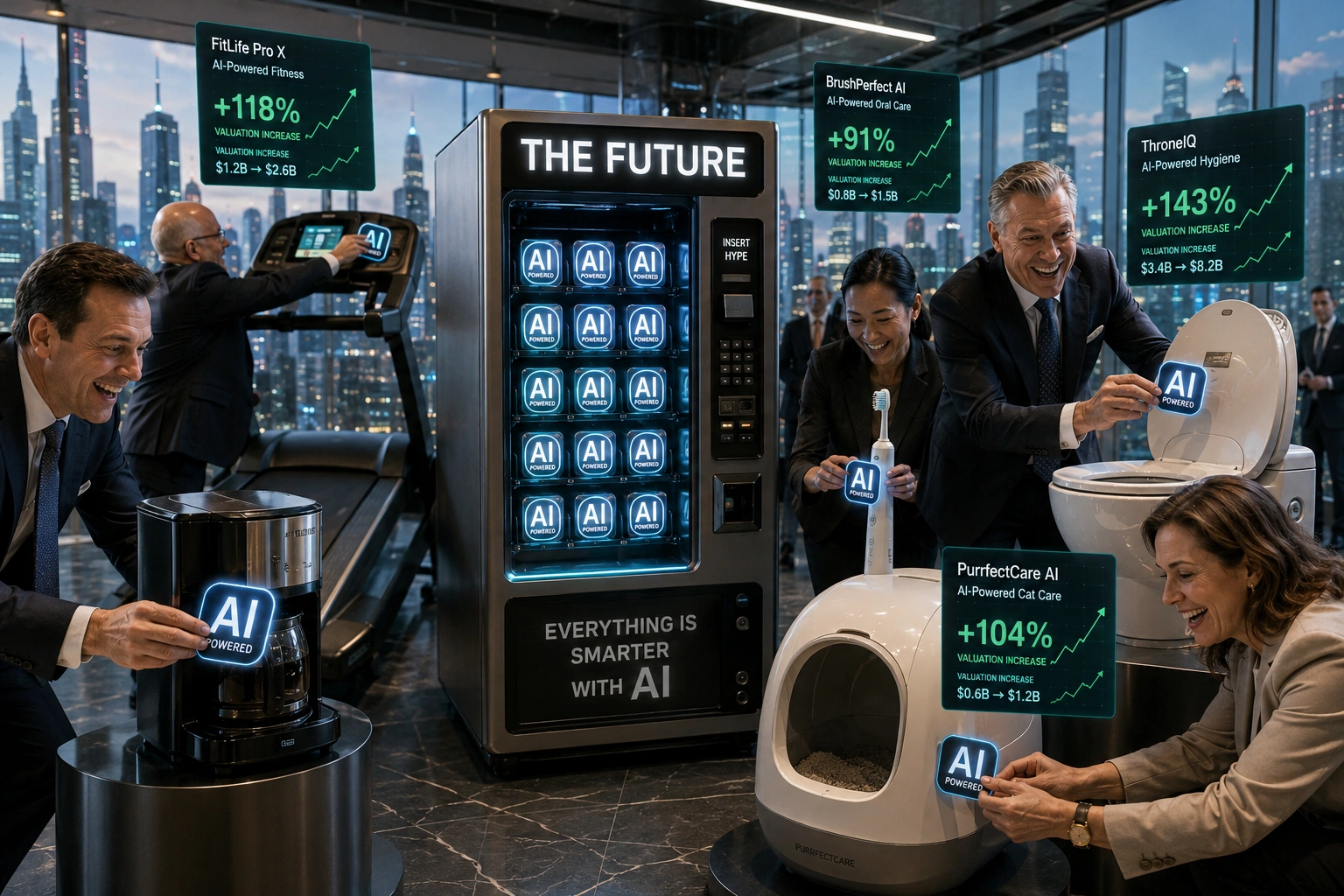
Image generated using ChatGPT.
But the internet gave us Pets.com, Webvan, eToys and a sock puppet that somehow got a Super Bowl ad. The grift always runs alongside the revolution because the grift never waits for proof of concept.
That’s what happens when a technology becomes a magic word. Investors hear it. Consumers hear it. Executives hear it. Suddenly, products that never needed artificial intelligence are redesigned around the appearance of artificial intelligence. The goal is no longer solving a problem. The goal is to be associated with the future.
It leads to some truly weird products, for instance, the VOVO Neo AI toilet, currently available for $4,990. It analyzes your urine and displays the results on a wall monitor. Think about that the next time you have trouble choosing a show on Netflix. The VOVO Neo AI toilet features an avatar named Jindo the Dog, who alerts your family if the toilet goes unused for twelve hours. It won an innovation award at CES 2026.
The consumer product world is flush with such absurdity.
There is an AI anti-snore pillow that inflates six internal airbags to reposition your head while you sleep; an AI toothbrush that critiques your brushing technique in real time; an AI cat feeder with facial recognition; an AI-powered treadmill that won Worst in Show for cybersecurity at CES 2026; the Bosch 800 Series Personal AI Barista, an automated coffee machine that won the “Who Even Asked For This” award.
Then there is Lollipop Star, a $9 piece of candy with electronics in the stick that transmits music through vibrations in your jaw. Each flavor comes with its own song. You don’t choose the song. Mashable called it impossible not to admire for its commitment to the concept, which is a generous way of saying it exists.
None of these products needed AI. Some barely have it. What they have is the word.
I’m not Clifford Stoll, who wrote in 1995 that the internet would never replace newspapers or classrooms. He was wrong about the technology. But he wasn’t wrong that a lot of what got built in its name was stupid.
The people who backed Kamen at a $600 million valuation weren’t idiots. They were caught in the gravitational pull of a magic word, one that meant the future is here, and you’d better be in it.
That word used to be Ginger. Now it’s AI.
The future probably is here. The toilet doesn’t need to know that.