✰PREMIUM Writing what he knows: David Lindsay-Abaire’s new play pulls inspiration from his Brooklyn neighborhood
‘The Balusters’ is on Broadway until June 7
Derek McLane designed the set for “The Balusters,” modeled after the large Victorian homes characteristic of Prospect Park South, where Lindsay-Abaire lives. Photo: Jeremy Daniel
By Ella Spungen and Peter Stamelman
May 5, 2026
Copy Link
Email
Facebook
X
LinkedIn
WhatsApp
Telegram
Pinterest
Print
PROSPECT PARK SOUTH — Big, old Victorian houses on grassy lawns; a diverse, well-to-do community in a bigger city; a riotous neighborhood association in a heavily landmarked area: David Lindsay-Abaire may have named the neighborhood at the center of his newest play Vernon Point, but Brooklynites may recognize it as Prospect Park South, where the playwright has lived with his wife for 14 years.
David Lindsay-Abaire, Brooklyn resident and writer of “The Balusters.” Photo: Joan Marcus
“The Balusters” is now playing on Broadway at the Samuel J. Friedman Theatre with direction by Kenny Leon. For the play, Lindsay-Abaire took loose inspiration, though not direct representation, from his wife’s short stint in a Brooklyn neighborhood group.
“I was scared — I think my wife was more scared — that people were going to egg our home,” Lindsay-Abaire joked to the Brooklyn Eagle. “But no. Many neighbors have come to see the play, including the entire board who came on one night together. I was terrified, but they were downright giddy about it.”
Lindsay-Abaire’s Victorian home, characteristic of the neighborhood, closely resembles the play’s set, which Derek McLane designed. The house on stage belongs to Kyra (Anika Noni Rose), a newcomer trying to find her footing in her new neighborhood association.
“The Balusters” makes comedy out of hyperlocal politics, the way someone might grow “passionately upset” about something that seems to be ridiculously minor. “I just personally found it so hilarious,” said Lindsay-Abaire.
The idea for the play came from an online neighborhood debate “about drainage ditches and rainwater spill off. People had such strong opinions about what should and should not be in terms of discussing rainwater,” he said. “I thought, ‘Well, this is ridiculous.’ It can’t really be about drainage ditches. It’s about something deeper.”
As Helen Shaw wrote in herNew York Times review, which named the play a critic’s pick, “larger thoughts hide among the wisecracks.” These larger thoughts emerge from the tension in a neighborhood trying to balance preservation and progress.
“There’s something really metaphorical about people holding on to the past just because and also at the expense of change,” said Lindsay-Abaire. “Life is different, and faces have changed, and colors have changed, and ethnicities have changed, and so people holding on to a past that doesn’t include the present seems potentially dangerous.”
“It felt like we’re wrestling with a lot of these same things as a country — people harkening back to times that did not include other folks,” he continued. “Now that I’m hearing how the play resonates, it’s made me realize this play isn’t just about porch railings, it’s about something bigger.”
The introduction of Kyra to the neighborhood group challenges its delicately held order, while Kyra must find her footing in a group of strangers. This topsy-turvy situation is the kind of premise that has become a hallmark of most of Lindsay-Abaire’s productions, ranging wildly from the Pulitzer Prize-winning 2006 tragedy-drama “Rabbit Hole” to “Shrek the Musical.”
“It’s always about outsiders who find themselves in an upside-down world who have to somehow figure out the rules of the world and how they fit into it. People being displaced in their own lives,” Lindsay-Abaire said, echoing anearly review by Ben Brantley.
Despite the focus on Kyra, “The Balusters” is a play about a neighborhood, with a cast of 10 characters to match.
“The play is more than any of my other plays about community,” he said. “I felt I had to serve the community, which meant every character had to serve a purpose and have a moment in the play that made their presence inevitable.”
That sentiment didn’t mean Lindsay-Abaire treated them all kindly. He pulled no punches with his characters, writing offensive lines and making his characters of all backgrounds as messy as they might really be.
Drama in the neighborhood association, modeled after Prospect Park South. Photo: Jeremy Daniel
“There were lines that I wrote myself that I was actually uncomfortable with and almost didn’t put in the play because they made me a little itchy, but then I thought, ‘No, this is exactly what this character would say,’” he said.
He also broke from his usual writing process and asked some friends of his, who are writers of color, to read a draft of the play. “They said, ‘Yeah, no problem, except you are so mean to the white characters, and it feels like you’re pulling your punches with the characters of color. You can make them as prickly and problematic as everyone else. We’re giving you permission to make them complicated and dimensional,’” he said.
Though the neighborhood association may be at times ridiculous, it’s clear Lindsay-Abaire wrote “The Balusters” out of a love for the place he calls home.
“I grew up in the inner city in Boston. Kyra’s feelings of, ‘Oh, I’m living in the kind of place I always dreamed of living’ — that is true of me. I’m such a sucker for that kind of thing,” he said. “I want to walk a block and have a really great restaurant. I don’t actually want to live in the suburbs. I hate the suburbs.”
Some of Lindsay-Abaire’s favorite neighborhood haunts in question include pizza spot Wheated and neighborhood bar the Hinterlands. “It’s just really nice, is what Kyra says, and that’s what I feel,” he said.
SUNSET PARK — “As a resident of Marine Park, one of the great surprises I found biking around Industry City and visiting Japan Village was to discover Bush Terminal Park. I continue to be amazed at the serene hideaways that the city offers in some of the busiest places — and, still, with an iconic view.”
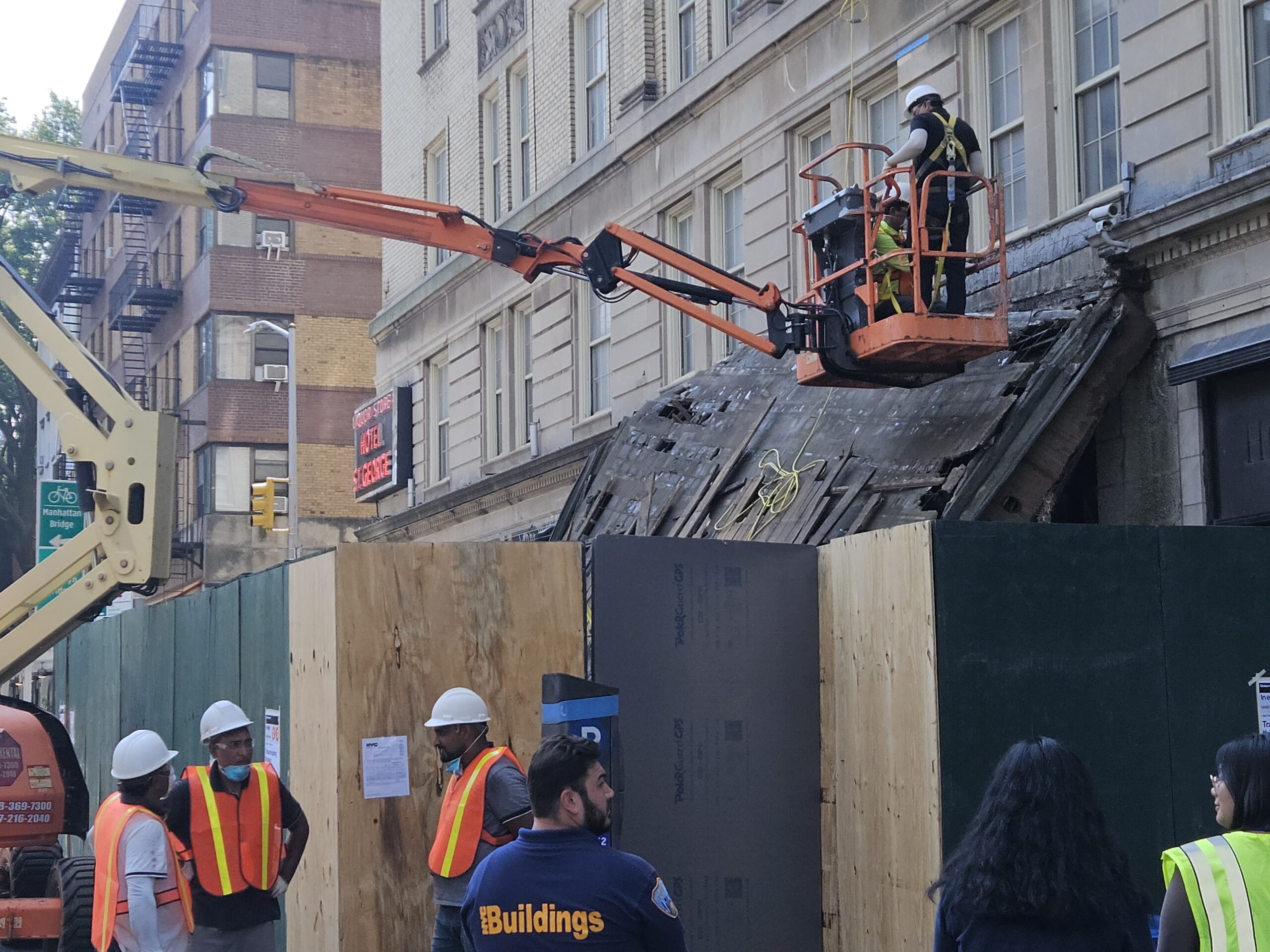
BROOKLYN HEIGHTS — ‘A miracle that no one was killed …’ That’s what neighbors are saying about the collapse of the Hotel St. George marquee. Shown in this photograph are workmen beginning the removal and repair of the historic, old neon sign at the corner, referencing a relic of Brooklyn Heights’ past: the St. George Hotel.
ATLANTIC AVENUE — Exhausted shopper with cluster of bags and goods from mall at Boerum Place stops to look at huge construction site across the street. “Is that REALLY going to be a jail??” Her male companion is reassuring, “Nothing like Rikers … this is 21st Century.”
BROOKLYN HEIGHTS — Overheard in line at one of most popular pastry outlets on Montague Street: “Hope I can get them into a camp …” A mother with two pre-schoolers in tow was showing a friend the Dodge Y flyer for Healthy Kids Day on Saturday, April 18.