



William Galarza awoke to chills that felt like 10 degrees in Union Square Park Tuesday morning, his corner of the public space still cordoned off by the foot of snow that descended Sunday — the most New York City has seen in five years.
“I didn’t know the snow was coming that day, so I got stuck here,” Galaraza, 40, said.
A blanket of snow swallowed his surroundings, and a single pair of footprints — Galarza’s own — marked the way to his camp. None of the city’s 400-plus homeless outreach specialists, he said, had come to visit so far during the cold spell.
“Nobody even shoveled anything over here,” he added, pointing to a small clear patch in front of his fort, assembled with cardboards and folded tables and covered overhead with tarps held down by cinder blocks.
“Look at all this snow, I was pushing all of this,” he said. “But someone took my shovel.”

The Department of Homeless Services could not immediately provide an update to that figure Thursday, but spokesperson Neha Sharma said outreach workers have made 620 referrals to its facilities from Jan. 19 through Wednesday afternoon — a number that counts an individual for each night they’re placed into a shelter. Most of those referrals, Sharma added, involved people who’d previously resisted offers to move into shelters.
Those numbers account for a fraction of the more than 4,500 New Yorkers who live on the street, according to the city’s latest point-in-time estimate, tallied last winter.
Many, like Galarza, have remained unsheltered throughout the frigid stretch, sleeping between interruptions on street corners, above heat vents, inside parks, subway stations, fast food restaurants and bank vestibules.
Some unsheltered New Yorkers who have remained outside told THE CITY this week that they do so by choice, preferring the freedoms of the streets to the curfews and restrictions of the shelter system. Others say they’ve simply fallen through the gaps.
The consequences of being unsheltered in the cold can be dire, however. Since Saturday, 10 New Yorkers have been found outside in the extreme weather and pronounced dead. Six of them, Mayor Zohran Mamdani said on Wednesday, were people known to the shelter system.
During “Enhanced Code Blue” events — a city designation for special protocols that take place during snowfalls and long stretches of below-freezing days — outreach workers pay special focus to the approximately 350 unsheltered individuals on their priority lists, with a goal of visiting them once every two hours from 8 p.m. to 8 a.m. These lists broadly cover individuals who live with medical, mental health or substance use conditions, who are older, or who appear to be chronically underdressed.
Some agencies step in to help cover the rest of the city’s unhoused population during the weather emergency. Homeless assistance requests to 311, the city’s service line, for one, are rerouted through 911 to police officers and emergency medical technicians to speed up response times. Parks Department officers, too, canvass more than 100 parks where unhoused people gather, beginning patrols at around 6 a.m. through midnight, said Parks Enforcement Patrol Inspector Cynthia Thompson.

Mamdani on Tuesday also announced additional emergency outreach protocols on the heels of the 10 deaths, including requests to shelter providers and faith-based organizations to have staff “canvass nearby blocks and engage anyone who needs assistance” every few hours. City Hall spokesperson Sam Raskin told THE CITY Thursday that several of DHS’s usual partner agencies are also involved in carrying out the new measure, including the Parks Department, the Department of Health and Mental Hygiene, the Emergency Management Department and the city’s public hospital system.
Since then, no deaths of people found outside in the extreme cold have been reported, a police spokesperson said Thursday evening, even as temperatures have remained frigid.
While Galarza said Tuesday that he had not been contacted by any of the city’s contracted outreach specialists during the cold spell, he noted that Parks Department officers had twice connected him with a room within the city’s shelter system over the summer.
“But they took me out of the place,” he said, referring to shelter staff.
Galarza, who makes some income guarding chess players’ tables and pieces in Union Square, said he suspected it was because he had violated curfews while working.
“I don’t know what’s the problem,” he said. “Why I’m outside on the streets, why the police be harassing me everywhere I go.”
He said he hasn’t thought much about returning to the shelter system since, mostly because of his new companion: Casi, a tabby cat who had found her way to Galarza from the Union Square Holiday Market. (Pets are generally not allowed in shelters, with some exceptions.)
Galarza said he wished outreach specialists would help find an accommodation for him and Casi.
“I just want to have a home. That’s why I come here to work,” said Galarza, stationed not far away from the park’s chess players. “But I got no home.”
Several feet underneath the park, a man who asked to be identified as John Lancaster sat along a staircase ledge inside the Union Square subway station. Lancaster, 32, said he had just returned to the city from working a 13-hour shift at a warehouse in New Jersey.
He became homeless shortly after his mother died two years ago, he said, and has been working a seasonal job at the warehouse since October. He had been staying with friends at the time, though that changed two months later.

“People — when they know you need them, they become predators, so I had to leave,” said Lancaster.
One of DHS’s drop-in centers had connected him to a Brooklyn hotel shelter then, he said, where he was granted an exception to the curfew because of his night shifts at the warehouse. But by the time he returned from work in the daytime, shelter staff had already given his bed away to someone else.
He tried walking into shelters on a freezing day two weeks ago too, with hopes of making use of the open-door policy during Code Blue events, which circumvent normal intake procedures while they’re in effect from 4 p.m. to 8 a.m. the next morning.
“But they tell me it’s only at night,” he said. “And I work at night.”
Sharma, however, said the open-door policy extends to the daytime during “Enhanced Code Blue” events, when freezing conditions stretch for days at a time, as has been the case since Jan. 23.
Other times, Lancaster said, he’s sent on a runaround from one shelter to another.
“They say the same thing. They’ll say, ‘We don’t have room,” and then they’ll say, ‘Go talk to that shelter too.’ And then you talk to that shelter and they tell you to talk to that other shelter,” Lancaster recalled. “There’s nothing you could really do.”
In the meantime, he’s been sleeping on bus rides provided by his company to and from his job — two hours on the way there, and two hours on the way back. The rest of the time, he said, he tends to stay underground, bouncing from one subway station to another to keep warm.
“Right now, it’s survive or die,” Lancaster said. “And I’m just not the type to sit and die.”
Jojo was rolling up a cigarette in a corner of the main hall of Grand Central station as noon approached on Tuesday. The 54-year-old, who asked only to be identified by his nickname, said he’d spent the night earlier sleeping in a vestibule.
He doesn’t carry around blankets, and said he tends to sleep in just his clothes — a black puffer and several sweaters underneath — at night.

“I basically wander around ‘til I’m tired, and I fall asleep,” he said. “And then I do this,” he continued, gesturing to how he’d tuck his hands into his puffer sleeves at night.
Jojo said he prefers to sleep on the streets because of the surveillance at shelters.
“I was in prison for 10 years, and the shelter system gets very complicated with the police — and it should, because it’s got so many people and they want to get into each other’s things,” he said. “But I can’t be around any police.”
Some of his personal belongings, he added, are also prohibited in shelters.
He pulled out a small round case from his puffer pocket, unfolding a nail clipper that he keeps in it along with pendants collected from the ground. One resembles a heart, another a ribbon, a third a skull with wings, and the last the Ankh — the ancient Egyptian symbol of life, sometimes used as a protective amulet in everyday life.
Jojo pointed to the nail file attached to the clipper. “This is considered a knife, and they break it off,” he said. “But I use it to clean my nails.”
His clipper is an especially essential part of his personal hygiene routine, he continued, recalling a time when he’d avoided a job interview because of his nails.
“I cleaned up to go to a business interview that was put together, but my nails weren’t good enough for me to go see these people,” he said. “And I didn’t go anywhere because my nails were a mess.”
These days, Jojo mostly spends his days in Midtown Manhattan — charging his phone on a LinkNYC tower while playing his favorite video game on his phone: “Puzzles and Survival.”
He likes to stop at a church near Grand Central to sip on a hot cup of coffee, too, he said.
“It’s usually open, warm, but [Monday] it was closed. And the other places were closed, so I figured they were snowed in,” he added.
Jojo said he’d spent the rest of the Sunday at Grand Central and the Bryant Park subway station. But for the past six months, he said, he’s been thinking about leaving New York to get out of the cold for good.
“I want to get to Nevada, get some ID, apply for services, and be in the shelter again,” Jojo said. “In Nevada, I can begin all again.”
Outside the Columbus Circle subway station, Alex, 42, organized his shopping cart as he prepared to duck underground.
The former theater teacher said he became unhoused about three years ago, after his job was eliminated amid the post-pandemic theater slump.
“COVID happened, and the loss of theater came, and it seemed like it hasn’t really picked up the same way,” Alex, who asked to be identified only by his first name. “I guess I’ve just been discouraged.”
He makes money these days by collecting recyclables and selling abandoned furniture and electronics online. And once in a while, he said, his friends would invite him to spend the night in their apartments — as they’ve done twice during this cold snap, including during Sunday’s snowstorm. Alex, in exchange, would do chores around the house to help out.

“When I don’t want to impose on them, I go to the subway stations,” he added. “Because when I’m on the train overnight I feel like I’m imposing on the other passengers and whatnot.”
Many of his unsheltered peers, he added, would gather in the cavernous 181th and 168th Street 1 train stations because they’re deep underground and provide better insulation from the cold.
“Unfortunately the police have been bothering us which is really odd because it’s Code Blue,” Alex said, noting how officers have been evicting them from those stations “hard core.” Still, he continued, he turns to those stations for warmth: “I’ll spend the day there, choosing to be warm over being frozen.”
Outreach specialists, he noted, reach out to him “all the time,” with offers to get him placed into one of DHS’s facilities. He’s once taken up their offer to shelter in a single-room occupancy building, but quickly decided it was not for him.
“Upon arrival, I was told, ‘Oh, your room doesn’t have a lock, but don’t worry, it’s cool,’ and it’s just like an instinct. Something just doesn’t seem right. It’s just a big red flag right away,” said Alex, who finds the curfews and visitation rules at shelters restrictive. “There just isn’t a good place to go to, where you actually have your own space. So sleeping on the street is like the devil you know.”
The mid-afternoon sun was now tucked behind the clouds. The numbing wind whipped through Columbus Circle as Alex contemplated his plans for the evening.
“Honestly, right now, I’m just about to go to the bathroom, just to wash up. Stay there for an hour or so, go to the next spot. It really is like moment to moment,” he said, his voice trembling from cold as he spoke. “When you’re homeless you just kind of want to get through the day. You try to make enough money so you can have some food.”
He pushed his shopping cart towards the subway station elevator.
“Being homeless, I’m not sitting around at home watching the Weather Channel,” Alex continued before stepping into the elevator. “The cold sneaks up on you. First it’s uncomfortable, then painful, before you’re like ‘This is dangerous.’ Frostbite is no joke.”
Then in swift seconds the door closed, and the elevator carried Alex underground.










SUNSET PARK — “As a resident of Marine Park, one of the great surprises I found biking around Industry City and visiting Japan Village was to discover Bush Terminal Park. I continue to be amazed at the serene hideaways that the city offers in some of the busiest places — and, still, with an iconic view.”

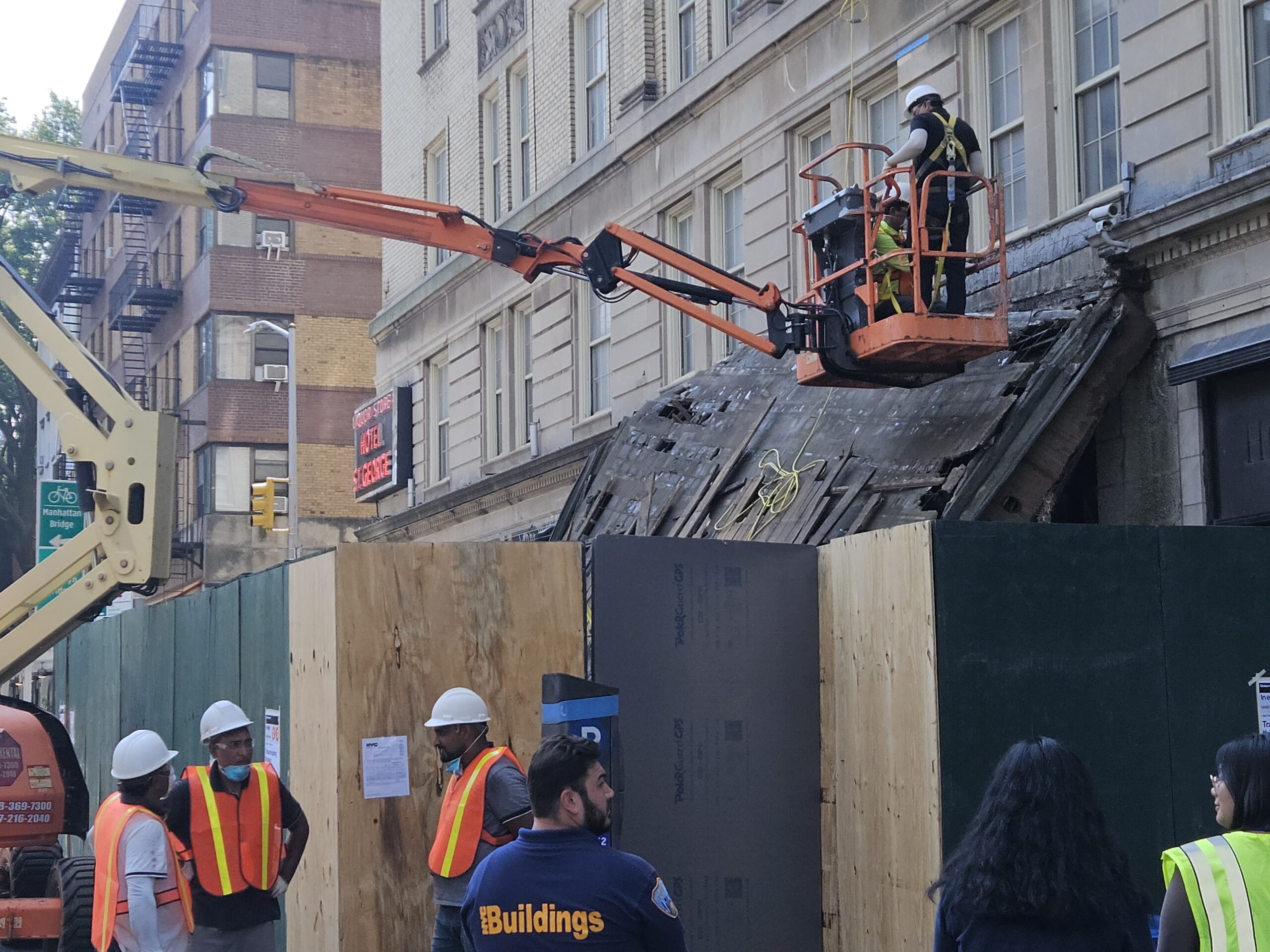
BROOKLYN HEIGHTS — ‘A miracle that no one was killed …’ That’s what neighbors are saying about the collapse of the Hotel St. George marquee. Shown in this photograph are workmen beginning the removal and repair of the historic, old neon sign at the corner, referencing a relic of Brooklyn Heights’ past: the St. George Hotel.
ATLANTIC AVENUE — Exhausted shopper with cluster of bags and goods from mall at Boerum Place stops to look at huge construction site across the street. “Is that REALLY going to be a jail??” Her male companion is reassuring, “Nothing like Rikers … this is 21st Century.”
BROOKLYN HEIGHTS — Overheard in line at one of most popular pastry outlets on Montague Street: “Hope I can get them into a camp …” A mother with two pre-schoolers in tow was showing a friend the Dodge Y flyer for Healthy Kids Day on Saturday, April 18.