Climbing bus stop mountain: Snowfall makes a mess of wheeled commutes
The transportation and sanitation agencies and adjacent property owners all play a role in clearing the way for bus riders.
Arnaldo Duarte helps another commuter over a snowbank trying to board a bus on Fordham Road in The Bronx, Jan. 26, 2026. Photo: Jose Martinez/THE CITY
By Jose Martinez, THE CITY
January 28, 2026
Copy Link
Email
Facebook
X
LinkedIn
WhatsApp
Telegram
Pinterest
Print
In the aftermath of a winter storm that belted New York City with more than 10 inches of snow, officials said hundreds of bus shelters and stops were still snowed in, forcing commuters to scale slushy mounds Monday before going on their way.
The piles created by the city’s biggest snowfall in five years were, in some cases, stacked even higher by plows clearing the streets of accumulation and also creating icy obstacle courses for riders.
“It was a bad decision for me, OK?” Virgilio Gabarra, 78, said at a snowed-in bus shelter at Columbus Avenue and West 80th Street in Manhattan. “I thought it would be more convenient to take the bus and get dropped right in front of the church where I’m going — then I got to the stop and saw all this snow and oh, it’s too late now.”
City officials estimated that, by Monday morning, just over half of the 3,400 bus shelters citywide where riders can partially escape the elements before boarding a bus had been cleared. That’s with sub-freezing or single-digit temperatures in the forecast for the rest of this week, upping the potential for a stretch of icy and treacherous commutes.
There are approximately 10,000 New York City Transit bus stops across the city, according to the MTA, which kept more than 2,300 buses running throughout the storm, along with 4,400 subway and Staten Island Railway trains. The 3,400 bus shelters have benches where riders can sit while waiting for a ride.
Snow mounds blocked a bus stop on the Upper West Side, Jan. 26, 2026. Photo: Jose Martinez/THE CITY
“It is the Department of Transportation’s responsibility to clear bus stops and we have activated extra resources and DOT staff to be working on that,” Julia Kerson, deputy mayor for operations, said Monday. “This was sort of an extraordinary amount of snow.”
At those shelters that had not been cleared after a storm whose total city accumulation ranged from 8 to 15 inches, according to the National Weather Service, commuters helped each other scale the slopes or navigate around them into the street.
Geraldine McMillian struggled over mounds of snow at the East Fordham Road and Valentine Avenue bus shelter with the help of two fellow commuters at the stop.
“My balance isn’t great,” the 72-year-old woman told THE CITY while waiting in the street for an eastbound Bx12. “This lady helped me, this gentleman helped me and there was another woman who helped me previously where I could not get through.”
McMillian was joined on Fordham Road by several other commuters.
“We’ll be all right as long as they don’t run us over,” she cracked.
The clearing of the areas around bus shelters and bus stops requires help from various parties, including city agencies, contractors and property owners.
Sidewalks and bus stops without shelters are the responsibility of neighboring property owners, according to the DOT, while contractor JCDecaux is charged with removing snow within its 3,400 bus shelters and three feet around them. A DOT spokesperson said the contractor’s crews had been out since 1 p.m. Sunday — a few hours into the winter storm — clearing sheltered stops.
The Department of Sanitation had more than 500 emergency snow shovelers at work Monday to clear three-foot paths between the sidewalk and the street so that people can board buses, a spokesperson said. The department hires the workers for $19.14 an hour — a rate that goes up to $28.71 after the first 40 hours worked in a week — to help clear snow and ice from bus stops, crosswalks, fire hydrants and other public areas.
A top official with the largest union for transit workers told THE CITY that conditions during and after snowstorms add up to create a “very challenging” environment for bus operators.
“The piles of snow at the bus stops limit the space people have,” said Gary Rosario, a vice president with Transport Workers Union Local 100. “If you have a small group at a bus stop, they all have to squeeze into a little spot.”
Donald Yates, another TWU vice president, said that during snowstorms, buses move at slower speeds, with operators instructed to pull up parallel to bus stops to avoid the potential of a bus sliding.
Mounds of snow blocked bus stops along Fordham Road in The Bronx, Jan. 26, 2026. Photo: Jose Martinez/THE CITY
“Sometimes the customers get angry as to why the bus driver didn’t pull into the bus stop,” said Yates, who represents Manhattan and Bronx bus operators. “But we’re not supposed to so the bus doesn’t get stuck and it’s more of a safety thing.”
While waiting on East Fordham Road, Arnaldo Duarte, 59, acknowledged the challenge of quickly clearing thousands of bus stops after such a significant snowfall.
“They’re doing the best they can,” he said. “But they really should be doing a better job.”
A few minutes later, a Bx12 pulled up and Duarte stepped over the snow bank to help a lady wearing a backpack and then a man walking with the help of a cane.
SUNSET PARK — “As a resident of Marine Park, one of the great surprises I found biking around Industry City and visiting Japan Village was to discover Bush Terminal Park. I continue to be amazed at the serene hideaways that the city offers in some of the busiest places — and, still, with an iconic view.”
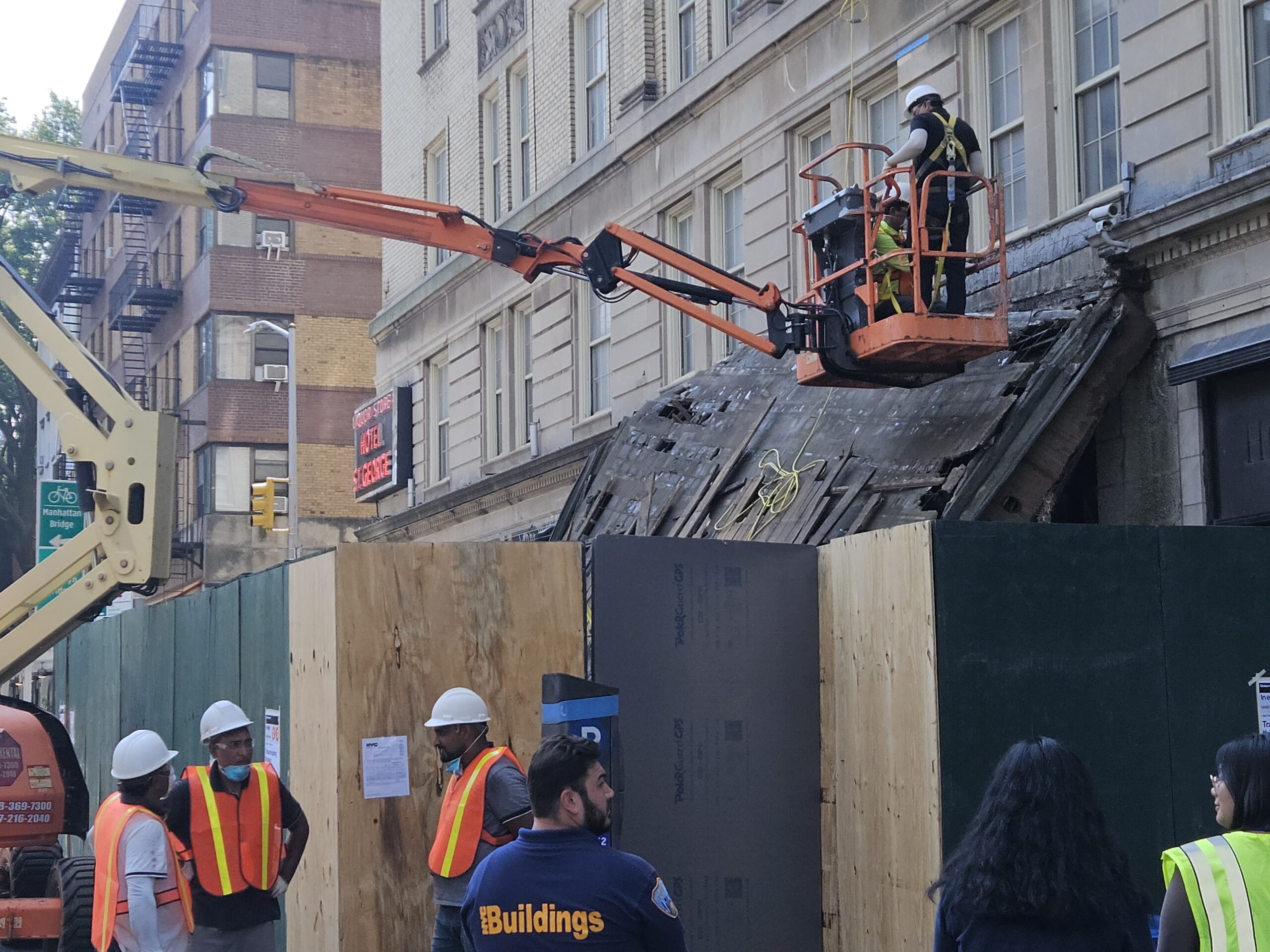
BROOKLYN HEIGHTS — ‘A miracle that no one was killed …’ That’s what neighbors are saying about the collapse of the Hotel St. George marquee. Shown in this photograph are workmen beginning the removal and repair of the historic, old neon sign at the corner, referencing a relic of Brooklyn Heights’ past: the St. George Hotel.
ATLANTIC AVENUE — Exhausted shopper with cluster of bags and goods from mall at Boerum Place stops to look at huge construction site across the street. “Is that REALLY going to be a jail??” Her male companion is reassuring, “Nothing like Rikers … this is 21st Century.”
BROOKLYN HEIGHTS — Overheard in line at one of most popular pastry outlets on Montague Street: “Hope I can get them into a camp …” A mother with two pre-schoolers in tow was showing a friend the Dodge Y flyer for Healthy Kids Day on Saturday, April 18.