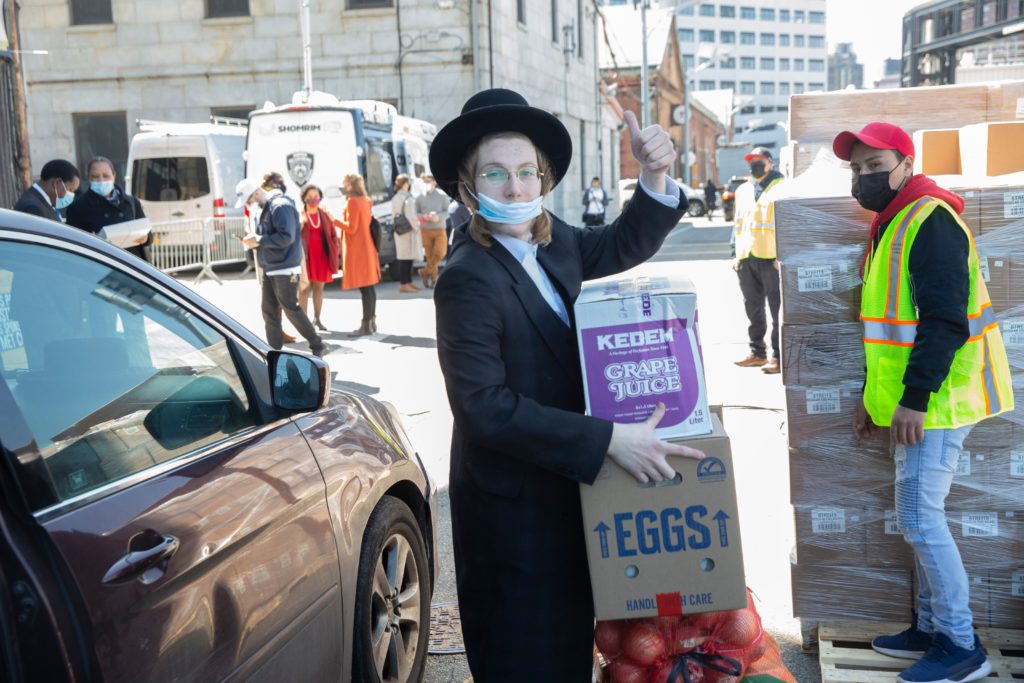
Brooklyn has the highest proportion of Jewish poverty in the New York metro area, with more than a quarter of borough Jews “poor or near poor.” And among the groups with a higher proportion of poverty are elderly immigrants from the former Soviet Union, elderly Holocaust survivors (more than half of the metro area’s estimated 38,000 live in Brooklyn), Hasidic and ultra-Orthodox Jews, and the disabled.
A “COVID-19 Impact Study” just released by the UJA-Federation of New York surveyed adults throughout the metropolitan area between February and May of 2021.
Looking at Brooklyn specifically, the study found that 13 percent of Jewish adults are “food-insecure,” and 8 percent in Brooklyn are behind in their rent.
All in all, the study says, “Brooklyn represents the highest levels of Jewish poverty, with 37% of households poor or near poor.”
And in general, one in five adults in Jewish households have reported symptoms of anxiety and depression since the start of the pandemic. The groups more likely to experience mental health problems included the young, Jews of color, women, LGBTQ adults, the unemployed, “those who have undergone a recent change in their job situation, and those with a small social network,” the study said.
Jews in the United States have the image of being an economically successful group — the Pew Research Center reported earlier this year that roughly half say their annual income level is at least $100,000. Lower-income Jews are often ignored by movies, TV and so on.
However, Masbia, a Brooklyn-based network of kosher soup kitchens that also prepares emergency food packages, reports that it serves more than 2 million meals per year. (Of course, not all of its clients are Jewish.)
The surviving Holocaust survivors in the New York area are now in their late 80s, 90s or beyond. Selfhelp, a social service agency that helps them (among others), says that according to its projections, in 2025, 52 percent will be “poor” according to federal guidelines. In addition, fully 35 percent will be coping with serious chronic illnesses.
As for ultra-Orthodox and Hasidic Jews, according to a 2018 op-ed in the Israeli newspaper Haaretz on “Haredi (ultra-Orthodox) Poverty,” “There are only 240,000 ultra-Orthodox Jews in the greater New York area, but they are impoverished (43% are defined as poor and 16% as near poor). They get by via a mix of mostly badly paid work and increasingly on government assistance.”
In some ultra-Orthodox and Hasidic yeshivas, Haaretz author David Rosenberg wrote, the youngest boys “get about six hours a week of instruction in basic English and math. The classes are an afterthought following a grueling day of religious studies and often taught by unqualified teachers.”
Commenting on the new UJA-Federation report, Eric Goldstein, the social service umbrella group’s author, said, “This study sheds important light on the myriad ways Covid-19 has negatively impacted the lives of Jewish New Yorkers. It is also the first representative survey in the nation offering statistics about social isolation, mental health, domestic violence, and substance abuse in the Jewish community.
“There is no vaccine for poverty or hunger, and the effects of the pandemic will be felt in our community for years to come.”




























3 Responses
An op-ed piece in an Israeli newspaper doesn’t indicate a source for its information. I think the number for how many chareidim are in the metropolitan area is small considering the enrollment in Yeshivas. 8% behind in rent also sounds small to me. The school description is describing boys schools not girls schools Girls get more secular studies and rate at the top city-wide on Regents scores. Their teachers too have a tendency to be unqualified. Their schools cannot afford teachers with Department of Education credentials.
As for the boys schools, I’ve never seen a comparison on basic skills between this population and public schools.
The one COVID-19 related issue not mentioned in this article is the COVID death-rate in this population. That trauma will have a long-term impact.
Could part of the reason for this poverty be that many families have 5 or more children and that their father’s choose to continue their religious studies while their wives have to work?
The father not working is not the norm in the American Chasidic community, although it is more common in non-chasidic chareidi communities. Even there eventually most men make it to the Labor market. There definitely is a high correlation between large families and poverty and 5 children is not a large family by Chasidic standards.