Brooklyn judge uses rock lyrics to teach legal ethics at Bay Ridge Lawyers meeting
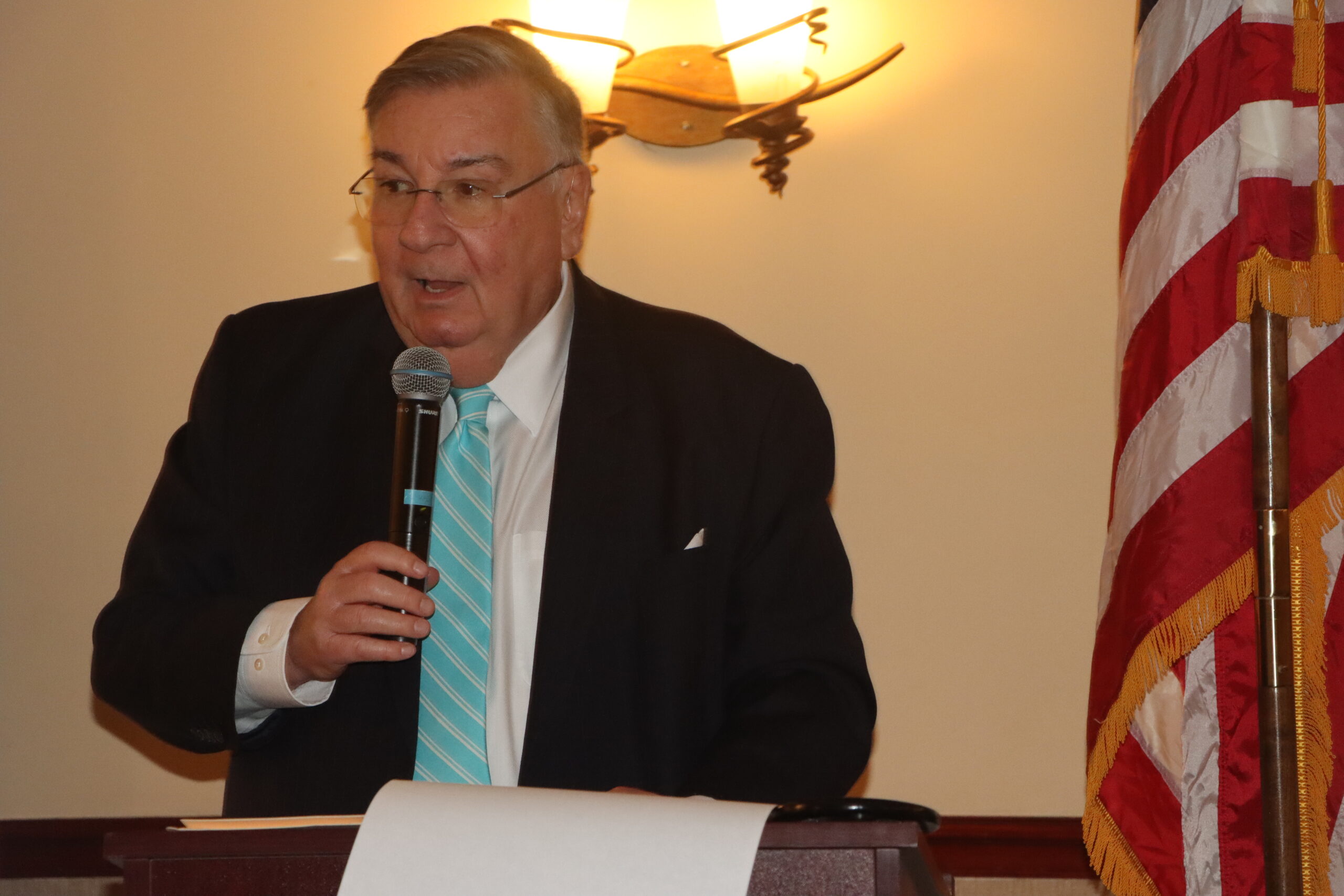
Judge Matthew D’Emic, a lifelong Bay Ridge resident and Administrative Judge for Criminal Matters in Kings County Supreme Court, delivers his annual ethics lecture to the Bay Ridge Lawyers Association, which blends legal insight with poetry and classic rock lyrics in a uniquely personal style. Brooklyn Eagle photo by Mario Belluomo
When Justice Matthew D’Emic walks into a room in Bay Ridge, it’s not just his judicial robes people think of, it’s also the guitar slung over his shoulder.
A lifelong Bay Ridge resident and fixture in the Brooklyn legal community, Judge D’Emic has served on the bench since 1996 and currently leads the Kings County Supreme Court as Administrative Judge for Criminal Matters. He also presides over the Brooklyn Mental Health Court and plays a key role in statewide efforts addressing mental illness in the justice system.
However, for many local attorneys, it’s the annual Bay Ridge Lawyers Association meeting each spring where Judge D’Emic’s impact is most personal. That’s where he delivers a continuing legal education lecture like no other, one that blends ethics, poetry and classic rock lyrics in a way that resonates deeply with the crowd.
Bay Ridge Lawyers Association President Mario Romano (left) and Vice President Yolanda Guadagnoli (right) present Judge Matthew D’Emic (center) with a certificate of appreciation following his featured lecture at the association’s monthly meeting, held at Mama Rao’s in Dyker Heights on April 30, 2025. Brooklyn Eagle photo by Mario Belluomo
This year’s lecture, titled “The Ultimate Professional Legal Ethic – Faithfulness to Daily Duty,” featured lines from Glen Campbell’s “Wichita Lineman,” Billy Joel’s “The Downeaster ‘Alexa’” and Robert Hayden’s poem “Those Winter Sundays.” Each selection was meant to express themes of consistency, diligence and integrity.
“I am a lineman for the county, and I drive the main road,” the judge read aloud, opening a discussion on consistency in legal practice. Later, he cited Joel, “I got bills to pay and children who need clothes,” to illustrate quiet perseverance and the burdens lawyers carry outside the courtroom.
Hon. Alexis Riley (left) and Christina Fratangelo at Mama Rao’s for the monthly meeting. Brooklyn Eagle photo by Mario Belluomo
The talk wasn’t just about inspiration; it was grounded in Judge D’Emic’s ongoing work on two of the most urgent issues facing the criminal justice system: mental illness and the future of Rikers Island.
As co-chair of the New York State Judicial Task Force on Mental Illness, Judge D’Emic has taken an active role in shaping how courts respond to individuals with severe psychiatric needs.
The Task Force’s first annual report, issued in February 2025, outlines a series of internal reforms aimed at improving how state courts handle competency evaluations, civil commitments, guardianship proceedings and diversion programs.
Christopher Caputo and Dominic Famulari. Brooklyn Eagle photo by Mario Belluomo
Among its key recommendations are the creation of regional mental health courts to serve low-volume counties, the establishment of a pilot program for assisted outpatient treatment with judicial oversight and the development of a centralized dashboard to monitor the status and progress of individuals deemed unfit to proceed. The report also calls for new court-based screening tools, expanded use of the 988 crisis hotline and training initiatives for judges, clerks, court officers and interpreters.
From left: Darran Winslow, Paul Nuccio and Hon. Christopher Robles at the Bay Ridge Lawyers Association meeting in Dyker Heights. Brooklyn Eagle photo by Mario Belluomo
In a separate section of the lecture, Judge D’Emic returned to the topic of his 2024 CLE presentation: the effort to close the Rikers Island jail complex. As a member of the Independent Rikers Commission, he is part of a citywide initiative working to replace Rikers with a borough-based network of modern jails and secure psychiatric treatment facilities.
The Commission’s March 2025 report, “The Blueprint to Close Rikers,” cites the dangerous conditions, long delays in court processing and high rates of mental illness among those incarcerated as key reasons to shut the complex down. According to the report, more than half of the people held at Rikers suffer from a mental illness, with over 1,400 classified as having a serious mental illness.
Mary Ann Stathopoulos, James Villani and Thomas Tafuri gathered during the evening’s event at Mama Rao’s. Brooklyn Eagle photo by Mario Belluomo
Judge D’Emic used the lecture to walk attendees through the Commission’s latest proposals, which included expanded use of treatment courts, increased pretrial supervision options and the addition of 500 secure psychiatric beds in hospital settings. The goal, he explained, is not only to reduce the jail population but to ensure that people with serious mental health needs are treated appropriately and not warehoused in facilities ill-equipped to care for them.
From left to right: Hon. John Ingram, Hon. Pat Hayes Torres and Hon. Carmen Pacheco. Brooklyn Eagle photo by Mario Belluomo
He also cautioned that, despite a 2027 deadline mandated by city law, Rikers is unlikely to close on time.
The Independent Rikers Commission’s March 2025 report acknowledged that the city had failed to sufficiently advance the borough-based jails envisioned to replace Rikers, making the 2027 closure deadline unfeasible.
Lisa Becker, Maria Neri and Gianna Famulari in attendance at the Bay Ridge Lawyers Association’s April meeting. Brooklyn Eagle photo by Mario Belluomo
The report says that Brooklyn’s replacement jail, located in Boerum Hill on Atlantic Avenue, is the furthest along of the four planned facilities but is still not expected to be completed until 2029, making it impossible for the city to meet the legally mandated 2027 closure date for Rikers.
The report stressed that while the law mandating Rikers’ closure by Aug. 31, 2027, should remain in place, the city must expedite the construction of the new facilities and implement reforms to reduce the jail population, particularly among individuals with serious mental illness.
New members of the Bay Ridge Lawyers Association receive certificates from past president William Gillen. Pictured from left to right: Will Gillen, Maria Hatzipetros, Maria Patelis, President Mario Romano, Darran Winslow, Dylan Swincicki, Kathleen Higgins and Brandon Amato. Brooklyn Eagle photo by Mario Belluomo
Judge D’Emic explained the urgency of these reforms and said that without accelerated efforts, the city risks prolonging the operation of a facility widely criticized for its dangerous and inhumane conditions. He went on to say that the closure of Rikers is not just a legal mandate but a moral imperative to ensure the safety and dignity of all New Yorkers involved in the criminal justice system. These reforms, he added, are not theoretical. They are about building a system that reflects fairness, decency and responsibility, day in and day out.
Hon. Bernard Graham and Michael Benjamin. Brooklyn Eagle photo by Mario Belluomo
What draws the biggest crowds to his lectures isn’t just policy. It’s the personality behind them.
Justice D’Emic’s approach is intimate, often humorous and unmistakably rooted in his identity as a Bay Ridge native. He’s not a distant figure on the bench; he’s a neighbor, a former Guild for Exceptional Children board member and an adjunct professor who teaches with the same mix of candor and compassion.
And after court adjourns, he’s a guitarist in a local band, Whippoorwill, which plays classic rock covers in neighborhood bars and venues. It’s not unusual for members of the legal community to gather for a set — lawyers, clerks, court officers and even former adversaries, shoulder to shoulder with a drink in hand, nodding along to the music.
Clockwise from top left: Hon. Joseph Maltese, Hon. Matthew D’Emic, Hon. Mark Partnow and Hon. Brian Gottlieb joined fellow judges at the event. Brooklyn Eagle photo by Mario Belluomo
The lecture ended not with a summary but with a warning — a reminder that the pressures of practice can chip away at purpose. But his message was clear: lawyers must show up each day, do the work and do it right. That, he said, is the quiet ethic that holds the whole system together.
Robert Abruzzese reported and edited for the Brooklyn Daily Eagle from 2013 to 2024. He now contributes legal community coverage while serving as Principal Court Attorney to Hon. Wayne Saitta in the Kings County Supreme Court, Civil Term. The views expressed do not reflect those of the court or the judiciary.
SUNSET PARK — “As a resident of Marine Park, one of the great surprises I found biking around Industry City and visiting Japan Village was to discover Bush Terminal Park. I continue to be amazed at the serene hideaways that the city offers in some of the busiest places — and, still, with an iconic view.”
BROOKLYN HEIGHTS — ‘A miracle that no one was killed …’ That’s what neighbors are saying about the collapse of the Hotel St. George marquee. Shown in this photograph are workmen beginning the removal and repair of the historic, old neon sign at the corner, referencing a relic of Brooklyn Heights’ past: the St. George Hotel.
ATLANTIC AVENUE — Exhausted shopper with cluster of bags and goods from mall at Boerum Place stops to look at huge construction site across the street. “Is that REALLY going to be a jail??” Her male companion is reassuring, “Nothing like Rikers … this is 21st Century.”
BROOKLYN HEIGHTS — Overheard in line at one of most popular pastry outlets on Montague Street: “Hope I can get them into a camp …” A mother with two pre-schoolers in tow was showing a friend the Dodge Y flyer for Healthy Kids Day on Saturday, April 18.