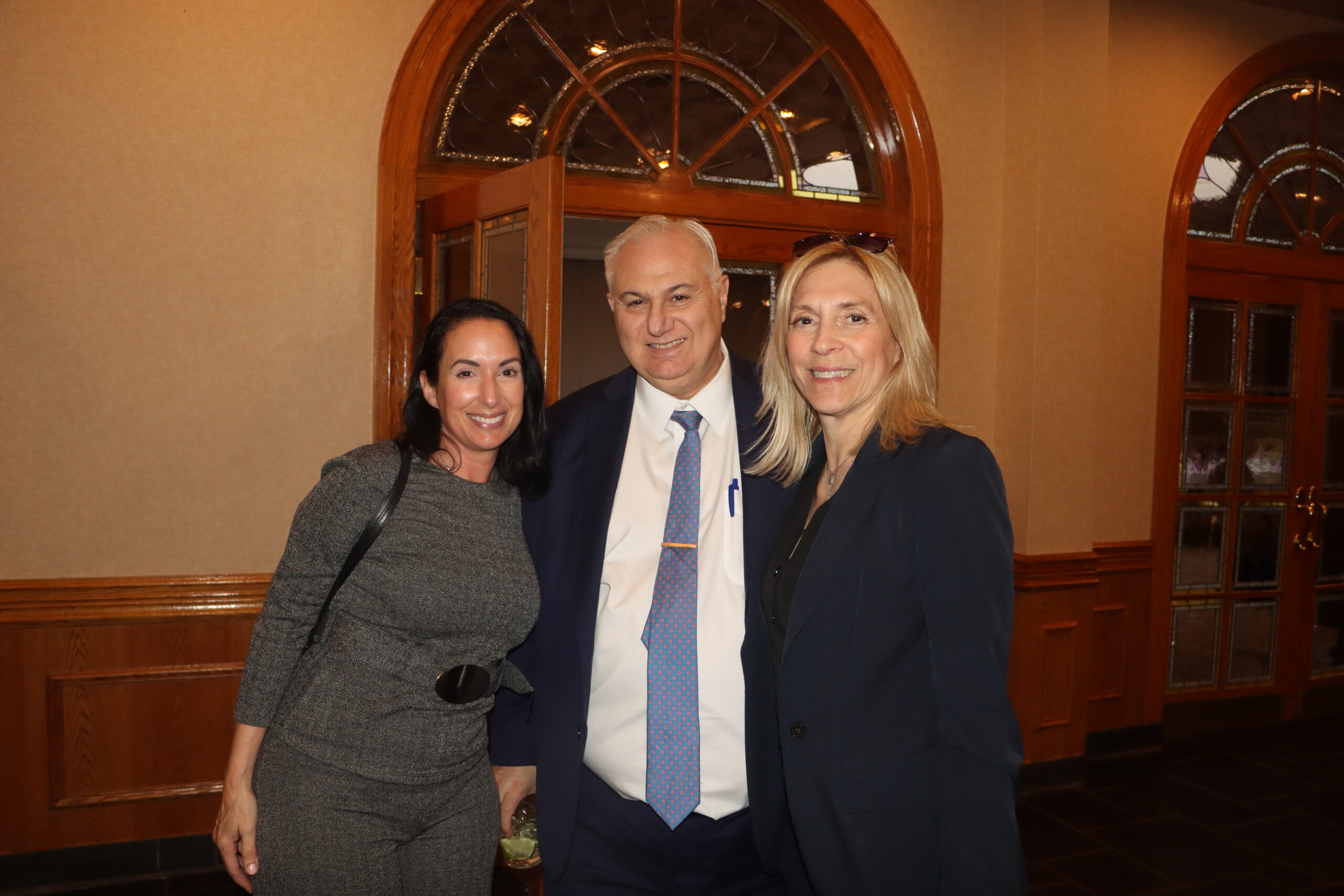
CONEY ISLAND — “Valuing your Law Practice: Why optimizing the value of your firm is important now” was the topic of the most recent Columbian Lawyers Association of Brooklyn CLE that took place the evening of April 8 at Gargiulo’s restaurant, 2911 West 15th St.
MSG Accountants, Consultants and Business Valuators founder Mark Gottlieb, CPA, and Forensic and Litigation Support Services Director Reuben Gottlieb, Esq., presented the evening’s CLE.
The session was designed to provide attendees with a framework to be a more informed participant, whether they are advising a client who owns a firm, planning their own succession or reviewing a valuation report in a transaction context.
“We focused specifically on New York City dynamics throughout because the market, the economics and the regulatory environment here have real and important differences from the rest of the country,” the Gottliebs explained.
Ten substantive areas were covered in the presentation, beginning with the knowledge gap, which the Gottliebs described as the disconnect between what an attorney believes their firm is worth and what the market will actually pay.
“Most attorneys overestimate their firm’s value, and for understandable reasons,” Mark said. “They have spent decades building something, but a buyer does not pay for effort invested. A buyer pays for future transferable cash flows, discounted for risk. Those are very different things.”
From left: John Dalli, Esq., Bay Ridge Lawyers PresidentYolanda Guadagnoli, Esq., Dean Delianites, Esq., and Columbian Lawyers Association of Brooklyn President Mario Romano, Esq. Photo: Mario Belluomo/Brooklyn Eagle
The Gottliebs also spoke to why law firm valuation is different from general business valuation, pointing out that in most businesses, value resides in tangible assets such as patents, equipment or brand names. In a law firm, value resides in people.
“The primary assets are human relationships and reputation,” said Mark. “If the founding attorney leaves, the question becomes what, exactly, did the buyer acquire.”
The NYC-specific dynamics that affect value and deal structure were also addressed. Specifically, the high cost of Manhattan commercial real estate and the liabilities those leases create, the intense competitive market, the material differences between a midtown practice and a borough-based practice, and the New York Rule of Professional Conduct 5.4, which prohibits non-lawyer ownership of law firms.
That rule limits the buyer pool to other attorneys and law firms, unlike in Arizona and Utah, where alternatives exist, and it has a direct and measurable effect on valuations.
The standard and premise of value, which are foundational definitional questions that must be answered before any number is calculated, was also covered. The Gottliebs noted that fair market value, investment value and fair value are not interchangeable, and using the wrong standard produces a wrong result even if the arithmetic is correct.
Yolanda Guadagnoli, Esq., left, alongside RoseAnn Branda, executive partner and director of the Family and Matrimonial Law department at Abrams Fensterman, LLP. Photo: Mario Belluomo/Brooklyn Eagle
Valuation approaches
The CLE walked the audience through the three standard valuation approaches: the asset approach, which serves as a floor value; the market approach, which is intuitive but difficult to apply rigorously because comparable transaction data for private law firms is thin and poorly documented; and the income approach, which is the primary methodology for law firms because all value ultimately flows from earnings power.
Normalization of owner compensation, which is the process of restating a firm’s reported earnings to reflect true economic performance, was brought into the spotlight as well.
“Attorneys who run personal expenses through the firm pay themselves inconsistently or carry non-recurring items in their financials cannot hand an appraiser a tax return and expect a meaningful result,” Reuben said.
Buy-sell agreements, which are among the most critical and most neglected governance documents in law firm practice, were covered.
According to the Gottliebs, “Most agreements either use book value, which drastically understates true value in a firm with minimal tangible assets, or a fixed price that becomes stale almost immediately. Neither is adequate.
A well-drafted agreement specifies the standard of value, the premise, the type of appraiser and a realistic payment structure.”
The NYC mergers and acquisitions market for law firms was also discussed, including who the buyers are, what they look for, how earnout structures work and how the landscape is evolving as platform buyers and institutional capital find ways to participate in legal services despite Rule 5.4.
What drives value up and what drags it down, from practice area diversification and recurring client revenue to key-person concentration, unfavorable lease obligation, aging receivables, and practical guidance for preparing a firm for sale or succession, were the closing points addressed at the CLE.
Dominic Famulari, Esq., left, and Steve Bamundo, Esq. Photo: Mario Belluomo/Brooklyn Eagle
The key to optimizing value: ‘Start early’
As for why this particular topic is so important to convey to other lawyers, the Gottliebs said, “Most attorneys have never thought about it seriously, and the consequences of that oversight can be severe.”
“Attorneys are trained to plan meticulously for their clients,” they said. “They structure estates, negotiate shareholder agreements and advise on business succession, but when it comes to their own practices, the planning often stops. An alarming number of attorneys have no clear picture of what that asset is actually worth, no succession plan, and a buy-sell agreement, if they have one at all, that would produce a deeply inequitable result if a trigger event occurred tomorrow.”
The Gottliebs also disclosed that there is a timing dimension that makes planning urgent, pointing to a large cohort of founding partners in their late 50s and 60s approaching the point where succession is no longer a distant abstraction.
“The window to build transferable value, reduce key-person dependency and prepare a firm for a successful transition is finite. Attorneys who begin that process three to five years before a planned sale have materially more options and materially better outcomes. Attorneys who wait until they are burned out or under time pressure have almost no leverage,” they said.
How does one optimize the value of their law firm effectively?
According to the Gottliebs, “The short answer is: Start early and be intentional about building transferable, institutional value rather than value that depends entirely on one person. Your law practice is a financial asset with a finite window to maximize its value, and the time to think seriously about that is now, not when you are ready to retire.
John Dalli, Esq., praised the Gottliebs for breaking down complex valuation methods into clear, actionable steps with real-world examples that made the material stick.
“It was practical, engaging and left me confident about applying these principles,” Dalli said. “I’d highly recommend it to any attorney thinking about the future of their practice.”
The general consensus from the audience was that the Gottliebs’ CLE was a smashing success.
According to Dominic Famulari, Esq., it gave him a lot to think about with respect to the valuation of a law practice, “how much value is tied to us as individual attorneys, our names and reputations,” he explained.
Famulari added that a specific point of interest to him was how partnership buyouts should be structured.
“It also was informative in that there are many considerations when a partner or a key person passes away and how their estate is compensated, how the shares are valued and the like,” he said. “Unfortunately, as lawyers, we are so preoccupied with representing our clients and advocating for them that we do not always take care of our own matters.”
Steve Bamundo, Esq., called the CLE “not only extremely informative, but it touched upon an area that all practitioners, especially those in smaller practices, should consider.”
Bamundo said that the presentation was well organized, professional and mixed with anecdotal references that all lawyers can relate to. “The bottom line is that it gave all of us in that room food for thought concerning issues that affect us all.”
Mark Gottlieb’s practice is built entirely around litigation support. His casework spans shareholder disputes, partnership dissolutions, post-acquisition conflicts, breach-of-fiduciary-duty claims and high-stakes matrimonial actions. Gottlieb has also been a testifying expert witness throughout the country in federal and state courts, arbitration panels and mediations.
Reuben Gottlieb, Esq., oversees forensic accounting investigations, business valuations and economic damages analyses in complex commercial and matrimonial disputes at MSG. Gottlieb is both a licensed attorney and a certified public accountant, which gives him fluency in both the financial analysis and the litigation process.
The Columbian Lawyers Association of Brooklyn is a nonprofit bar association founded in 1966 that serves attorneys, judges and legal professionals in Brooklyn. Established to promote professional development, collegiality and the advancement of its members within the legal community, the organization hosts regular meetings, CLE programs and networking events. It also plays an active role in fostering connections between the bench and bar while supporting the broader legal community.
SUNSET PARK — “As a resident of Marine Park, one of the great surprises I found biking around Industry City and visiting Japan Village was to discover Bush Terminal Park. I continue to be amazed at the serene hideaways that the city offers in some of the busiest places — and, still, with an iconic view.”
BROOKLYN HEIGHTS — ‘A miracle that no one was killed …’ That’s what neighbors are saying about the collapse of the Hotel St. George marquee. Shown in this photograph are workmen beginning the removal and repair of the historic, old neon sign at the corner, referencing a relic of Brooklyn Heights’ past: the St. George Hotel.
ATLANTIC AVENUE — Exhausted shopper with cluster of bags and goods from mall at Boerum Place stops to look at huge construction site across the street. “Is that REALLY going to be a jail??” Her male companion is reassuring, “Nothing like Rikers … this is 21st Century.”
BROOKLYN HEIGHTS — Overheard in line at one of most popular pastry outlets on Montague Street: “Hope I can get them into a camp …” A mother with two pre-schoolers in tow was showing a friend the Dodge Y flyer for Healthy Kids Day on Saturday, April 18.