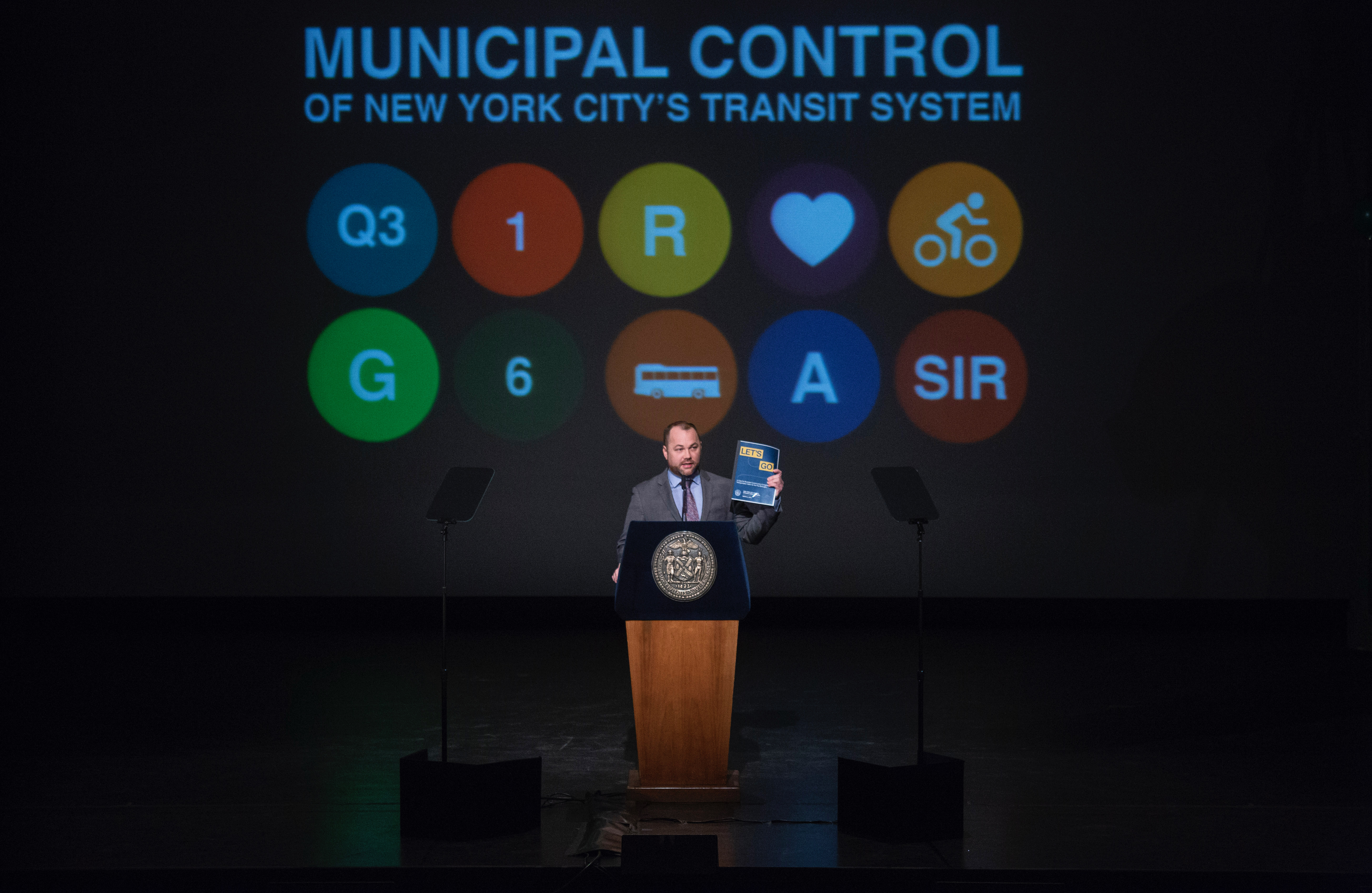
In his first State of the City speech on Tuesday, City Council Speaker Corey Johnson focused on one topic: getting rid of the MTA and taking control of the city’s dysfunctional mass transit system.
He also rallied the city to “break the car culture” and rethink its controversial plan to rebuild the Brooklyn-Queens Expressway from Atlantic Avenue to Sands Street.
“We’ll have a new system with a new name,” he said. “I’m calling it Big Apple Transit — BAT for short.
“Accountability will fall squarely on one person: the mayor of New York City,” Johnson said.
His fellow city officials and council members gathered at LaGuardia Community College in Queens for the speech and cheered as he described his vision.
“Transit is the lifeblood of New York City, and it’s in crisis. Our economy lives and dies on how we move people around,” he said. “Are we getting it right? I think all 8.6 million of us know the answer to that question. No. We are not.”
Johnson described a tangled web of state and city authority that has resulted in no one being held accountable for transit.
“We heavily subsidize the system, and what do we get for it? For all that, we get four seats on a 17-member board and virtually nothing to say about where our billions go,” he said. “Right now, New York City doesn’t control our subways and buses. We don’t control the money. We don’t control what gets built. We don’t even control our bus routes.”
Johnson has drafted a 104-page report on how the new system would work.
All BAT board members must be New Yorkers who live in the city and use the system, he said, unlike today’s requirement that only one MTA board member be a user of mass transit.
“In addition to a strong board, we’d have City Council oversight and independent auditing,” Johnson said. “We would put those checks in place, because that’s what riders deserve. It’s their money. We recommend a new Deputy Mayor position.”
Coordination of regional railroads and city roads, lower fares for low-income riders and accessibility are also part of the picture, he said.
Congestion pricing, taxes to fund BAT
Johnson said the City Council was prepared to pass a local congestion pricing toll to pay for the changes. “We did it with speed cameras, and if we have to, we’ll do it again with congestion pricing.”
Additional funds could come from payroll mobility taxes, the corporate franchise tax and some of the city’s business taxes, which are still deductible at the federal level. “That means we can increase these taxes, get the money we need for the subway. And the federal government will pick up more than 20 percent of the tab,” he said.
He also wants businesses to contribute more, since an efficient mass transit system benefits them as well.
Since the state also benefits from a solvent transit system in New York City, “the state should transfer a portion of the sales tax we already pay to the Big Apple Transit,” he said.
Climate change and the BQE
Johnson prominently mentioned the DOT’s controversial plan to rebuild a section of the decrepit BQE as the emblem of everything that’s wrong with the city’s transportation vision.
“Let’s get people out of private cars. Let’s break the car culture,” he said. “Right now, we’re living in a past created by Robert Moses, the ‘master builder of New York’ who loathed mass transit and worshiped highways from the back of a limousine.
“Take the Brooklyn Queens Expressway — one of his biggest legacy projects. Its construction ripped Brooklyn apart and destroyed working class neighborhoods,” he said. “And now we’re talking about spending $4 billion dollars to rebuild a mile-and-a-half of highway. That’s almost two Mars Rovers! No one’s even talking about other options. That is a failure of imagination.”
Johnson pointed out that the BQE only carries 150,000 vehicles a day, while the Lexington Avenue subway line carries more passengers than that in a morning rush hour.
“We need to take a fresh look at the BQE problem. We shouldn’t assume that the best way forward is the old, car-centric way. We can’t change the past, but we can make choices that will lead us to a better future,” he said.
Johnson said he is introducing legislation that will require the city to complete and implement a master plan for New York City’s streets every five years. “The city will be required to look at the streets as a whole, not one neighborhood or street at a time, the way we do it now.”
Laurie Garrett, a member of transportation advocacy group A Better Way, NYC, and Pulitzer Prize-winning author on global public health, said it was “very exciting to see the New York conversation about climate change and city planning escalate from the hand-waving we’ve been getting from Mayor De Blasio and Governor Cuomo.”
She added, “At the very least, I hope Johnson’s statement will force De Blasio and Cuomo to up their games, getting past liberal rhetoric to genuine solutions that imagine what New York City should be in 2030, not what it (shrug) just has to settle for.”
Another Better Way member, Brooklyn resident Linda LaViolette, sent a one-word reaction to the Brooklyn Eagle: “Fantastic.”
Ticking time bomb
Even though the city’s population and economy have increased, subway ridership dropped 5 percent from 2015 to 2018, and bus ridership has decreased by 15 percent from 2012 to 2018, Johnson said.
“This is a ticking time bomb. If people can’t move around, New York City can’t function,” he said.
He ended his hour-plus speech with a rallying cry.
“We are the greatest city in the world!” he said in part. “We have the Lemon Ice King of Corona. Amateur night at the Apollo. The Cuchifrito spot on One-Eighty-Eighth Street. The Mermaid Parade. We have four Chinatowns and two Little Italy’s. We gave the world Barbra Streisand, Spike Lee, Mos Def, J-Lo! … We can do this New York!”