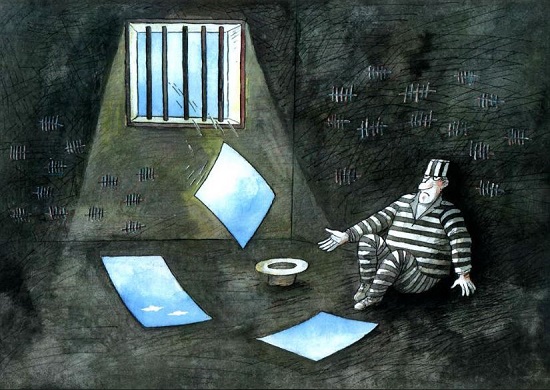
The practice goes by many names: Restrictive housing, administrative segregation, secure housing, lockdown or, more informally, being put into “the hole.” Most people would recognize it as “solitary confinement” — placing prisoners alone in small cells with little or no human contact 22 or more hours every day.
Does simply being alone and confined to a small space constitute torture? The answer is yes, according to the United Nations Special Rapporteur on Torture, Juan Méndez.
“Considering the severe mental pain or suffering solitary confinement may cause, it can amount to torture or cruel, inhuman or degrading treatment or punishment when used as a punishment … for a prolonged period [or] for persons with mental disabilities or juveniles,” he said in a 2011 report.
In January 2016, President Barack Obama used an executive order to ban the use of solitary confinement on juvenile offenders in federal prisons and reduced the maximum time a prisoner could be placed in solitary confinement for a first offense to 60 days, down from 365 days. (Mr. Méndez recommended that solitary confinement, if absolutely necessary, never exceed 15 days in duration because of its harmful mental and physical effects on prisoners.)
Juveniles and those who enter prison with mental health issues may be particularly adversely affected.
“How can we subject prisoners to unnecessary solitary confinement, knowing its effects, and then expect them to return to our communities as whole people?” the president wrote in an opinion article in The Washington Post. “It doesn’t make us safer. It’s an affront to our common humanity.”
Several states have already begun to reduce their use of solitary confinement, among them Colorado and New Mexico. North Carolina has banned its use on juveniles, and Nebraska has prohibited it as a punishment for disciplinary violations.
In December, five other states — Louisiana, Minnesota, Nevada, Utah and Virginia — joined the Safe Alternatives to Segregation Initiative, a project of the nonprofit Vera Institute of Justice in New York City, which seeks to limit the use of solitary confinement in state and local facilities. They join Nebraska, North Carolina, Oregon, New York City and Middlesex County, N.J., which have been involved since 2015. The 21-month partnership is funded by a $2.2 million grant from the U.S. Department of Justice; states contribute a matching amount of as much as $50,000.
In Minnesota, an investigative series by the Star Tribune newspaper found that in the past decade more than 1,600 inmates in that state had spent half a year or more in solitary confinement. More than 400 had been isolated in their cells for more than a year.
Solitary confinement is also being applied unevenly among racial groups.
According to a 2015 survey, a higher percentage of black and Latino inmates are being placed in solitary confinement than white inmates. Out of 54,000 inmates studied, black men made up 40 percent of the general population but 45 percent of those in solitary confinement, according to the data, which was analyzed by researchers at Yale Law School and the Association of State Correctional Administrators. In California, Latinos made up 86 percent of those in solitary confinement, but only 42 percent of the general prison population.
Inmates already suffering from various mental illnesses are often put in solitary confinement because a prison or local jail lacks any other means to deal with the problem. In many cases the inmate not only suffers during isolation, but emerges in an even worse condition.
States may find that solitary confinement serves a useful purpose in very limited cases. But the ongoing efforts to reduce its use will make facilities more humane while increasing the likelihood that upon release prisoners are better able to function normally in society.
© 2016 The Christian Science Monitor