At Jacob Riis ‘People’s Beach,’ pushback grows as iconic bathhouse turns into ritzy clubhouse
The semi-private Rockaway Ocean Club was slated to open in July but has faced construction delays — and now growing calls for a boycott.
Boardwalk bikers pass the under-construction Rockaway Ocean Club, July 20, 2026. Photo: Kaitlyn Schwanemann/The City Reporter
By Kaitlyn Schwanemann, The City Reporter
July 27, 2026
Copy Link
Email
Facebook
X
LinkedIn
WhatsApp
Telegram
Pinterest
Print
For nearly a decade, the Jacob Riis Bathhouse in the Rockaways has been promised a makeover. This summer was supposed to be when a semi-private beach club finally opened inside the 1930s Art Deco building, including a pool and lounge for paying members. There’s a $750 joining fee, and a standard annual membership will run you $1,500 if you’re under 30 or $2,000 for everyone else.
Some of the concessions — slated to include restaurants, bars, a gelato parlor and a beach essentials shop open to the public on the ground floor — were reportedly scheduled to open by Fourth of July weekend.
But that date has come and gone, and the Rockaway Ocean Club is still a construction site, with the project’s backers hoping for an early August opening. Builders are working inside. Tools and materials are strewn about behind black gates. Typed-up signs line the windows, reading “GELATO” and “RESTAURANT.”
For the last 50 years, the bathhouse has been mostly vacant, and with the 2023 demolition of the abandoned tuberculosis hospital on the other end of the beach, it’s the most prominent structure at Jacob Riis Park. The architectural marvel was used partly to house lifeguards at one point, but mostly has fallen into disrepair since the early 1970s and faced significant damage during Hurricane Sandy in 2012.
The work has met various delays, Ursula Damani, a founding partner and the chief marketing officer, told The City Reporter.
The under-construction Rockaway Ocean Club advertised job openings, July 20, 2026. Photo: Kaitlyn Schwanemann/The City Reporter
Lagging work isn’t the only thorn in the beach club’s side, though: the Tuesday after Fourth of July weekend, a handful of grassroots organizations from the city announced a boycott against the planned club and all of its on-site businesses.
In an Instagram post that’s now amassed over 3,000 likes, the groups, organized as the Riis Beach Bloc Association, encourage fellow Riis-goers not to buy anything set to open at the former bathhouse and not to perform at or attend any of their future events.
The post cites the privatization of a once public space, writing “Riis needs care, not gentrification!” Damani argued that the neighboring community, Neponsit, is one of the most affluent in the city.
Queer history
For decades, New Yorkers have trekked to what’s known as “The People’s Beach,” run by the National Park Service. The Marine Parkway-Gil Hodges Memorial Bridge, built just a few years after the bathhouse, was designed to make the beach more publicly accessible, connecting Flatbush Avenue to the Rockaway Peninsula.
The easternmost parts of the beach have been a haven for queer people since at least the 1940s, according to jah elyse sayers, a longtime Riis beachgoer who wrote their PhD dissertation on Black and working class queer and trans placemaking amid erosion at Riis and started the “People’s Riisearch Group,” a collective archive, in 2022.
“We’ve been the only people who have cared for this beach for a long time,” sayers said.
Pride flags fly at a queer-friendly section of Jacob Riis beach, July 22, 2026. Photo: Kaitlyn Schwanemann/The City Reporter
They lamented NPS’ “reliance on privatization for revenue” — adding that locals have been unofficially stewarding the land for years, crowdfunding for an accessibility mat and beach wheelchair, for example.
NPS confirmed in an email that community groups crowdfunded for the mats, adding that the park hadn’t previously installed them due to erosion issues, and that beach wheelchairs have always been available for use.
The Riis Beach Bloc Association was created to help formalize the stewardship of the beach by queer Riis lovers, especially after the 2023 demolition of a former hospital nearby, which longtime queer beachgoers say contributed to the making of Riis as an LGBTQ haven (and sometimes nude beach) with the building acting as a privacy barrier between beachgoers and the largely conservative Neponsit homeowners.
Dean Labowitz, an urban planner and member of the RBBA, fears that Rockaway Ocean Club will push out queer people. Labowitz moved to the city in 2019 and said that going to Riis beach helped them discover their own identity.
“I have not heard them say the words ‘queer community’ one time,” Labowitz said, speaking of the bathhouse developers. “They want to bring in everyone from New York City, but they cannot say queer people.”
The language the developers of Rockaway Ocean Club used to describe the project, like “family-friendly,” raised alarm bells in particular.
Damani, of the bathhouse developer group, said the project is in no way anti-queer.
“For some reason, people feel that if we say families are welcome, then that means the queer community isn’t welcome. And I don’t, in my mind, see those as mutually exclusive. A lot of queer communities have families,” Damani said. “They may not be the traditional definition of a family, but it’s still a family, and maybe not in the nuclear sense, but it’s still a family.”
Some beach goers joined the tribute walk to seashore while others cheered from under their parasols on Saturday, August 28, 2022. Photo: Hiram Alejandro Durán/THE CITY
“I don’t see why we can’t have, you know, swim lessons for kids in the morning and like a killer queer dance party in the courtyard at night,” she added.
Damani added that the team is committed to “being a good neighbor to every community that calls this beach home” and keeping 60% of the restored building free and open to the public.
Investor on ‘watchlist’
The developers of Rockaway Ocean Club are working toward an August opening, Damani said. But it is slated to be even bigger than just the beach club. A 28-room hotel — aiming to open in 2027 — is also in the works, to be built on the second floor.
The project has been pending for nearly a decade. In 2018, the NPS announced a tentative agreement with Aaron Broudo and Belvy Klein, the duo behind Brooklyn Night Bazaar, an outdoor pop-up event turned events venue that closed in 2019. NPS told The City Reporter they were the applicant deemed “most responsive” to a request for proposals.
Four years later, NPS announced the signing of a 60-year lease for the historic bathhouse building with Bathhouse Lodge LLC, doing business as Brooklyn Bazaar — Broudo and Klein — and CBSK Developers, a New York City real estate development partnership.
There are many backers involved in the project, including one that raised alarm bells for critics because he appeared on the public advocate’s “Worst Landlord’s Watchlist,” in 2023 and 2024, Jonah Bamberger of the investment group Aulder Capital.
But Damani, a native New Yorker, highlighted her passion for the project and the beach itself, beyond the potential for profit.
“This is not a get-rich-quick scheme by any stretch of the imagination,” she said. “This is definitely a true passion project and a labor of love.”
Bamberger appeared on a podcast in late 2024 to discuss his work on the bathhouse, saying that he’d been involved for the “last five or six years.”
But Damani and a representative from Aulder both said he is in no way involved with the operations or management of Rockaway Ocean Club.
“For the past five years, Aulder Capital has not involved [sic] in any aspect of the Rockaway Ocean Club project including as a limited partner or as an investor,” said David Myers, who runs marketing operations for Aulder.
“He’s maybe part of that pool of private equity money, but as far as having any influence over this project, or me or my team, there’s zero,” Damani said.
Still, at least one of Bamberger’s tenants, Brandice Taylor Davis — who’s lived at one of Bamberger’s properties for the last decade — said she was horrified when she read on the investment company’s website that he was involved in the project at all.
“My only hope is that someone who has the power to do something does something about this, to protect the people at the beach and to protect the tenants who are under his portfolio,” Davis said.
Several of Bamberger’s Brooklyn tenants told The City Reporter they’d gone months without heat and hot water, including during the winter, and had multiple issues with their apartment buildings that went unaddressed. As president of the tenant’s association, Davis has active, pending litigation underway against her landlord.
Bamberger told The City Reporter that his role in the beach club is “passive,” adding that he works closely with the city’s Department of Buildings and Department of Housing Preservation and Development.
Labowitz said they’re afraid of developers like Bamberger influencing a historical safe haven. “If Riis isn’t Riis anymore … that is a crisis,” they said.
With construction still underway, Riis-goers walking up and down the boardwalk looked curiously at the Art Deco building on a sunny day in late July, not long before the planned opening.
Bryan Manning, a Forest Hills resident of more than 30 years and a Riis beach visitor since the 1960s, wandered around the huge building, peeking through the windows to see how far along construction was going. It’s a habit he’s picked up in the last few years, coming almost every day to see how the work is coming along.
Manning said he’s glad someone’s finally doing something with the bathhouse, but he’s not getting a membership — and he’s not sure who can afford it.
SUNSET PARK — “As a resident of Marine Park, one of the great surprises I found biking around Industry City and visiting Japan Village was to discover Bush Terminal Park. I continue to be amazed at the serene hideaways that the city offers in some of the busiest places — and, still, with an iconic view.”
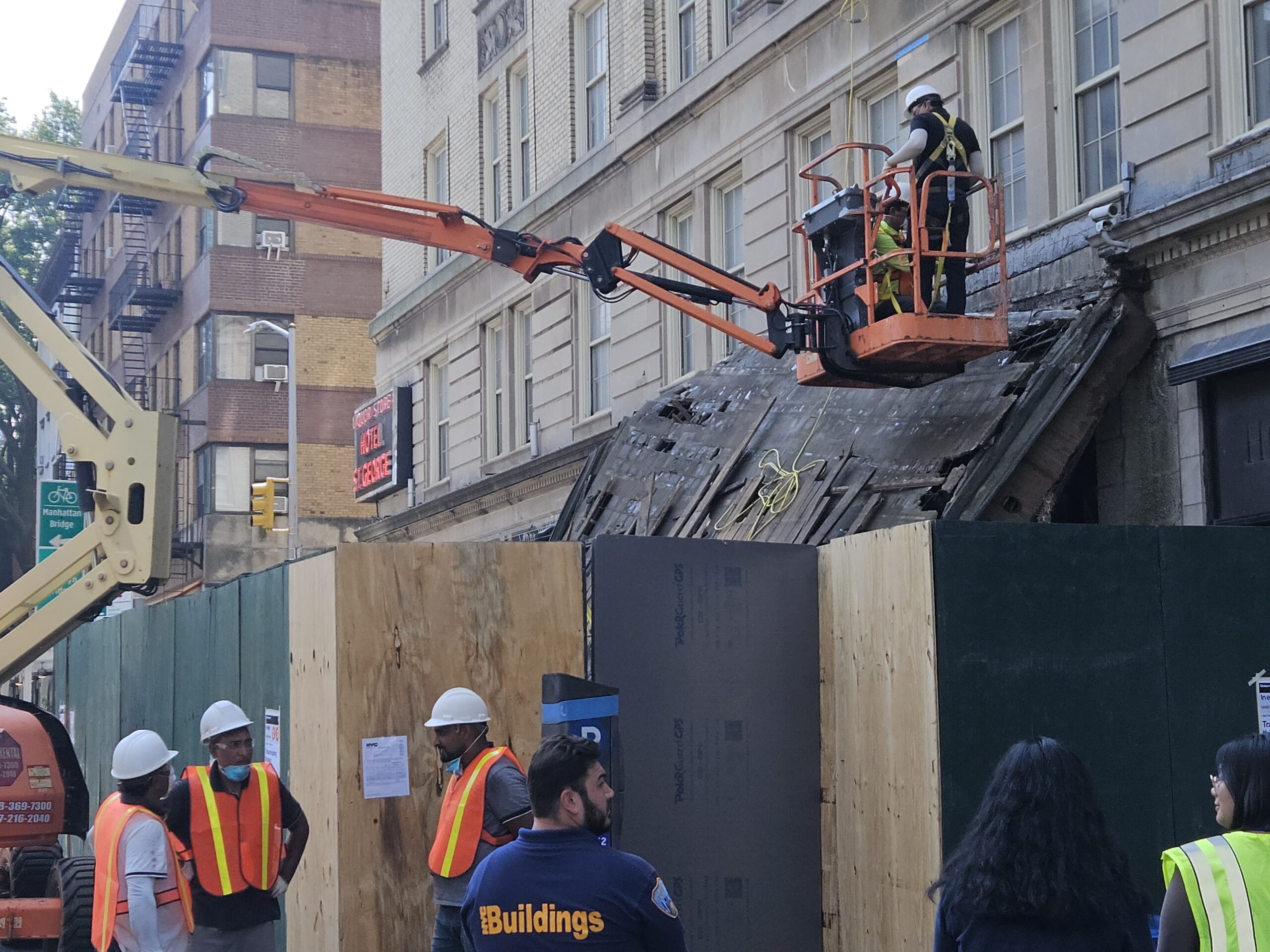
BROOKLYN HEIGHTS — ‘A miracle that no one was killed …’ That’s what neighbors are saying about the collapse of the Hotel St. George marquee. Shown in this photograph are workmen beginning the removal and repair of the historic, old neon sign at the corner, referencing a relic of Brooklyn Heights’ past: the St. George Hotel.
ATLANTIC AVENUE — Exhausted shopper with cluster of bags and goods from mall at Boerum Place stops to look at huge construction site across the street. “Is that REALLY going to be a jail??” Her male companion is reassuring, “Nothing like Rikers … this is 21st Century.”
BROOKLYN HEIGHTS — Overheard in line at one of most popular pastry outlets on Montague Street: “Hope I can get them into a camp …” A mother with two pre-schoolers in tow was showing a friend the Dodge Y flyer for Healthy Kids Day on Saturday, April 18.