Rikers-reform fight awaits Mamdani as advocates release jails ‘blueprint’
With a court-appointed manager set to take over parts of the city’s Correction Department, advocates want the incoming mayor to back up pledges he made about city jails while on the campaign trail.
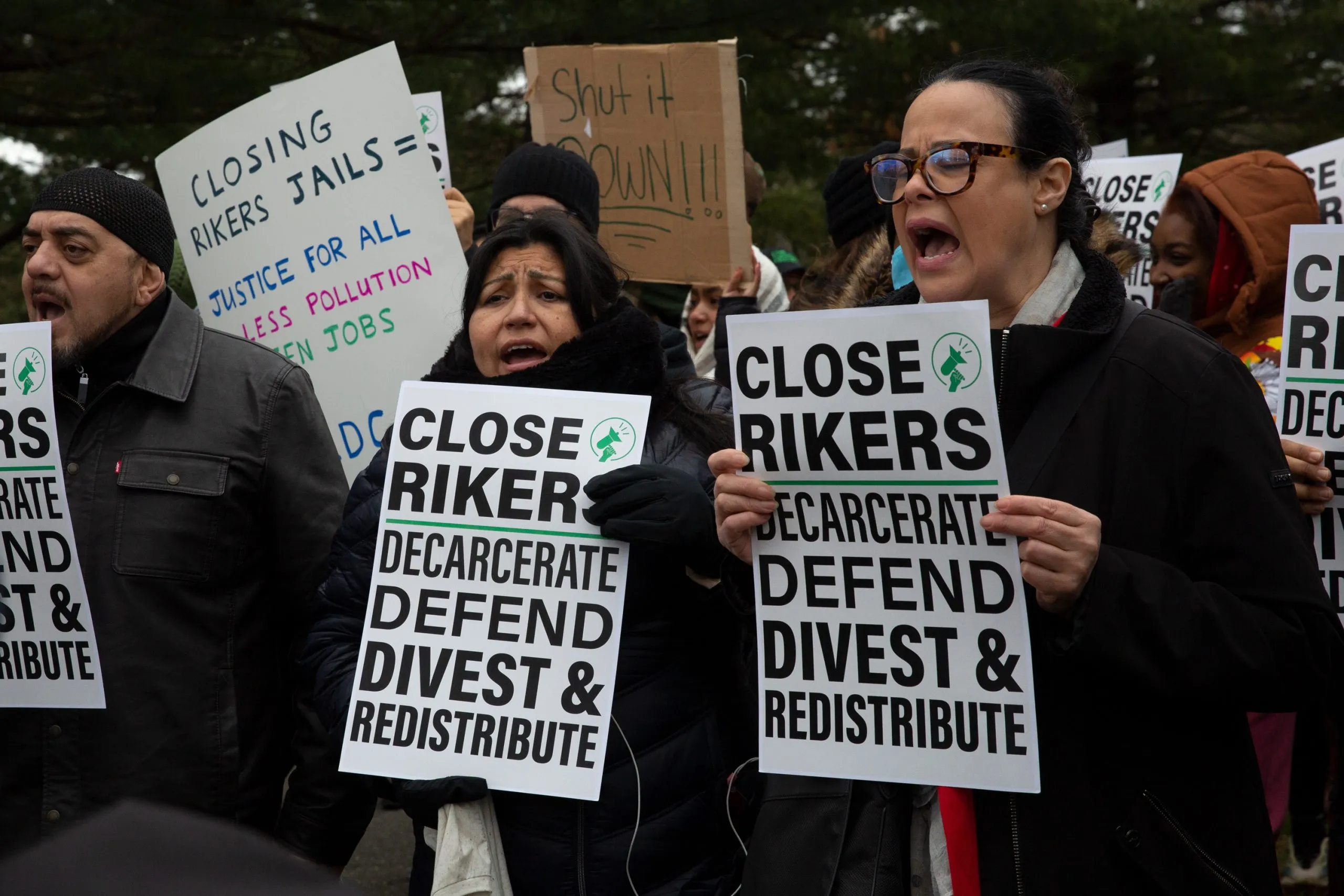
Protesters demanded the shuttering of Rikers Island at Mayor Eric Adams’ State of The City address at the Queens Theatre, Jan. 26, 2023. Photo: Ben Fractenberg/THE CITY
By Reuven Blau, THE CITY
November 17, 2025
Copy Link
Email
Facebook
X
LinkedIn
WhatsApp
Telegram
Pinterest
Print
While running to be New York City’s next mayor, Zohran Mamdani pledged to shutter Rikers Island and shrink the city’s jail population.
Now, as he prepares to take office in just over a month and a half, a coalition of formerly incarcerated New Yorkers, family members and advocates are demanding that Mamdani make good on those promises — and go even further.
Members of the Jails Action Coalition and the #HALTsolitary Campaign on Thursday released a comprehensive “ Blueprint” outlining a series of sweeping reforms they say are necessary to end what they describe as a “humanitarian catastrophe” inside city jails.
The 23-page document calls on the incoming mayor to immediately reduce the number of people incarcerated, fully end solitary confinement and improve medical and mental health care. It also demands that Mamdani do everything possible to close Rikers Island for good, a shuttering required by legislation passed by the City Council in 2019 with the approval of then-Mayor Bill de Blasio.
“We must end the abuses, neglect, torture, and lack of mental health and medical care treatment that continue on Rikers Island,” said Victor Pate, a former Rikers detainee who is now co-director of the #HALTsolitary Campaign. “We are far beyond a humanitarian crisis on Rikers and it must be ended.”
Some of the decisions may not be directly up to the mayor and his hand-selected commissioner.
Laura Swain, chief district judge for Manhattan federal court, is in the process of selecting a so-called “ remediation manager” to take over large parts of the city’s troubled Department of Correction.
Mamdani told THE CITY last week that he supports a court-appointed receiver but hasn’t detailed how that person will work alongside his yet-to-be named jails commissioner.
His press team did not respond to an email seeking comment.
The Blueprint paints a grim picture of life inside New York City’s jails: rampant staff brutality, sexual abuse and medical neglect; widespread use of solitary confinement despite a city law banning it, and the continued incarceration of thousands of legally innocent people awaiting trial.
Over the past five years, more than 70 people have died in city custody, including at least 12 so far this year, according to the report. Many have died from drug overdoses, and some have taken their own lives, records show.
The number of people detained has also nearly doubled since Eric Adams became mayor in January 2022, Department of Correction records show. The population has spiked from a pandemic-era low of roughly 3,800 to 7,022 as of Tuesday.
The suffering and harm inflicted on thousands of people in the city jails cannot be ignored,” said Jennifer Parish, director of Criminal Justice Advocacy at the Urban Justice Center Mental Health Project. “Addressing these atrocities must be the first priority of the next administration.”
The “Blueprint” also highlights the racial disparities underpinning the city’s jail system: as of this fall, Black New Yorkers were incarcerated at 10 times the rate of their white counterparts, and 86% of people in city custody were being held pretrial — often because they cannot afford bail.
Close-Rikers advocates rally ahead of a Board of Correction meeting in Lower Manhattan, Jan. 10, 2024. Photo: Ben Fractenberg/THE CITY
Closing Rikers, the document contends, is not just a moral imperative but a fiscal one.
“The city spends over $1 billion a year maintaining Rikers, largely due to staffing, overtime and inefficiency,” the report said. “At the same time, prolonged detention, often for people who cannot afford bail, contributes to overcrowding and worsening conditions within the jail complex.”
The advocates also want the incoming Mamdani administration to implement Local Law 42, which strictly limits the use of solitary confinement beyond four hours and replaces it with structured, out-of-cell programming.
After years of lobbying from activists and criminal justice reformers, the law had been set to go into effect in July 2024 before Mayor Eric Adams signed an emergency executive order that blocked major parts of its implementation.
The emergency hold has not been lifted since that time.
It required jail officials to put detainees who acted out into so-called “de-escalation cells” where they could cool off and get additional counseling and services.
The list of recommendations also calls on the city to invest in jail-diversion programs by expanding community-based treatment options for people with mental health and substance-abuse disorders.
For people in jail, the activists are pushing Mamdani and his team to expand programming and education with peer-led and therapeutic classes.
Mamdani is set to take office as city jails struggle to transfer defendants who are deemed mentally unfit to stand trial after failing so called 730 exams to secure state-run mental health facilities, THE CITY has reported.
A report soon to be released by researchers at John Jay College’s Data Collaborative for Justice and the Katal Center for Equity, Health & Justice found that mental illness among the jail population has reached record levels — with 60% of people in custody now receiving mental health services, up from 44% in 2020.
Nearly one in four detainees is diagnosed with a serious mental illness, the study found, and more than one quarter are homeless or “likely to be homeless” upon release.
“Mayor Adams not only abandoned the plan to close Rikers, he abandoned the people whose lives are impacted by the horror of Rikers,” said Gabriel Sayegh, executive director of the Katal Center. “This new report, and our report coming out next week, are good places to start.”
SUNSET PARK — “As a resident of Marine Park, one of the great surprises I found biking around Industry City and visiting Japan Village was to discover Bush Terminal Park. I continue to be amazed at the serene hideaways that the city offers in some of the busiest places — and, still, with an iconic view.”
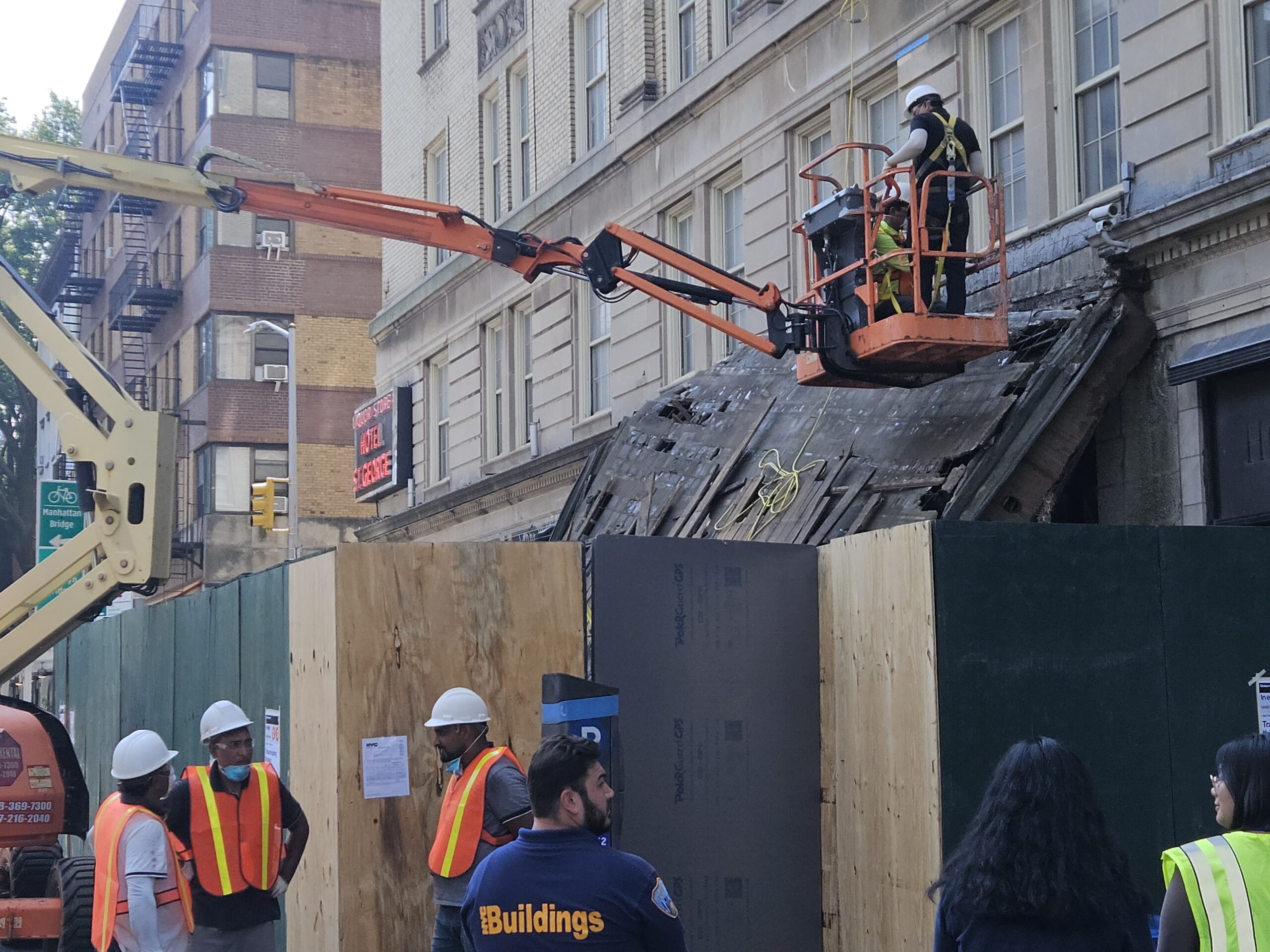
BROOKLYN HEIGHTS — ‘A miracle that no one was killed …’ That’s what neighbors are saying about the collapse of the Hotel St. George marquee. Shown in this photograph are workmen beginning the removal and repair of the historic, old neon sign at the corner, referencing a relic of Brooklyn Heights’ past: the St. George Hotel.
ATLANTIC AVENUE — Exhausted shopper with cluster of bags and goods from mall at Boerum Place stops to look at huge construction site across the street. “Is that REALLY going to be a jail??” Her male companion is reassuring, “Nothing like Rikers … this is 21st Century.”
BROOKLYN HEIGHTS — Overheard in line at one of most popular pastry outlets on Montague Street: “Hope I can get them into a camp …” A mother with two pre-schoolers in tow was showing a friend the Dodge Y flyer for Healthy Kids Day on Saturday, April 18.