Ronny Jaramillo gives a lesson on Ecuadorian street food at Chuzo Culture
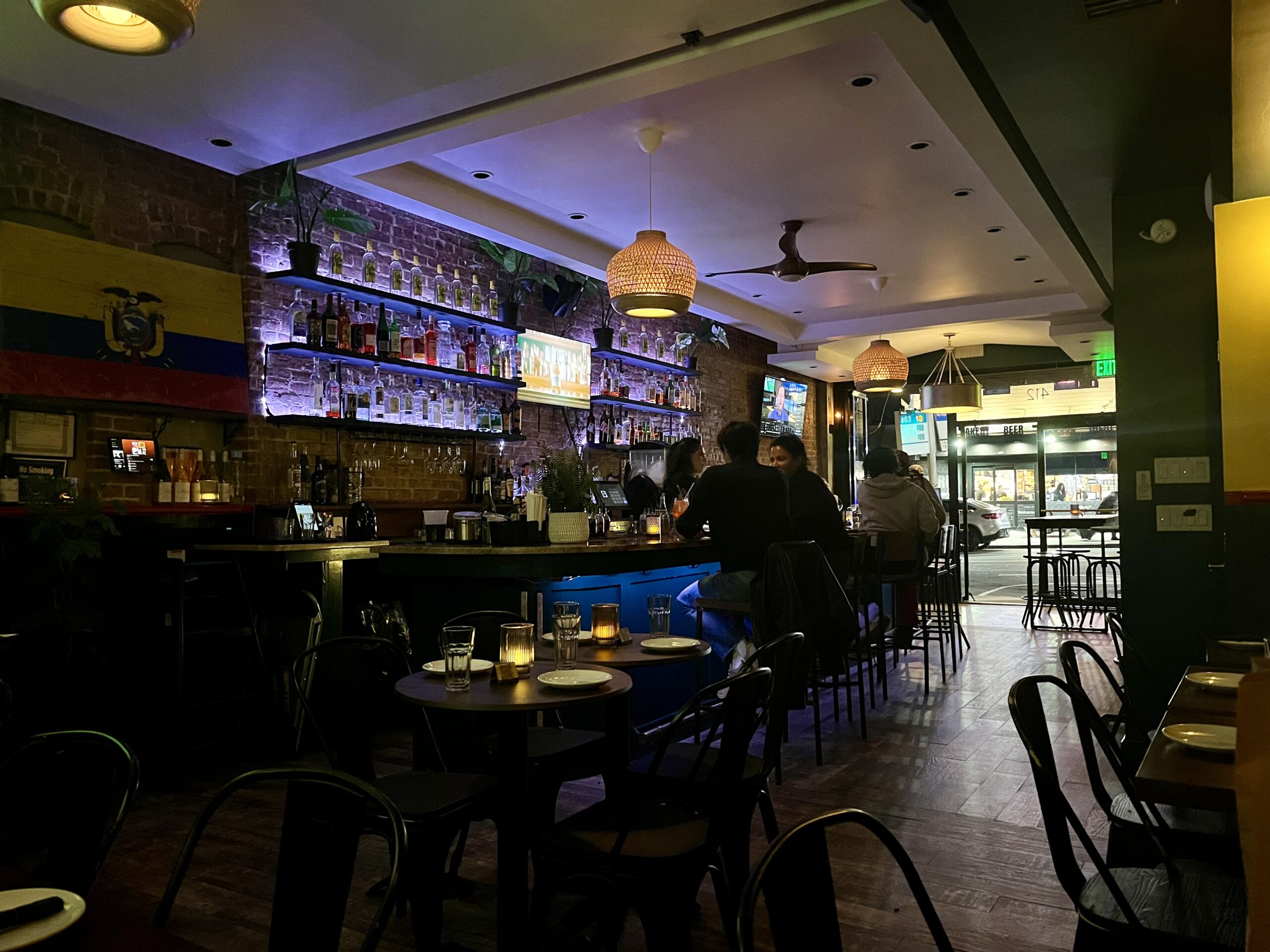
Interior of Chuzo Culture. Photo by Alice Gilbert
By Alice Gilbert
June 7, 2024
Copy Link
Email
Facebook
X
LinkedIn
WhatsApp
Telegram
Pinterest
Print
New York City restaurants are full of secrets, whether you have towalk through a grocery store to find them or they make youcover your phone camera to prevent photography. Some secrets, though, are unintentional, like the one about the sports bar serving up excellent Ecuadorian street food in Park Slope.
Chuzo Culture is not trying to disguise itself as something it’s not — it’s definitely a sports bar. There’s no shortage of TVs playing reruns of soccer games, loud music coming from the speakers and patrons clad in sweatpants. But owner Ronny Jaramillo is pumping out inventive, imaginative takes on bar food, with twists on the late-night munchies of his hometown, Guayaquil, in coastal Ecuador.
Ronny Jaramillo. Photo by Liz Degen
“I’m kind of playing around,” Jaramillo tells me as he explains the menu’s fried chicken dish. A combination of Korean, Ecuadorian and his own personal techniques, he smothers the crispy cutlet in a sweet and spicy passionfruit and habanero sauce, finishing it with his take on a salprieta: a peanut-based spice mixture with roots in the region’s Afro-Ecuadorian population. “Peanut salt became that ingredient for fried chicken that nobody knew you needed,” he says. He’s got that right. It’s nutty and earthy, defining the role of a secret ingredient by adding a little something special.
Jaramillo’s playfulness extends beyond the food. “I really do this to mess with my own people,” he says of his use of cross-cultural techniques and ingredients. “Ecuador can be very racist. And when you learn that half of our population is from an African background, it makes me think, ‘Are you guys kidding me?’ It’s amazing how much ethnic diversity we have, and now we call this food ‘ours.’” The peanut salt on the fried chicken is not just for flavor. It’s a cheeky wink to marginalized and indigenous groups in his homeland.
Jaramillo is also winking, through an array of dishes, to his family of chefs. Almost everyone in his family can cook, he tells me, which means that everyone’s a critic. His mom doesn’t necessarily approve of everything he cooks, but that doesn’t stop him from using her recipe for ceviche, which includes tender shrimp, swimming in a limey, vinegary broth, surrounded by onions and tomatoes, to be scooped with massive patacones (plantain pancakes).
Fried chicken and rice and beans. Photo by Alice Gilbert
Perhaps the most traditional element of Chuzo Culture is its namesake: the chuzo, or grilled meat skewers, commonly purchased from carts outside of concerts or on street corners. When Jaramillo goes home to Guayaquil, “There is this woman who has been in the same spot for, like, 20 years,” he reminisces. “Back in the day, she used to have a little makeshift stone and charcoal grill on the street. You would pass by and think, ‘That is so gross,’ but there would be, like, 20 people around her. Two years ago, she actually got a grill, but she’s in the same spot doing the same thing every day. So, every time I go home, I tell my cousin that’s the first spot I want to go.” Jaramillo’s chuzoskewers come in pork, chicken, chorizo, veggie, steak and corn varieties (the Chuzo Combo allows you to try three), and theyall come with a creamy basil sauce and a bright, fresh salsa for contrast.
Jaramillo has inadvertently become a local authority on Ecuadorian cuisine. “This food is pretty unknown to people,” he says. “It can be very underrated, and people think it’s the same thing as Peruvian. I’m going down a road of a lot of education.”
Chicken, steak and corn chuzo with a side of fries. Photo by Alice Gilbert
A lesson on the gastronomic and political history of Ecuador might have been totally unexpected when you walked into this unassuming sports bar, but the best-kept secrets usually are.
SUNSET PARK — “As a resident of Marine Park, one of the great surprises I found biking around Industry City and visiting Japan Village was to discover Bush Terminal Park. I continue to be amazed at the serene hideaways that the city offers in some of the busiest places — and, still, with an iconic view.”
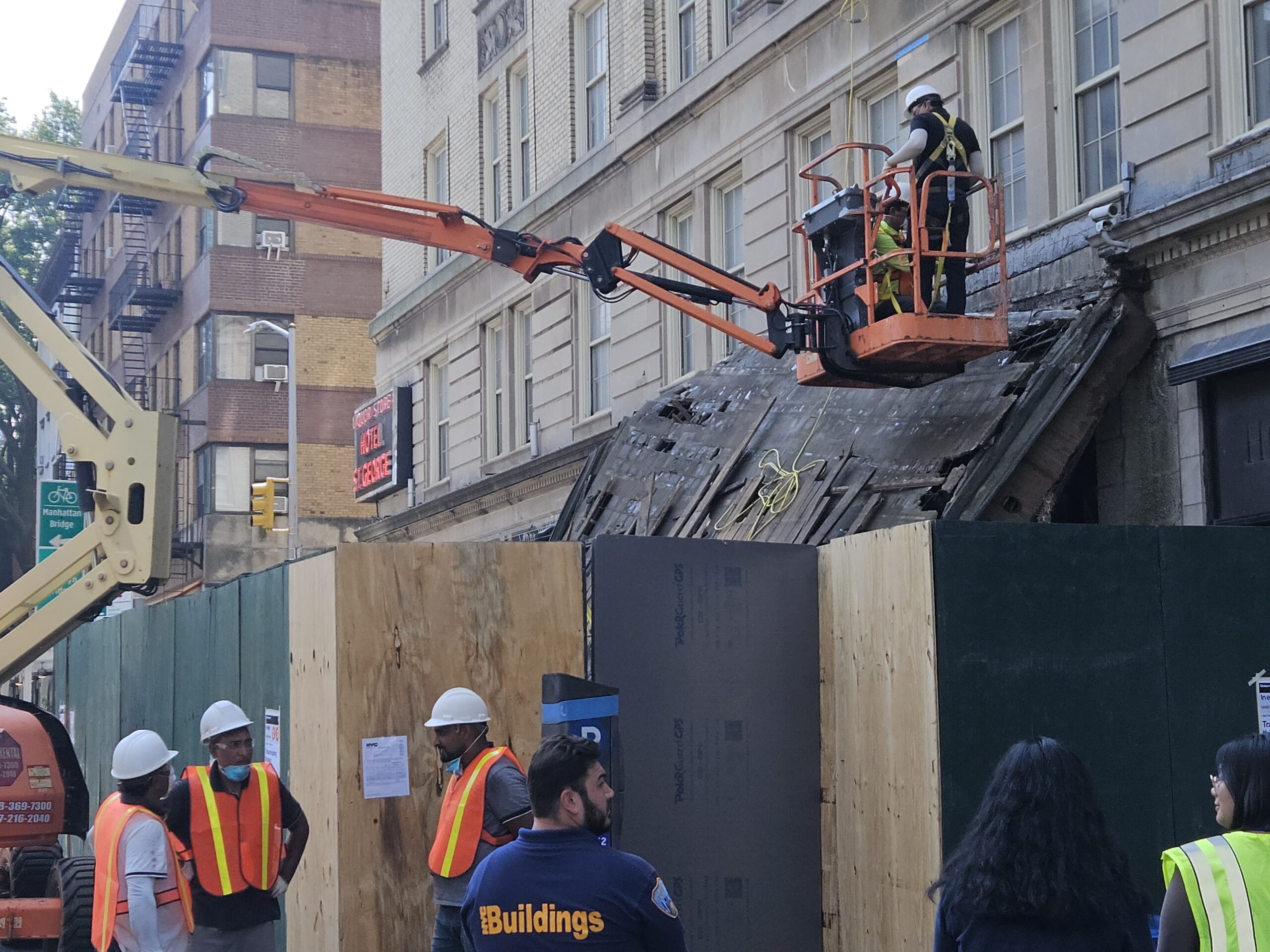
BROOKLYN HEIGHTS — ‘A miracle that no one was killed …’ That’s what neighbors are saying about the collapse of the Hotel St. George marquee. Shown in this photograph are workmen beginning the removal and repair of the historic, old neon sign at the corner, referencing a relic of Brooklyn Heights’ past: the St. George Hotel.
ATLANTIC AVENUE — Exhausted shopper with cluster of bags and goods from mall at Boerum Place stops to look at huge construction site across the street. “Is that REALLY going to be a jail??” Her male companion is reassuring, “Nothing like Rikers … this is 21st Century.”
BROOKLYN HEIGHTS — Overheard in line at one of most popular pastry outlets on Montague Street: “Hope I can get them into a camp …” A mother with two pre-schoolers in tow was showing a friend the Dodge Y flyer for Healthy Kids Day on Saturday, April 18.