Advocates and Business Leaders Warn Against Sabotaging Groundbreaking Efforts to Make Most of Used Plastics Recyclable
11th Hour Legislative Effort To Create Major Repercussions for New York’s Plastic Waste Crisis
By Brooklyn Eagle Staff
May 23, 2022
Copy Link
Email
Facebook
X
LinkedIn
WhatsApp
Telegram
Pinterest
Print
More than two dozen statewide advocates and business leaders are cautioning lawmakers against hastily-written legislation introduced at the 11th hour that would snatch defeat from the jaws of victory when it comes to addressing New York’s waste crisis.
Responding to legislation introduced by Assemblymember Steve Englebright just 12 days before lawmakers are set to leave Albany, advocates warn that a provision in the well-intentioned legislation setting up an “extended producer responsibility (EPR) program” to curb plastic waste would prevent cutting-edge recycling facilities – already helping address the plastic waste crisis in nearly twenty other states – from operating in New York and close the door to more than $500 million in new economic activity annually.
This recycling technology, known as advanced recycling, would represent one of the most significant private investments in New York’s green economy – recycling more than 90% of used plastics, as opposed to the 10% we recycle now, and bringing with it hundreds of millions of dollars annually in economic output, hundreds of new green-collar jobs, and the potential to displace some 800,000 tons of used plastic from landfills each year. Despite the opportunity promised by advanced recycling, Assemblymember Englebright’s bill, as currently written, would ban these sustainable facilities from operating in New York.
“For more than a decade, our company has committed itself to reducing the amount of used plastics that end up in landfills, streets, water resources, and parks. Operating advanced recycling facilities has been central to our success,” said Michael Moreno, Co-Founder and Chief Operating Officer of Braven Environmental. “We’re based in Yonkers, yet if Assemblymember Englebright’s well-intentioned but misguided EPR bill were to pass, we would be forbidden from operating advanced recycling facilities in our own backyard and from doing our part to reduce plastic waste in our home state.”
“Upstate New York’s economy is recovering from the impacts of the pandemic,” said Justin Wilcox, executive director of Upstate United. “Modernizing our recycling infrastructure to generate local investment, jobs, and economic activity is very important right now. While seemingly well-intentioned, Assemblymember Englebright’s bill won’t solve the waste crisis as it is currently written. It will only prevent proven economic and environmental solutions like advanced recycling from being introduced in New York and create more hardship for Upstate communities and economy.”
Despite more than a dozen co-sponsors from all corners of the state signing onto the advanced recycling bill already introduced by Senator John Mannion (D-Geddes) and Assemblymember Alicia Hyndman (D-Queens) and overwhelming support among New York voters on both sides of the aisle to leverage advanced recycling as a plastic waste solution, Assemblymember Englebright’s last-minute legislation would inadvertently prevent New York from joining the growing ranks of 18 other states depending on this burgeoning green-technology to address the waste crisis.
Similar EPR bills have been passed in other states, including most recently Colorado, yet none of them have included language that would ban advanced recycling from helping modernize statewide recycling infrastructure.
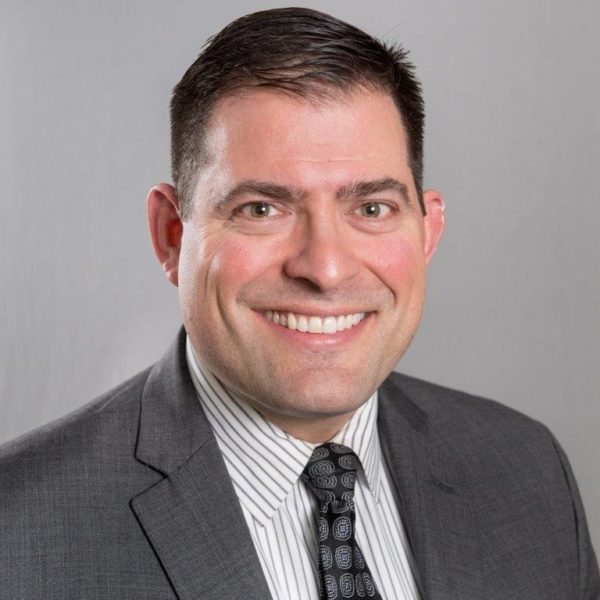
Craig Cookson
“We’ve seen firsthand the benefits that advanced recycling has brought to many other states,” said Craig Cookson, Senior Director of Plastics Sustainability, American Chemistry Council. “To forbid private companies operating these cutting-edge, sustainable recycling facilities in other states from doing their part to vastly expand the number of plastics that are recyclable in New York is counterproductive to the very intentions of the Assemblymember’s bill. EPR programs must engage stakeholders for expert input to get right. 12 days is a rush job that will create real repercussions for businesses and consumers across the state.”
Ashley Ranslow
“There’s certainly a need to address the state’s recycling infrastructure but passing hastily-written legislation in the final days of session will create more problems than it will solve,” said Ashley Ranslow, New York State Director of The National Federation of Independent Business (NFIB). “As currently written, this legislation would prevent New York from utilizing new technologies and modernizing its recycling infrastructure while also adding burdensome regulations and driving up costs for small businesses. The state should be focused on easing the load on small businesses, driving down costs, and creating jobs, not intensifying the state’s standing as a difficult and expensive state to do business in.”
In addition to this legislation cutting New York off from a burgeoning $5 billion green industry, it also contains an overly broad ban of packaging that disregards sound science and could have major unintended socioeconomic, environmental and public health consequences by arbitrarily eliminating packaging best suited for food preservation, medical supply and device protection and hazardous materials containers.
Advocates also say that this legislation introduced at the 11th hour lacks input from key stakeholders and fails to effectively evaluate cost analysis or market impact studies, leading to overly aggressive and unworkable mandates and timelines.
The group of advocates and business leaders addressed their concerns about the legislation in a letter sent to New York State lawmakers this week, which can be found here.
SUNSET PARK — “As a resident of Marine Park, one of the great surprises I found biking around Industry City and visiting Japan Village was to discover Bush Terminal Park. I continue to be amazed at the serene hideaways that the city offers in some of the busiest places — and, still, with an iconic view.”
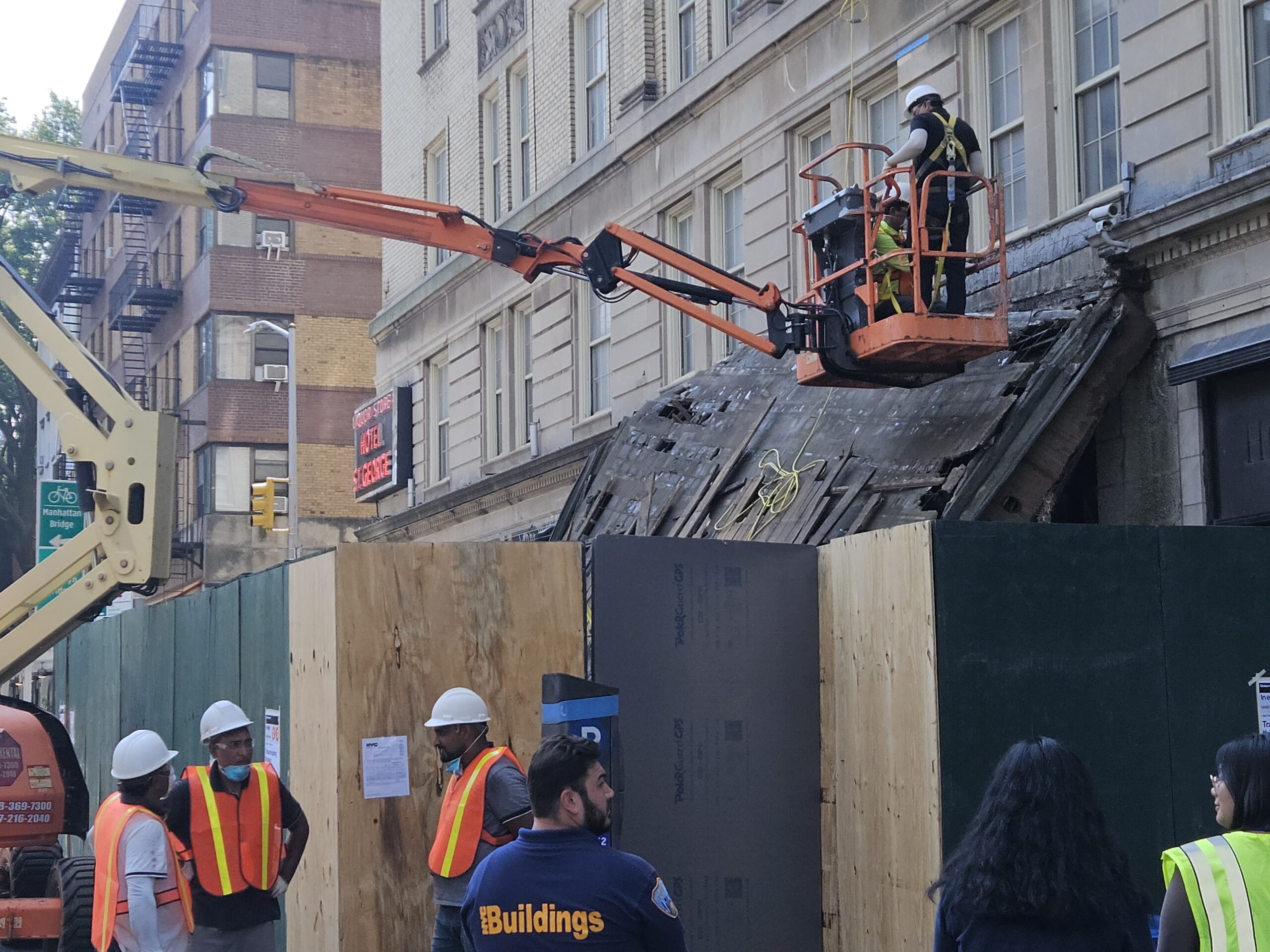
BROOKLYN HEIGHTS — ‘A miracle that no one was killed …’ That’s what neighbors are saying about the collapse of the Hotel St. George marquee. Shown in this photograph are workmen beginning the removal and repair of the historic, old neon sign at the corner, referencing a relic of Brooklyn Heights’ past: the St. George Hotel.
ATLANTIC AVENUE — Exhausted shopper with cluster of bags and goods from mall at Boerum Place stops to look at huge construction site across the street. “Is that REALLY going to be a jail??” Her male companion is reassuring, “Nothing like Rikers … this is 21st Century.”
BROOKLYN HEIGHTS — Overheard in line at one of most popular pastry outlets on Montague Street: “Hope I can get them into a camp …” A mother with two pre-schoolers in tow was showing a friend the Dodge Y flyer for Healthy Kids Day on Saturday, April 18.
 More than two dozen statewide advocates and business leaders are cautioning lawmakers against hastily-written legislation introduced at the 11th hour that would snatch defeat from the jaws of victory when it comes to addressing New York’s waste crisis.