To what extent can state or federal courts limit how state legislatures draw congressional districts?
It is a substantial question with huge implications for future elections and voting rights in America. But the Supreme Court has decided not to answer it — for now, at least. But on March 7, 2022, justices suggested that the question will be answered sooner rather than later, perhaps even before the 2024 presidential election.
In two orders, the justices refused requests from Republicans in Pennsylvania and North Carolina to block court-approved congressional maps to replace ones designed by Republican-led legislatures in both states.
The decisions are consistent with the court’s February order that halted a court injunction seeking to bar Alabama from using a congressional map that critics say disadvantages Black voters.
That order benefited Alabama Republicans. The ones that came down on March 7 will likely help Democrats in North Carolina and Pennsylvania. But all the orders were based on the same principle: America is too close to the 2022 elections for federal courts to demand legislatures redraw congressional maps to be used in those elections.
Justice Brett M. Kavanaugh said as much in his written concurrence in the North Carolina case: “It is too late for the federal courts to order that the district lines be changed for the 2022 primary and general elections, just as it was too late for the federal courts to do so in the Alabama redistricting case last month.”
But perhaps of more significance, he, along with the three dissenting justices — Clarence Thomas, Samuel Alito and Neil Gorsuch — suggested that the question of how closely courts can regulate how state legislatures draw congressional maps was one that would return.
“The issue is almost certain to keep arising until the court definitively resolves it,” wrote Kavanaugh. “We will have to resolve this question sooner or later, and the sooner we do so, the better,” added the trio of dissenting justices in the separate opinion.
Independent state legislature doctrine
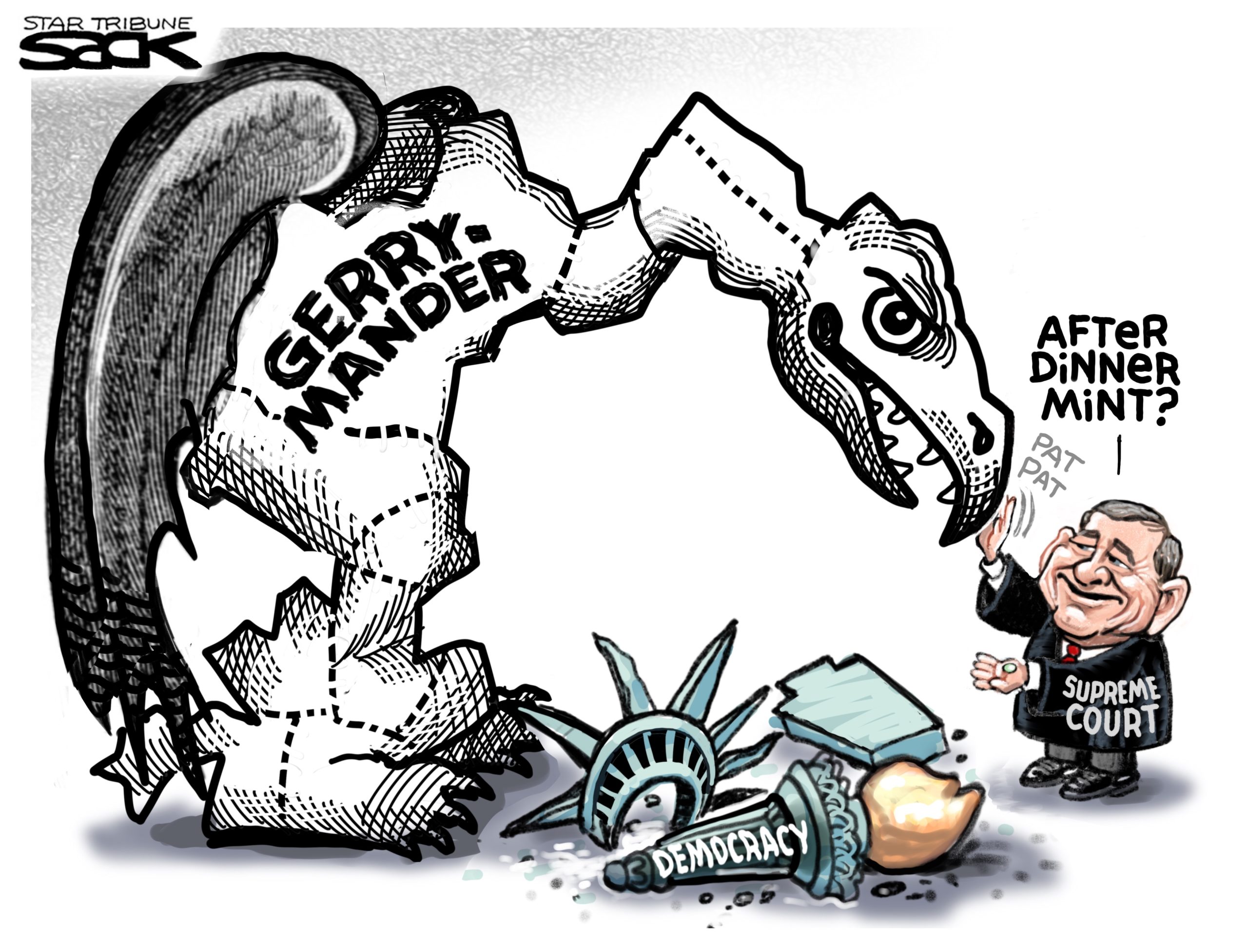
The court is clearly inching toward a showdown over what is known as the “independent state legislature doctrine.”
This is a legal theory in vogue largely among conservative circles that holds that state legislatures have an independent right to draw congressional districts free of much court oversight. The theory is based on the Constitution’s grant of authority to state legislatures to determine “the times, places and manner” of holding elections.
The independent state legislature doctrine is controversial, and may be inconsistent with Chief Justice John Roberts’s 2019 opinion in Rucho v Common Cause. In that case, which also centered on a congressional map in North Carolina, Roberts argued that partisan gerrymandering presented political questions that go beyond the reach of federal courts. He suggested states could address the issue through legislation that could then be enforced by courts.
However, a particularly legislature friendly version of the independent state legislature doctrine could limit how courts could curb partisan gerrymandering in congressional elections – and that will be of great concern to voters’ rights advocates.
It now seems only a matter of time before the Supreme Court addresses the theory. Four of the nine justices must agree to hear a case for one to be taken up. The opinions on March 7, 2022, suggest the court has the numbers.
Henry L. Chambers Jr. is a professor of law at the University of Richmond.