MARINE PARK — The Astra Vascular bipedal humanoid robot (Astra) belongs to Dr. George Bolotin, a vascular specialist, interventional radiologist and founder of the Astra Vein Treatment Center on Avenue U.
Astra was outside the specialty medical practice last week in a successful publicity stunt. The robot achieved its task and brought attention to the center’s services through the business’ name and QR code emblazoned across its chest and back.
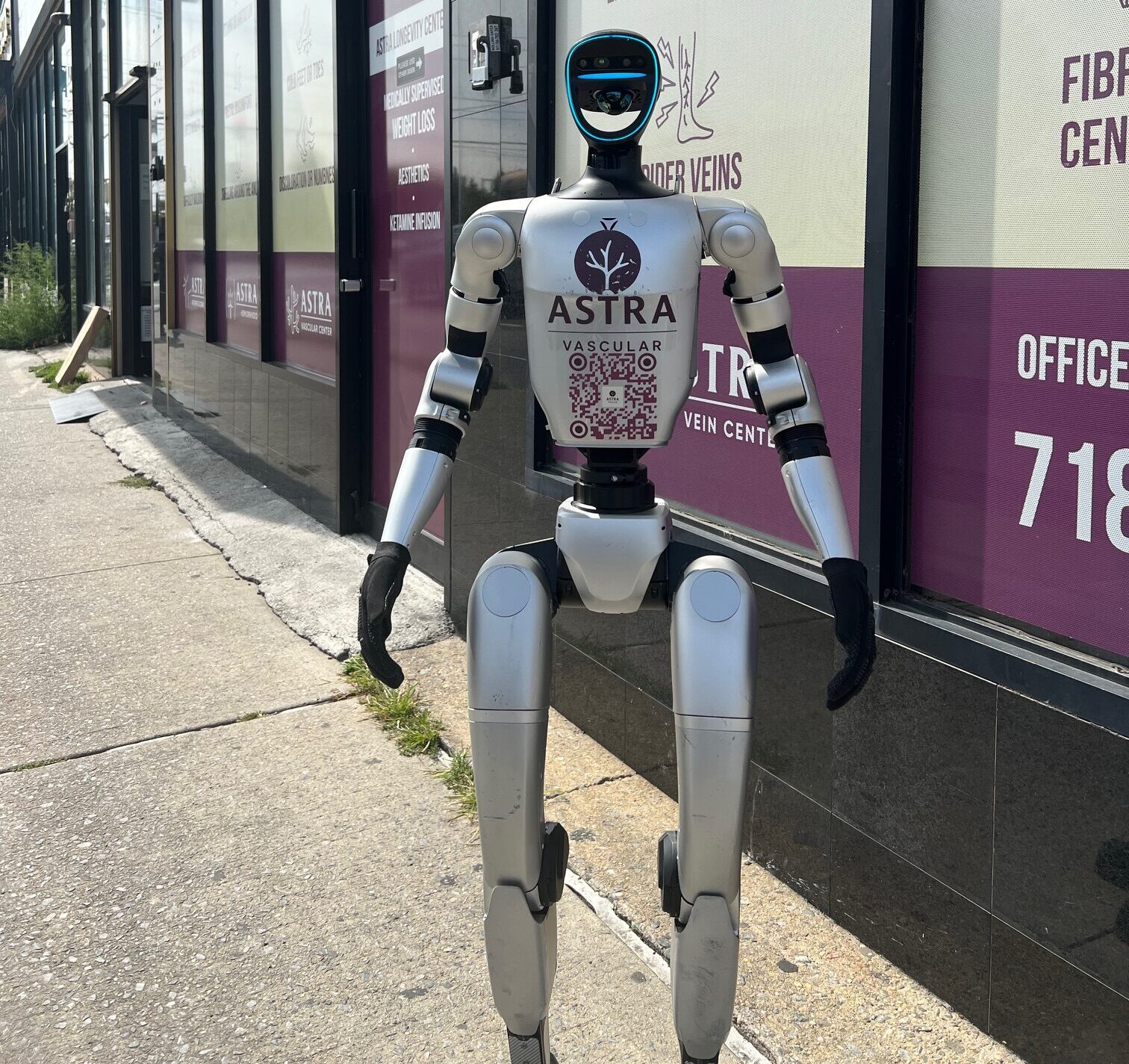
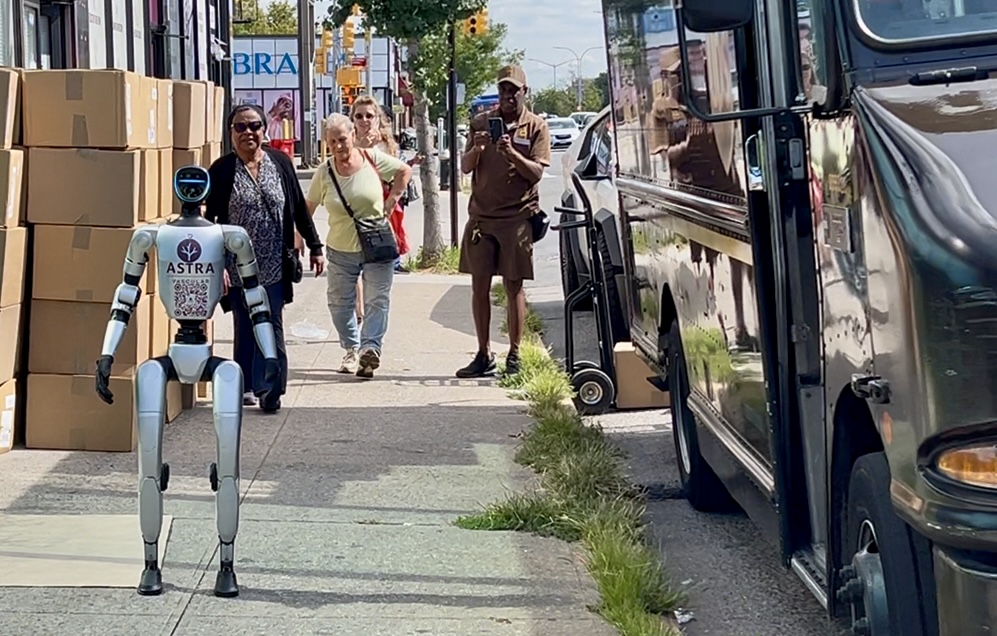
Phones whipped out to scan the QR code and record the robot’s antics as it strolled along the sidewalk, shook the hand of a passerby, clapped its hands and waved to itself as it admired its reflection in a store window.
The Astra robot in its natural setting in this technologically modern center. Photo by by Loretta Chin
“You gotta love it, man,” said one person recording the scene on his phone. “I can get rid of my dog now.”
Bolotin told the Brooklyn Eagle in an exclusive interview that he had to wait a year for the robot after ordering it from Unitree, a Chinese-based robotics company distributed through Robostore in Plainview, NY.
Sound Technician Galyna Lysetska said that technology is good and something new is always better. Photo by by Loretta Chin
He lets the robot come outside a couple of days a week. Its main purpose is advertising, but it can carry things, perform Kung Fu, run, dance and more. An added bonus is that it is useful for security surveillance. The robot operates through Bolotin’s iPhone or controller and is ChatGPT-enabled.
“He’s connected to Wi-Fi and will immediately give you an answer,” Bolotin said. “You can tell him, ‘tell me a joke,’ tell him to walk ten feet forward, turn around, and instruct him to do what you tell him.”
This man is shaking hands with Astra and trying to hold a conversation with the robot. Photo by by Loretta Chin
It uses lidar — light detection and ranging technology — which uses tiny laser beams to measure the environment, much like the way a bat uses echolocation to see in the dark but with light. The software is upgradable, and Bolotin receives regular monthly updates to gradually acclimate himself to the robot’s various functions. There is potential for other uses in the future, but any changes must be introduced carefully for safety reasons since the technology is so new.
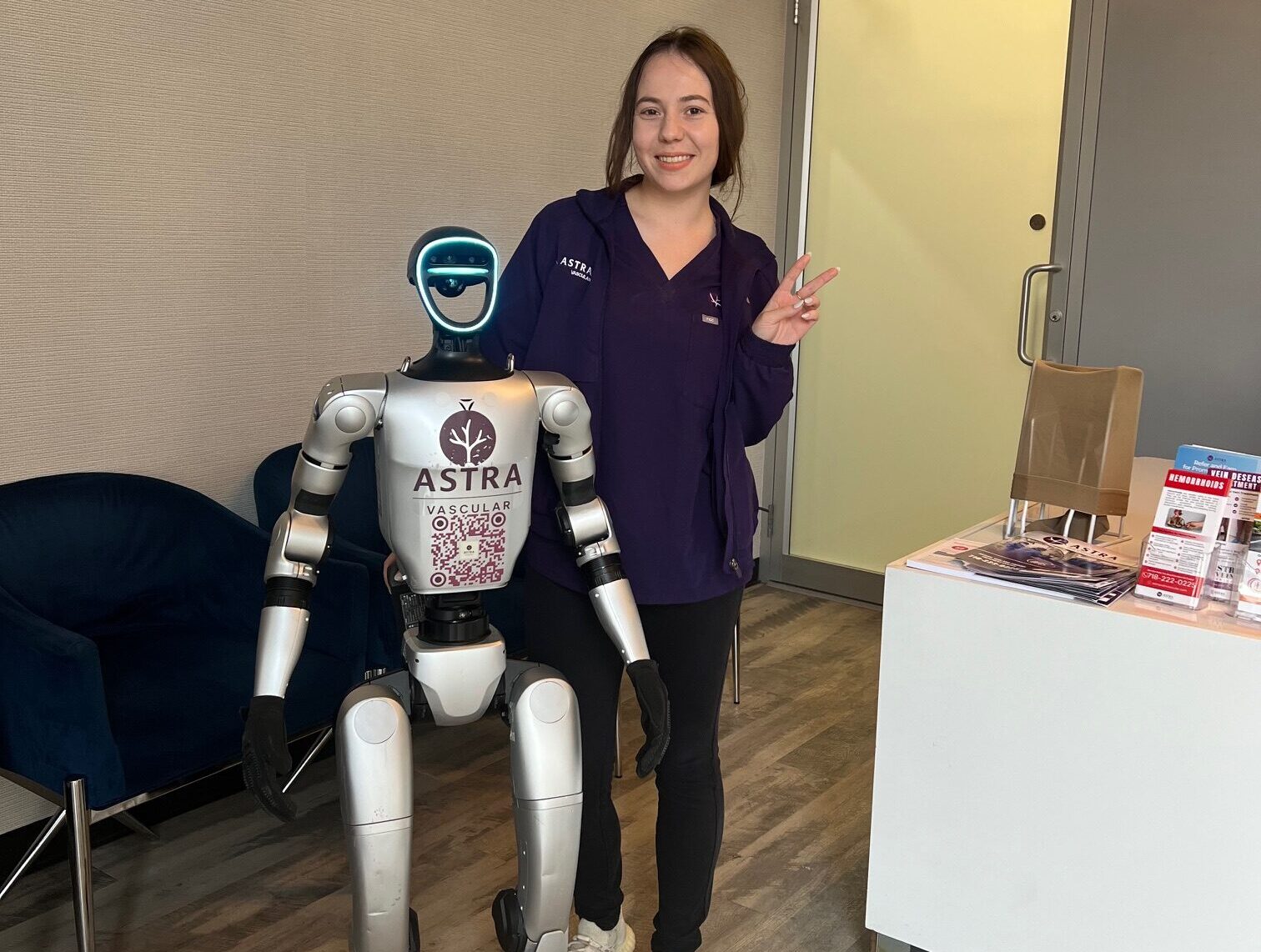
Nina Zav with Astra in the front reception area of the office. Photo by by Loretta Chin
Bolotin’s robot is a prototype, but he expressed concerns that once it becomes more natural in its movement, speech and function, these robots may come for jobs. The Agility Robotics website claims that they are helping to fill a growing labor gap. “It’s going to come very fast,” Bolotin said. “By 2028, it’s going to replace manual labor.”
Boris Kovler was visiting from Salt Lake City, UT, to help train Bolotin’s staff on modern equipment in their office. “Nice expensive toy,” he said in reaction to seeing the robot for the first time. “It’s a very impressive piece of equipment. Eventually, they are going to take over our jobs.”
Evelyn Anthony was working in the area and grabbing lunch when she was pleasantly surprised to meet Astra for the first time. Photo by by Loretta Chin
“My 6-year-old would go head over heels for that toy!” exclaimed Evelyn Anthony as she was walking by. “I would like to take him home with me.”
How many robots are out there?
Bolotin doesn’t know how many robots like his exist in the U.S., but his is the only one he knows about on the East Coast. Bolotin said the robots are mainly used for university robotics research and courses.
Astra holds hands with this little boy who gives him a thumbs up. Photo by by Loretta Chin
According to reports, another Unitree robot branded as Koid grabbed the attention of onlookers during a recent stroll through Manhattan a few months ago. It previously rang the NASDAQ opening bell, launching shares of its company, Global Humanoid and Embodied Intelligence Index ETV.
Astra is made by Unitree and is distributed through its partner, Robostore, in Plainview, NY. Photo by by Loretta Chin
Although there are other humanoid robots that glide like Robin the Robot which made its debut in June in a pilot program at St. Mary’s Hospital in Queens and the recently introduced ShopRite Tally inventory robot, one of which was spotted at their Avenue I and McDonald Avenue location in Brooklyn, there are very few humanoid robots with arms and legs.
Jack Haggerty, chief operating officer of Robostore, the largest distributor of Unitree Robotics in North America, told the Brooklyn Eagle in an email that his company has supplied hundreds of robots across the U.S. and Canada. A significant portion of those sales have been to customers in the tri-state area, including New York City.
Nina Zav, Astra and Boris Kovler give a friendly wave hello. Photo by by Loretta Chin
Currently, most robots are being used by universities, but Haggerty believes that getting them into the hands of developers is what pushes boundaries fastest since these teams can program robots to do almost anything.
He said that quadrupeds are already being adapted for industrial uses such as autonomous patrols, inspections, firefighting, and search and rescue. Humanoids will likely find early roles in warehousing, hospitality and service industries.
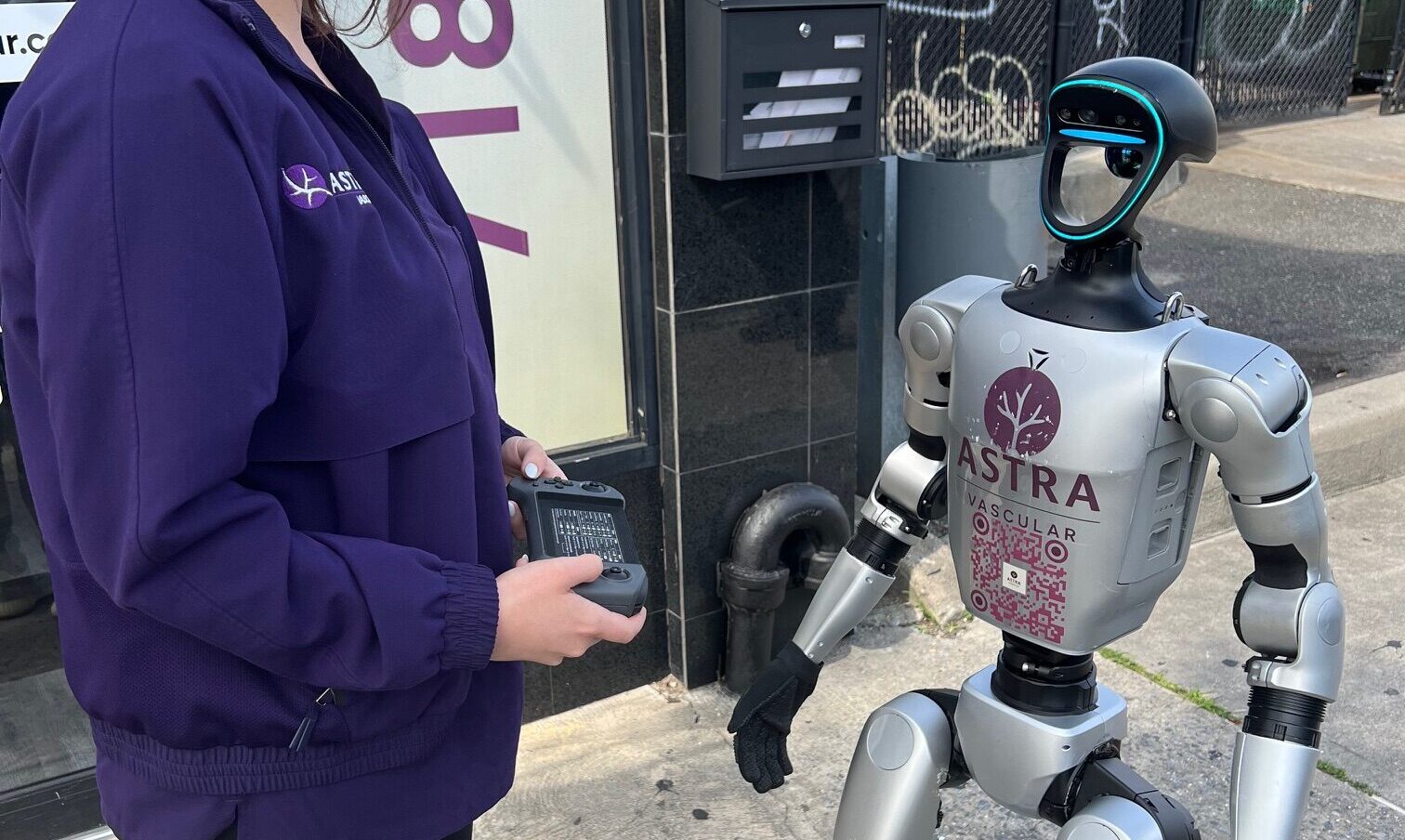
Staff member Nina Zav demonstrates the use of the remote control with Astra the robot. Photo by by Loretta Chin
“At Robostore, we are proud to be supplying innovators across NYC with the tools to shape the future of robotics,” Haggerty said. “We believe the real breakthroughs happen when the hardware gets into the hands of people with bold ideas, and it is exciting to be part of that journey here in New York.”
Brooklyn’s earliest humanoid robots to now
Dr. Ludovic Righetti, an associate professor who co-directs the Center for Robotics and Embodied Intelligence and directs the machines in motion robotics research laboratory at NYU Tandon School of Engineering in Brooklyn told the Brooklyn Eagle in a telephone interview that he researched many different types of robots. One robot is Hermes, one of the first four bipedal humanoid robots in the world designed 20 years ago. He believes that it is the first humanoid robot in Brooklyn.
People stop and stare as Astra, the humanoid robot, takes a stroll outside of the Astra Vein Treatment Center on Ave. U in Brooklyn. Photo by by Loretta Chin
The robot was a gift from the University of Southern California, and Righetti estimated the value to be around $1 million at the time. Robots today are comparatively inexpensive and come with better technology. They are being produced in larger quantities and by many more companies in the U.S.
Dr. Bolotin controls the robot’s movements while Boris Kovler looks on and records it. Photo by by Loretta Chin
Righetti recalled that Japan pioneered the consumer humanoid robot industry. Tesla was making but not selling them, and Boston Dynamics has been the leader in the U.S., making several versions for the past 15 years. The most growth has taken place in the last four to five years with companies and startups in a race to develop “agility” robots, especially in Japan, China and in Brooklyn. “If you google humanoid robots, you’re going to find 30 to 40 companies that make them,” Righetti said.
The Astra robot is a very basic model and is still a long way off from replacing someone’s job. Photo by by Loretta Chin
He said that the Brooklyn Navy Yard has about 10 startups that he is aware of and mentioned Reflex Robotics as an example of the kind of work being done today. “No more bottlenecks to growth. Just reliable workers, all day long,” the website states.
“Brooklyn is a very exciting place,” Righetti said. “It’s a place where there is lots of robotics activity right now. There’s lots of local things going on and lots of innovation here.”
With increased production, prices have now dropped significantly to under $50,000 for the latest models.
The Astra robot is controlled by Dr. Bolotin, who is in the store using his iPhone’s wireless connectivity. Photo by by Loretta Chin
Righetti said that the NYU Center for Robotics is in the process of buying some of these newer models in the coming months. “We’re discussing the different companies as there are lots of companies starting to make those robots,” he said. “20 years ago, when I started doing this research, there were almost zero companies building those robots, and it was very rare to get one, but nowadays, It’s much more common.”
Is this the start of a robotics revolution?
Dr. George Bolotin and his robot create quite a stir in front of his vein center. Photo by by Loretta Chin
“I do think it’s fair to call this a true robotics revolution,” Haggerty said. “This technology is continuing to change the way the world operates, and we’re proud to be part of this new age in tech. We are supporting today’s innovators while also helping shape the innovators of tomorrow through educational robotics.”
SUNSET PARK — “As a resident of Marine Park, one of the great surprises I found biking around Industry City and visiting Japan Village was to discover Bush Terminal Park. I continue to be amazed at the serene hideaways that the city offers in some of the busiest places — and, still, with an iconic view.”
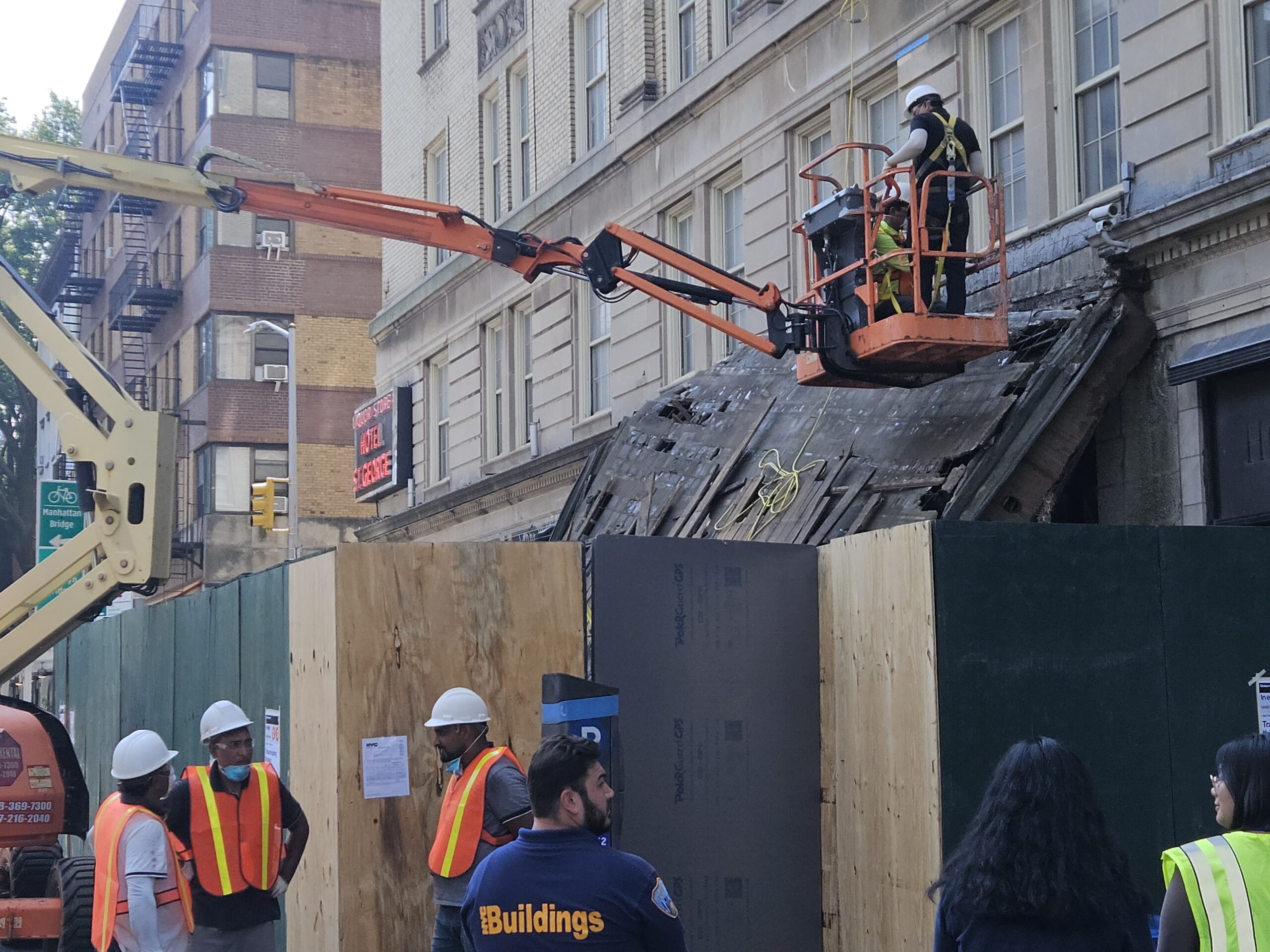
BROOKLYN HEIGHTS — ‘A miracle that no one was killed …’ That’s what neighbors are saying about the collapse of the Hotel St. George marquee. Shown in this photograph are workmen beginning the removal and repair of the historic, old neon sign at the corner, referencing a relic of Brooklyn Heights’ past: the St. George Hotel.
ATLANTIC AVENUE — Exhausted shopper with cluster of bags and goods from mall at Boerum Place stops to look at huge construction site across the street. “Is that REALLY going to be a jail??” Her male companion is reassuring, “Nothing like Rikers … this is 21st Century.”
BROOKLYN HEIGHTS — Overheard in line at one of most popular pastry outlets on Montague Street: “Hope I can get them into a camp …” A mother with two pre-schoolers in tow was showing a friend the Dodge Y flyer for Healthy Kids Day on Saturday, April 18.