IBX Brooklyn-Queens light rail advances into design phase
Interborough Express project to begin this summer
Gov. Kathy Hochul makes an IBX transportation announcement in Brooklyn. Susan Watts/Office of Gov. Kathy Hochul
By Gov. Kathy Hochul's office, with additional information from Raanan Geberer, Brooklyn Eagle
August 5, 2025
Copy Link
Email
Facebook
X
LinkedIn
WhatsApp
Telegram
Pinterest
Print
The long-awaited Interborough Express between Brooklyn and Queens has advanced from the planning stage to the engineering and design phase, Gov. Kathy Hochul announced on Friday.
The Metropolitan Transportation Authority’s board authorized the selection of a joint venture between Jacobs and HDR engineering firms as the team that will oversee the IBX’s design and engineering phase. That step represents major progress for the project, which will connect historically underserved communities in Brooklyn and Queens to the subway, bus and Long Island Rail Road.
The existing 14-mile freight line will be transformed, with the route’s end-to-end run time of 32 minutes expected to reduce travel times between Brooklyn and Queens significantly. Some of the neighborhoods in the transit desert that the IBX will serve include Borough Park, Sunset Park and East Flatbush.
“Building the Interborough Express will transform New York, connecting communities like never before, shortening commutes and unleashing the full potential of Brooklyn and Queens,” Gov. Hochul said. Susan Watts/Office of Gov. Kathy Hochul
In May, Hochul announced that ground could soon be broken when she signed legislation that was part of the state’s Fiscal Year 2025-26 budget and is considered the largest investment in New York State’s transportation history.
“Building the Interborough Express will transform New York, connecting communities like never before, shortening commutes and unleashing the full potential of Brooklyn and Queens,” Hochul said. “The IBX is the sort of project that future generations will describe as a no-brainer, and thanks to funding we secured for the MTA’s Capital Plan, we’re not just talking about it — we’re getting it done.
“It’s been talked about for more than 30 years. Most of you were not even alive then. But it’s also not just about creating the track, the stations, all the work that’s going to be involved, like lifting up about 48 bridges — which is quite extraordinary in itself. It’s about creating connections between communities. This is about bringing people together, that the outer boroughs are now joined, that there’s not a requirement that if you want to go see your mother in Queens from Brooklyn, that you have to go to Manhattan first,” Hochul said.
Gov. Kathy Hochul rides the subway from Atlantic Terminal in Brooklyn to make an IBX announcement. Susan Watts/Office of Gov. Kathy Hochul
The MTA says the IBX will be a new transit option for close to 900,000 residents living in neighborhoods along the route and 260,000 people who work near the corridor in Brooklyn and Queens. It will create 19 stations and connect with 17 different subway lines, 50 bus routes and two LIRR stations. The project will be built along an existing 14-mile freight line owned by the MTA, LIRR and CSX Corp. that extends from Sunset Park to Jackson Heights, Queens.
The IBX is the latest major transportation project that Hochul has advanced. In May, Hochul and the Port Authority of New York and New Jersey broke ground on the first phase of the new Midtown Bus Terminal project. In January, Hochul and the MTA commenced the nation’s first-ever congestion pricing program, which has successfully reduced traffic and increased economic activity in Manhattan. In July 2024, Hochul secured a $6.88 billion federal grant agreement for the Gateway Development Commission to proceed with the Hudson Tunnel Project, improving rail service for over 200,000 daily riders.
A map of the IBX’s proposed route. Map courtesy of MTA
As Raanan Geberer wrote for the Brooklyn Eagle in February, “Opposition to the light rail project has been centered in Midwood and Borough Park, where some locals have feared noise would disrupt their quiet neighborhoods. However, this feeling isn’t universal. Midwood resident Tarek Abdelaaty told THE CITY in 2022 that although he was concerned about potential noise and air pollution, the line could help him and his family travel to Queens more frequently.”
“The last streetcar line in New York City, which went over the Queensboro Bridge, was discontinued in 1957,” Geberer continued. “Light rail vehicles are similar to traditional streetcars but can hold more passengers. Until recently, New York City bureaucrats have been rather hostile to the idea of streetcars and light rail — possibly a legacy of 1940s-era Mayor Fiorello La Guardia, who couldn’t wait to see streetcars replaced by buses.
“By contrast, other cities, such as Boston and Philadelphia, have retained their lines, and some have even built new ones,” Geberer said. “If one wants to see a light rail line in operation, go no further than Hudson County, New Jersey, where the Hudson-Bergen Light Rail Line, opened in 2000, connects Union City, Hoboken, Jersey City and Bayonne.”
Design Progress
Hochul’s office says the project design will officially kick off this summer. It will focus on light rail system design, including communications, signals, vehicles and tracks. Civil engineering efforts will concentrate on stations, bridge reconstruction, retaining walls, and designing of the operations facility and storage yard. This process is the last major step in the project before formal construction begins.
The MTA says the project has undergone further refinement to ensure that it will provide the best service for passengers at the best value. In Middle Village, Queens, the agency is progressing with the design of a tunnel solution beneath Metropolitan Avenue, rather than on-street operations, making the proposed line less prone to travel delays due to mixed traffic operations. This refinement has reduced projected running times of the new line from 39 minutes to 32 minutes and has increased ridership projections to 160,000 per day, up 50,000 from the transit group’s prior estimate. IBX’s projected annual ridership is higher than the current ridership of any other light rail system in the country at 48 million riders — the next largest is Los Angeles at 46 million riders per year.
Light Rail was determined to offer the best service to riders at the best value to the MTA, with about 70% of projected IBX riders transferring within the city’s transit system. Station locations were selected based on public feedback, ridership projections, riders’ ability to transfer to other parts of the MTA network, constructability and spacing.
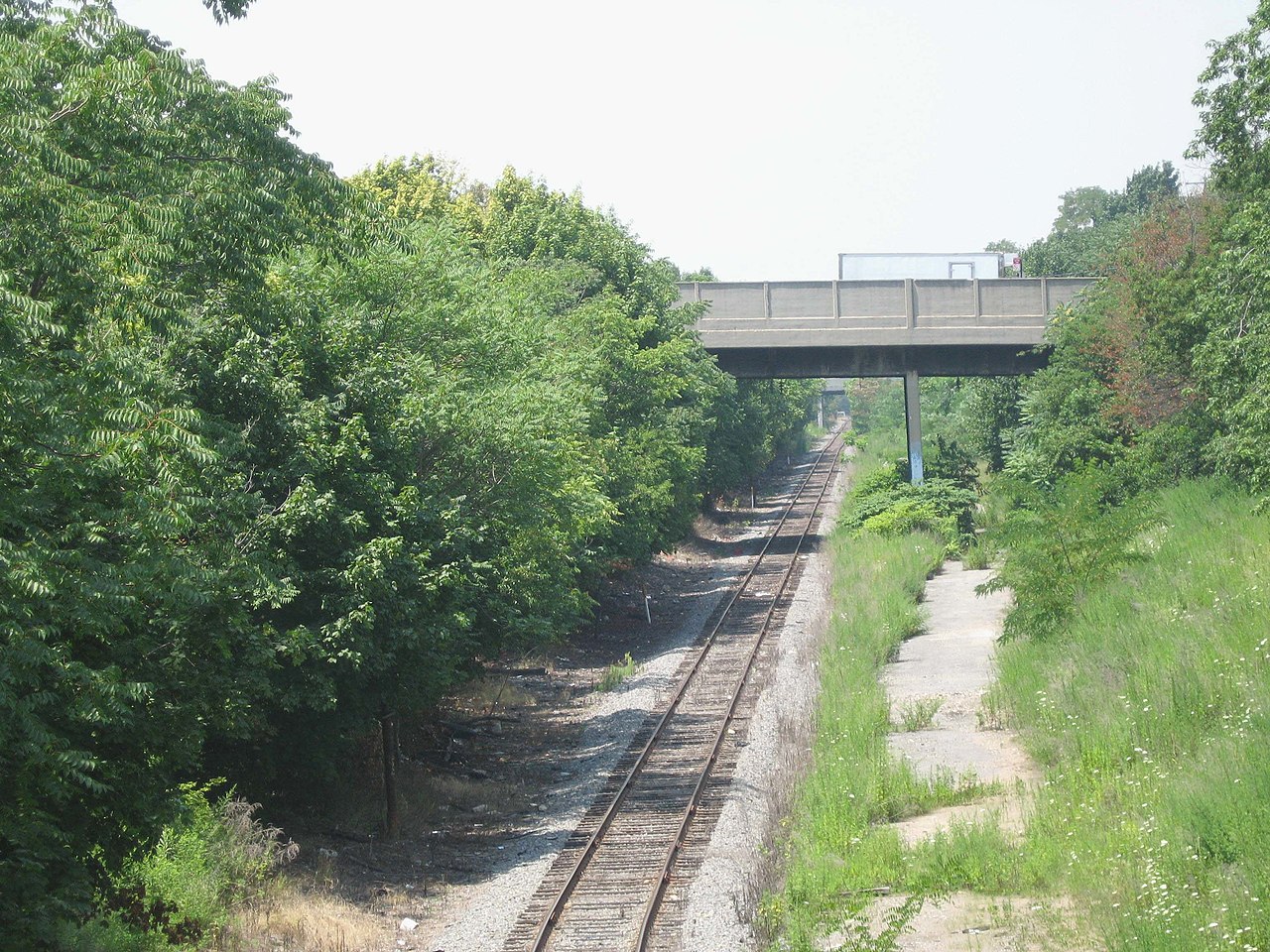
The present-day Bay Ridge Freight Line, looking west from 14th Avenue. New tracks would be built to accommodate the light rail trains. Wikimedia photo by Jim Henderson
Funding
The MTA says the project design phase will be principally funded through $45 million secured by Hochul in New York State’s 2025 budget and the MTA’s 2025-2029 Capital Plan. An additional $15 million was awarded by the United States Department of Transportation’s Rebuilding American Infrastructure with Sustainability and Equity grant, which will fund a corridor assessment supporting the design phase. USDOT has also provided $1 million to fund innovative finance expert services for the project. The estimated cost of the IBX project is $5.5 billion, with 50% of the total funding secured by Hochul in the MTA’s 2025-2029 Capital Plan.
Since 2023, the MTA has hosted 10 open houses attended by nearly 1,000 community members along the route to raise awareness and gather feedback. Also, pop-up outreach events were held at 10 subway stations across the IBX corridor, speaking with 1,300 members of the public and over 250 businesses. Every quarter, the MTA hosts a virtual assembly on the project with elected officials, neighborhood groups and community boards.
An artist’s rendering of a proposed Interborough Express station at Wilson Avenue in Brooklyn, showing a light rail train, a freight train and the entrance to the subway system’s L train station. Rendering courtesy of MTAA light rail track and train on the planned Interborough Express. Rendering courtesy of MTA
SUNSET PARK — “As a resident of Marine Park, one of the great surprises I found biking around Industry City and visiting Japan Village was to discover Bush Terminal Park. I continue to be amazed at the serene hideaways that the city offers in some of the busiest places — and, still, with an iconic view.”
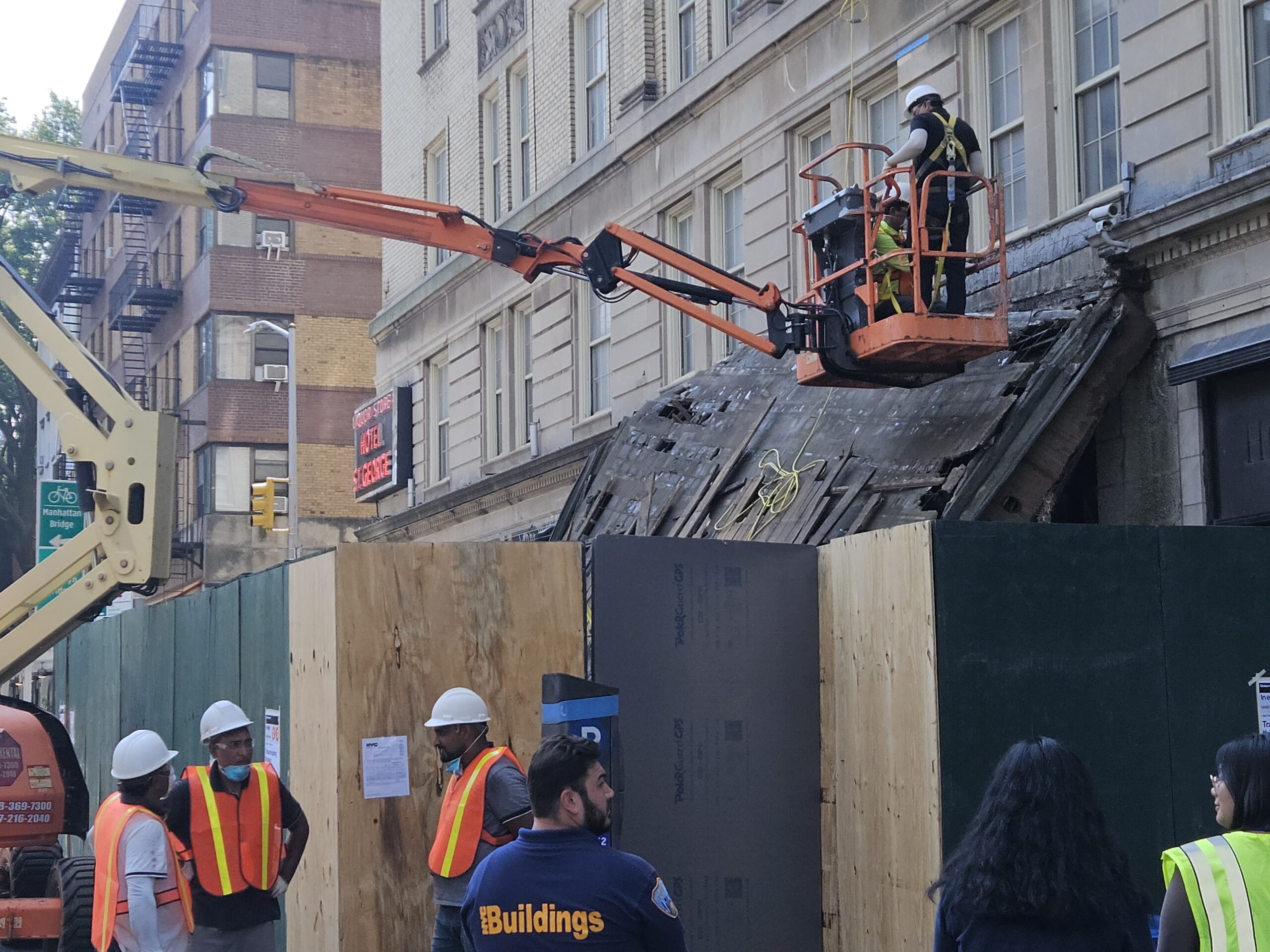
BROOKLYN HEIGHTS — ‘A miracle that no one was killed …’ That’s what neighbors are saying about the collapse of the Hotel St. George marquee. Shown in this photograph are workmen beginning the removal and repair of the historic, old neon sign at the corner, referencing a relic of Brooklyn Heights’ past: the St. George Hotel.
ATLANTIC AVENUE — Exhausted shopper with cluster of bags and goods from mall at Boerum Place stops to look at huge construction site across the street. “Is that REALLY going to be a jail??” Her male companion is reassuring, “Nothing like Rikers … this is 21st Century.”
BROOKLYN HEIGHTS — Overheard in line at one of most popular pastry outlets on Montague Street: “Hope I can get them into a camp …” A mother with two pre-schoolers in tow was showing a friend the Dodge Y flyer for Healthy Kids Day on Saturday, April 18.