The street-crime police units are back under Mayor Adams with a new name. Officials say they will be looking for guns in 30 precincts. Can you record them on your phone? Do they have to provide ID? We answer these questions and more.
NYPD officers with body cameras.
Photo by Ben Fractenberg/THE CITY
While campaigning for mayor, former cop Eric Adams vowed to bring back New York’s controversial plainclothes anti-crime police teams, sometimes holding press events near the scenes of recent shootings to make his point.
He took heat for the idea, as community members and activists pointed out those types of units have often used aggressive and sometimes violent tactics.
Twice — in the late 1990s and again in 2020 — the units were disbanded and reassigned.
Over the years, so-called anti-crime and other plainclothes units generated a mountain of civilian complaints and were at the center of a “staggering number” of killings, with little consequence.
Adams’ victory was partially driven by huge win in neighborhoods where the most shootings take place. He has made addressing gun violence a central part of his first year in City Hall.
As part of his Blueprint Against Violence released in January, he outlined the return of the anti-gun teams as a way to tackle a rise in shootings, specifically.
Now being called Neighborhood Safety Teams (NSTs), squads in unmarked vehicles and “modified” uniforms across 30 precincts will be composed of five police officers and one sergeant each.
Their mission, according to NYPD Chief of the Department Kenneth Corey, is to “proactively suppress violent major crimes and illegal gun possession through precision policing,” he said at a March 16 news conference.
NYPD leadership and the mayor have said the units will be given new training and oversight to make sure officers don’t commit the rights abuses and brutality seen before. Adams has also said their clothes will be more identifiable as police.
But civil rights advocates have serious doubts much will change.
“When a team culture is aggressive and abusive, and believes they’re above the law, that’s really a problem. And it’s going to take more than a partial uniform and a seven-day training to undo that culture,” said Molly Griffard, staff attorney with the Cop Accountability Project at the Legal Aid Society.
South Bronx Councilmember Rafael Salamanca at a Monday press conference with the mayor said new units are “exactly what communities like mine are asking for.”
“Regardless of what the naysayers may say, this is exactly what we needed,” he said “We needed a specialized neighborhood street team that will help reduce crime and take these guns off our streets.”
Your Rights if an NST Officer Approaches You
Even though there is a unit with a new name, “nothing has changed in terms of the legal landscape of the rights that we as New Yorkers have,” said Gifford.
Basic constitutional protections for a police stop still apply, the foremost of which is:
You have the right to remain silent, even before that phrase is specifically said.
“You always have the right to say, ‘I would like to remain silent.’ You don’t have to be read your Miranda rights to say that. You can say that of your own free will,” said Jacqueline Gosdigian, senior policy counsel at Brooklyn Defender Services.
That is important because even in a casual conversation a cop could be investigating you, noted Michael Sisitzky, senior policy counsel at the New York Civil Liberties Union.
Mayor Eric Adams attends a training in College Point, Queens for one of the NYPD’s new Neighborhood Safety Teams, March 16, 2022. Photo by Ed Reed/Mayor’s Office
“When an officer is starting to ask questions, you’re not going to know all the reasoning behind why you’ve been stopped, or why an officer’s pursuing a certain line of questioning, and you don’t know what they’re going to do with that information,” he said.
For example, if a burglary just took place nearby and you tell an officer you were just walking from that direction, that could “raise a red flag for them,” he said.
“The more you say, the more you are giving an officer to potentially use against you,” he said. “Which is why the right to remain silent is so powerful.”
You can ask, “Am I free to leave?”
Remember that, if an officer doesn’t have “reasonable suspicion,” they can’t make you stay, said Sisitzky.
“If you don’t want to have any further interaction with that officer, tell them that you’re not going to answer questions, but ask them if you’re free to leave. If the officer says yes, that you’re free to leave, that you’re not being detained, you can feel free to walk away from that encounter,” he said.
You do not have to consent to a search of your body, vehicle or home.
Sisitzky also reminds New Yorkers that “if an officer is trying to search you, you can say no” and you should say it clearly, out loud. Of course, it doesn’t always mean they will stop.
“It’s important to say that to have it on the record, in case the officer recovers evidence as the result of an illegal search,” he said.
You don’t have to show identification — unless you are a cop.
In New York, Gosdigian said, you are not required to carry identification and “you do not have to show ID to a police officer.”
But cops do: “If the officers are investigating criminal activity, they’re required to identify themselves to you and let you know the reason that they’re interacting with you,” she said.
Police legally need a warrant signed by a judge to unlock your phone.
If an officer takes your phone, they are not supposed to search it and they’ll need a warrant to actually go into your phone, said Sisitzky.
Even though the law may be on your side, arguing your rights could put you in harm’s way with a cop who doesn’t care.
“Confronting officers in that moment can be dangerous, especially as we’ve seen a history of these anti-crime and street crime officers who are incredibly aggressive and who have been responsible for a disproportionate share of police killings of unarmed people,” said Griffard.
She said the Legal Aid Society encourages clients “to take your safety first.”
Can You Record Police Encounters on Your Phone?
Adams has said that New Yorkers should be more careful about filming — and admonished people who interfere with the police’s work.
“If an officer is trying to prevent a dispute from taking place and de-escalate that dispute, they shouldn’t have someone standing over their shoulders with a camera in their face yelling and screaming,” the mayor said Wednesday.
“There’s a proper way to police and there’s a proper way to document,” he added. “Stop being on top of my police officers while they are carrying out their jobs. That is not acceptable and won’t be tolerated.”
That comment from the mayor “really concerned” Gosdigian because “you absolutely have a right to record the police and to record any of these police citizen encounters,” she said.
Sisitzky agrees.
“The right to record police activities is pretty clearly established in New York. It’s a right that exists under the First Amendment. It’s also a right that has been explicitly added to both New York State and New York City law,” he said.
But that doesn’t mean people can interfere with an officer’s work. You can’t physically get in the way, Sisitzky said. But you do have the right to “stay there and film it.”
“It’s really critically important because so much of what we’ve learned about some of the most notorious examples of police violence, we’ve learned from cell phone footage,” he said.
How Did We Get Here?
In recent New York City history, plainclothes and anti-crime units have gone by many names.
The first Street Crime Unit, or SCU, was formed in 1971 and given lots of latitude in the 1990s to act aggressively and make stops for low-level crimes in the hopes of nabbing illegal guns.
By 1999, The New York Times reported that SCU was responsible for 40% of illegal guns seized in the city while comprising only 2% of the force.
But the division also gained a reputation for aggressive stops and loose trigger fingers — including in the unprovoked fatal shooting that same year of 23-year-old Guinean student Amadou Diallo, who had nothing but a wallet in his hand in front of his Bronx home.
Amid multiple lawsuits and a federal investigation, then-Police Commissioner Raymond Kelly disbanded the unit in 2002.
SUNSET PARK — “As a resident of Marine Park, one of the great surprises I found biking around Industry City and visiting Japan Village was to discover Bush Terminal Park. I continue to be amazed at the serene hideaways that the city offers in some of the busiest places — and, still, with an iconic view.”
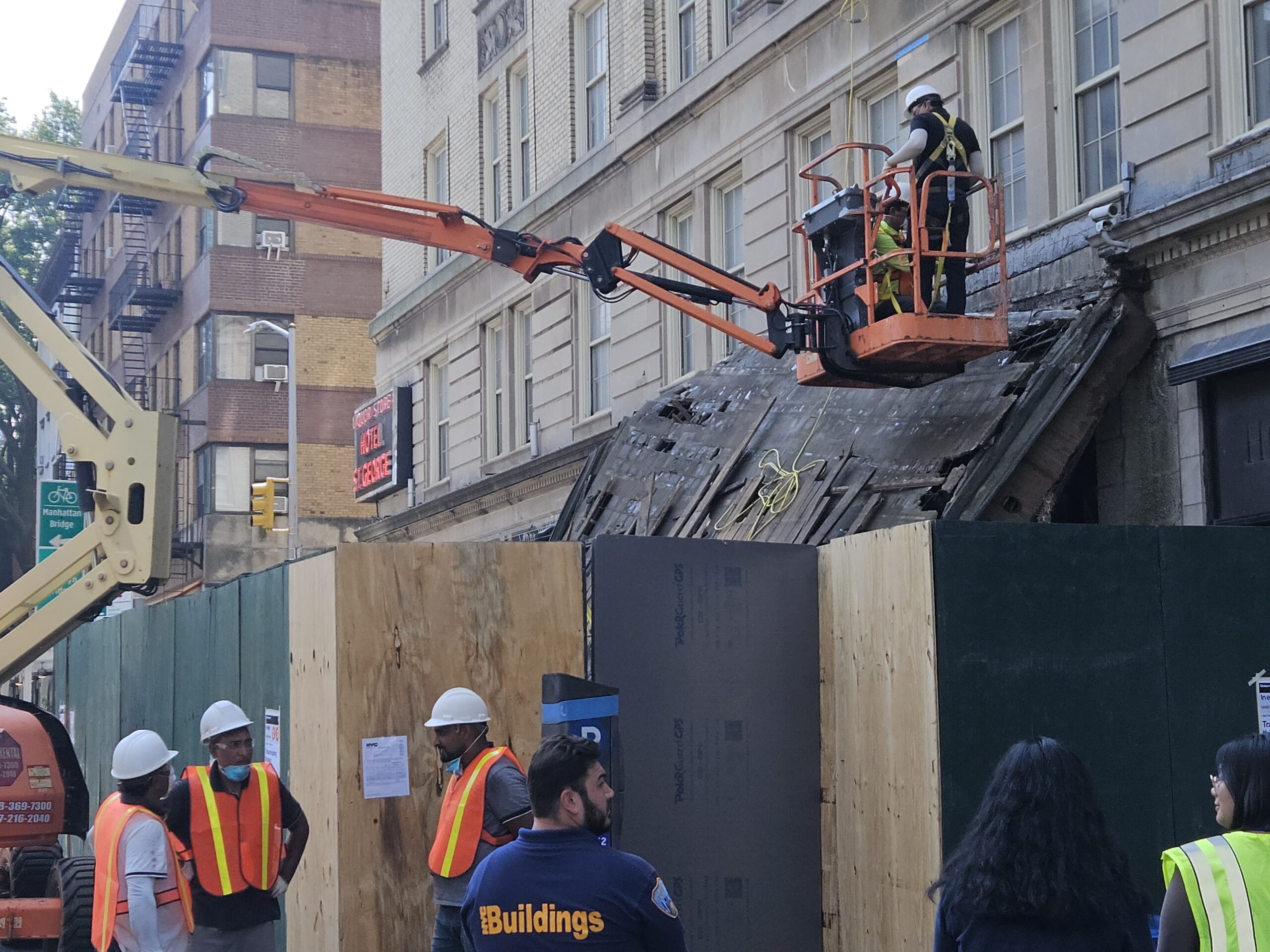
BROOKLYN HEIGHTS — ‘A miracle that no one was killed …’ That’s what neighbors are saying about the collapse of the Hotel St. George marquee. Shown in this photograph are workmen beginning the removal and repair of the historic, old neon sign at the corner, referencing a relic of Brooklyn Heights’ past: the St. George Hotel.
ATLANTIC AVENUE — Exhausted shopper with cluster of bags and goods from mall at Boerum Place stops to look at huge construction site across the street. “Is that REALLY going to be a jail??” Her male companion is reassuring, “Nothing like Rikers … this is 21st Century.”
BROOKLYN HEIGHTS — Overheard in line at one of most popular pastry outlets on Montague Street: “Hope I can get them into a camp …” A mother with two pre-schoolers in tow was showing a friend the Dodge Y flyer for Healthy Kids Day on Saturday, April 18.