Go forth and build that 29-story tower — right next to the landmarked Church of St. Luke and St. Matthew.
On Tuesday, the city Landmarks Preservation Commission (LPC) approved Hope Street Capital’s revised Clinton Hill tower-construction design and its plan to do facade restoration at the neighboring church.
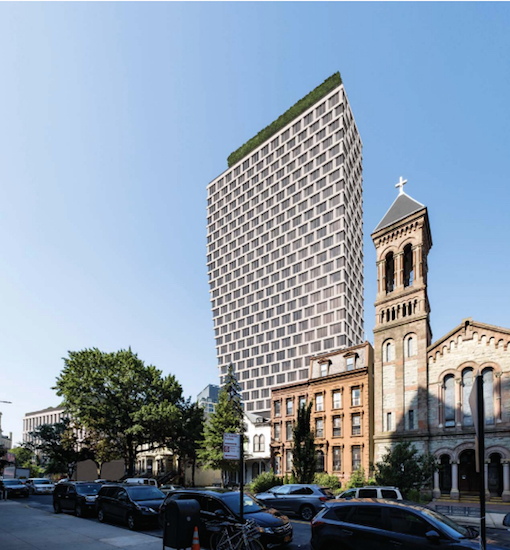
The new tower will be located at 550 Clinton Ave.
The Northern-Italian Romanesque church is an individual city landmark. It is located at 520 Clinton Ave. It was designed by architect John Welch and built between 1888 and 1891.
Jeffrey Gershon’s development firm is required to come up with a maintenance program for the historic church in order to get a special zoning permit under Section 74-711 of the city Zoning Resolution.
Hope Street Capital and the church will combine their properties into a single zoning lot so 60,000 square feet of air rights from the church can be used in the development.
As far as Section 74-711 proposals are concerned, “This is a textbook case of how it’s done right,” Commissioner Michael Goldblum said before the LPC’s unanimous vote of approval.
LPC Chairwoman Meenakshi Srinivasan said she was “very pleased” with the proposal.
A clear view of the iconic belfry
This was Hope Street Capital’s second go-round with the preservation agency about the Clinton Hill development project.
In its first appearance before the LPC in January, the firm drew criticism from commissioners for the quality of the materials it planned to use in its church-facade restoration.
At Tuesday’s public meeting at the Landmarks Preservation Commission’s Lower Manhattan headquarters, Judith Saltzman of Li/Saltzman Architects knocked it out of the park with her revised plan for church repairs.
Commissioners applauded her plan, which primarily entails retooling the damaged stone on St. Luke and St. Matthew’s polychromatic facade.
In spots where the historic stone absolutely must be replaced, brownstone from England will be used — or Li/Saltzman Architects might obtain stone that’s salvaged from another Brooklyn church.
Also, architect Morris Adjmi, who designed the pre-cast concrete and glass apartment tower, made subtle tweaks to his initial plans.
The bottom floors of the tower are designed so that they look like they’re twisting.
In the initial version of his design, this made it look like the tower was leaning over the church’s iconic belfry, some commissioners had said at the January hearing.
On Tuesday, Adjmi pointed out that his revised design twists much less and doesn’t look like it’s leaning over the belfry.
Commission Chairwoman Srinivasan said the revised tower design is “much more subtle.”
The 312-foot-tall tower will sit atop a retail base that will wrap around Clinton Avenue, Atlantic Avenue and Vanderbilt Avenue.
According to city Finance Department records, Hope Street Capital rents the development site through 99-year leases.