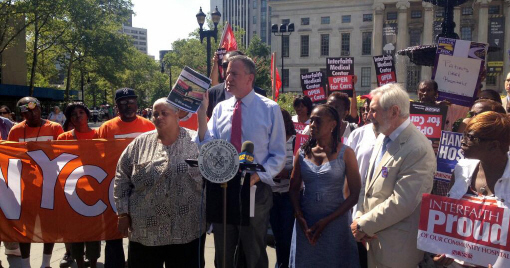
A report released by Public Advocate Bill de Blasio on Friday warns of “devastating consequences” if Interfaith Medical Center closes next month.
Interfaith is Brooklyn’s largest private provider of psychiatric care, with 67,000 patients receiving out-patient care and 1,750 in-patient hospitalizations each year.
According to de Blasio’s report, “Tearing the Safety Net,” losing those services would push remaining hospitals across Brooklyn to 107 percent capacity, and leave tens of thousands of Brooklyn psychiatric patients without care.
Interfaith, serving Bedford-Stuyvesant and Crown Heights, has already sent layoff notices to its 1,544 employees. Interfaith declared bankruptcy in December and announced on August 1 it was beginning the process of shutting down. Its closure, however, has been postponed until an August 26 bankruptcy hearing.
At a press conference on Friday, de Blasio said, “as it is, mental health isn’t address enough,” and urged the city, state and hospital’s board to come to negotiate an “orderly restructuring that preserves vital services, including psychiatric care.”
De Blasio is also calling on the federal government to waive a cap on the percentage of patients with mental illness a hospital like Interfaith is permitted to accept.
“These haphazard closures are stripping neighborhoods of clinics and emergency rooms. Here at Interfaith, we could lose the single biggest private provider of psychiatric care in all of Brooklyn. There’s no contingency here, and Brooklynites will pay the price if this shutdown goes forward,” de Blasio said in a statement.
De Blasio, a mayoral candidate, is also the strongest elected advocate for Long Island College Hospital (LICH) in Cobble Hill, and is fighting SUNY Downstate’s plan to close LICH in court.
Calling the potential hospital closures a health crisis, de Blasio has called for the creation of a Brooklyn Health Authority, with sweeping but temporary powers to transform hospitals across the borough. The Authority would prevent hospitals from closing without alternatives in place.
According to de Blasio’s report, 60 percent of all patients discharged from Interfaith have a psychiatric condition as either the principal diagnosis or comorbidity, compared to 27 percent across Brooklyn.
De Blasio recommended the follow steps to aid in Interfaith’s restructuring:
· Waive the cap on the percentage of patients with mental illness Interfaith is permitted to admit. Right now, hospitals cannot receive Medicaid matching funds if more than 51 percent of their patient roster consists of people between the ages of 22 and 64 with severe mental illness. This common sense change would allow Interfaith to accept more psychiatric patients, shoring up their balance sheets and stabilizing the hospital.
· Better integrate the City’s Health and Hospitals Corporation into existing health networks, by accepting referrals from voluntary hospitals, and stepping in to provide services when voluntary hospitals are insufficient or unable to meet community care needs.
· Establish the Brooklyn Health Authority, empowered through control of Federal Medicaid Waiver finds to guide a master plan for the equitable reorganization and reform of Brooklyn hospitals and health care. The authority should encourage existing hospitals with excess beds to transform some of their beds into inpatient psychiatric beds in order to meet the growing demand for psychiatric care across Brooklyn.
“The patients who would be most affected by Interfaith’s closure are also the most vulnerable — individuals who are struggling with the impact of severe mental illness,” Dr. Flavio Casoy, Executive Vice President of the Committee of Interns and Residents/SEIU Healthcare and a Psychiatry Fellow, said in a statement. “Not only are these diseases catastrophic and deeply marginalized, but they also make it very hard for these patients to access medical care, putting them at higher risk for chronic diseases including diabetes, heart disease, and cancer.
The full report can be found at: www.advocate.nyc.gov/Interfaith