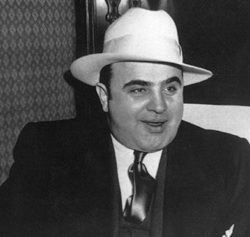
Alphonse (Al) Capone was born in Brooklyn on Jan. 17, 1899, the first American-born child of parents who had immigrated to the U.S. from Naples, Italy, in 1893.
His father, Gabriel Capone (born Caponi) was lured to America, the land of promise and golden opportunity. Unfortunately, the reality of the Red Hook neighborhood he wound up in differed drastically from his fantasies. The poor, illiterate immigrant failed miserably in his attempts to adapt to his new country. Working first as a grocer and then as a barber, Capone’s father could barely pay the monthly rent, averaging between $3 and $4.50 per room in turn-of-the-century New York. His wife Teresa added to the family coffers by working as a dressmaker. Their progeny — seven boys, two girls — were born at the rate of one every three years. Though the father of our country’s most famous gangster could not read, write or speak English, he was able to claim U.S. citizenship in 1906 — one month before the laws required these skills.
Al, the fourth of the nine siblings, quit school after hitting his sixth grade teacher (she hit him first — not uncommon in those days). He attended P.S. 133. Daniel Fuchs, a reformed member of a Jewish street gang in Brooklyn (and later a noted screenwriter and novelist), recalled: “[Capone] is remembered as something of a non-entity, affable, soft of speech and even mediocre in everything but dancing.” Fuchs further recalled, “When this Brooklyn boy made ‘good’ in the world, the surprise was general among his old friends and acquaintances.”
Capone joined Johnny Torrio’s James Street Boys gang, rising eventually to the Five Points Gang where he displayed some aptitude for personal violence. In a youthful scrape in a saloon in Coney Island, a young hoodlum slashed Capone with a knife or razor across his left cheek from ear to lip, prompting the later nickname “Scarface.”
Capone worked as a bartender and bouncer in Coney Island before Johnny Torrio moved to Chicago to help run the giant brothel business there. He needed a bodyguard and enforcer so Capone was summoned to join the Chicago underworld in 1919. It was either Capone or Frankie Yale who allegedly assassinated Torrio’s boss, Big Jim Colosimo, in 1920, making way for Torrio’s rule.
As Prohibition began, new bootlegging operations opened up and drew in immense wealth. In 1925 Torrio retired and Capone became crime czar of Chicago, running gambling, prostitution and bootlegging rackets and expanding his territories by the gunning down of rivals and rival gangs. His wealth in 1927 was estimated at close to $100 million. To play it safe in his Chicago regime, Capone was driven around the area in a seven-ton, custom-built armored limousine. Its rear window folded down for use as a gun port.
The most notorious of the blood lettings associated with Capone was the St. Valentine’s Day Massacre on Feb. 14, 1929, aimed at the Bugs Moran gang. Seven men were lined up against a garage wall on Chicago’s northside. Over a thousand machine gun bullets were fired at them. Heads and legs were nearly severed from bodies. A pool of blood formed, forty feet wide. The cops questioned Bugs Moran about it. “Only the Capone gang kills like that,” said Moran.
But Capone was never charged with the crime, and a new book about the arch criminal (Get Capone, 2010) by Jonathan Eig uses never-before-revealed FBI files to make the case that Capone was not behind the massacre. (The book points instead to a notorious gunman named William White who was most likely seeking revenge for the Moran gang’s murder of his cousin, William Davern.)
It was tax evasion that took Capone down. In June 1931 he was indicted for federal income-tax evasion and in October was tried, found guilty and sentenced to 11 years in prison and $80,000 in fines and court costs. He entered an Atlanta penitentiary in May 1932 but was transferred to the new Alcatraz prison in August 1934.
In November 1939, suffering from the general deterioration of paresis (a late stage of syphilis), Capone was released and entered a Baltimore hospital. Later he retired to his Florida estate, where he died in 1947, a powerless recluse. His mother died at 85, outliving the son who had become Public Enemy No. 1. But until the end she maintained, “Al’s a good boy.”