DUMBO — A New York Police Department drone, which had been hovering near the FIFA World Cup Fan Zone in Brooklyn Bridge Park last week, crashed to the ground and caught fire.
According to the New York City Fire Department, just after 9:40 p.m. on Tuesday, the drone crashed at 1 Water St. near Emily Warren Roebling Plaza, site of the Fan Zone. The drone came down south of the Fan Zone’s main entrance.
The soccer match between Panama and Croatia had wrapped up around 8:30 p.m., but the Fan Zone — with World Cup-related entertainment, food and retail — was unaffected by the crash and remained open through its normal closing time of10 p.m.
According to the NYPD’s Public Information desk, officers were operating the drone above the park when the unit “had a malfunction and fell from an elevated position,” causing the lithium-ion battery to catch fire.
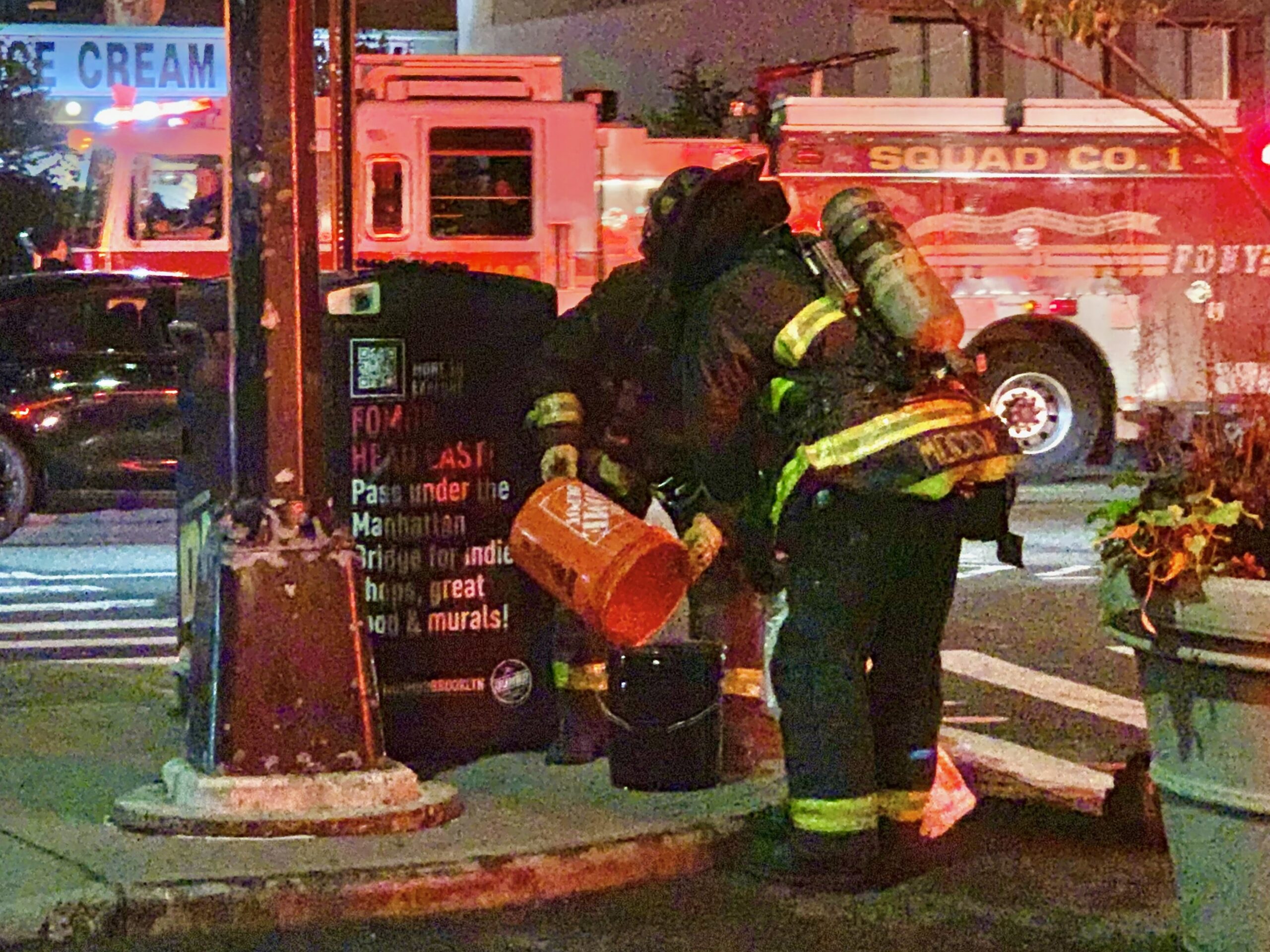
An FDNY spokesperson told the Brooklyn Eagle that the department received an alert that the drone’s battery was “smoking.” One fire engine, one ladder truck and a hazmat unit responded and mitigated the situation, the spokesperson said. The fire did not spread and no injuries were reported. FDNY closed the incident at 10:26 p.m.
Afterward, members of NYPD’s Technical Assistance Response Unit were seen packing a recovered piece of the drone into the back of an SUV. According to the city, TARU operates the department’s roughly 100 drones, officially called Unmanned Aerial Vehicles.
The cause of the incident has not yet been determined.
A spokesperson for drone manufacturer Skydio told the Eagle, “We are aware of the incident involving an NYPD drone and are working closely with the NYPD to understand what occurred. We have analyzed available flight logs and have found no evidence of a safety malfunction that could have caused the incident.”
The spokesperson said that safety is the highest priority at the company. “Skydio drones have multiple safety and reliability features that enable operations in a wide variety of conditions and over urban areas. We will continue to support NYPD’s review and will share appropriate updates as it progresses.”
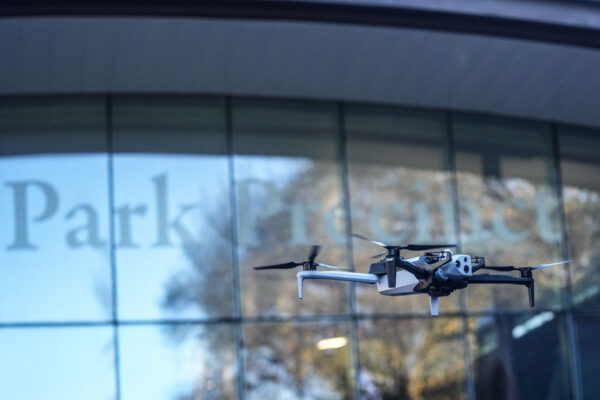
Former Mayor Eric Adams introduced the “Drone as First Responder” program in November 2024. One of the ten original drones is shown here. Photo: Michael Appleton/Mayoral Photography Office
NYPD’s ‘Drone as First Responder’ program
NYPD uses drones of various capabilities for a growing number of operations. The city’s mandatory quarterly report shows police drones were used for 2,595 operations during the first three months of this year: 1,246 times in Brooklyn — the borough with the most NYPD drone usage — followed closely by the Bronx with 1,011 uses. NYPD drones were used 174 times in Queens, 162 times in Manhattan and just twice in Staten Island during the same time period.
The main reason drones were used in Brooklyn was listed as “Drone as First Responder” — i.e., responding to 911 calls, alerts from the ShotSpotter gunshot detection system, search and rescue, or incidents of crimes in progress. The DFR program, initiated by former Mayor Eric Adams in November 2024, currently relies on Skydio X10 drones.
NYPD also deploys Skydio drones for crowd control, monitoring protests, tracking subway surfers, and “getting help where it’s needed,” according to the company’s social media pages.
In addition, NYPD utilizes drones made by BRINC and DJI, which may have specialized capabilities including dropping floatation devices to people in the water, breaking windows or squeezing into small spaces, according to NYPD’s “Unmanned Aircraft Systems: Impact and Use Policy,” updated Feb. 4.
Depending on how they are equipped, X10 drones can cost anywhere from $15,000 to $30,000 or more, according to various online sources. (Skydio does not publish its prices.) At the high end, the NYPD paid $87,750 in June for a Lemur 2 drone manufactured by BRINC, with night vision and thermal sensors, according to Gothamist.
In 2024, the Federal Aviation Administration allowed the NYPD to fly drones “beyond-visual-line-of-sight” across much of the city, increasing the ability of the department to use drones as first responders, according to Skydio. The FAA is currently considering a rule change which would expand BVLOS drone operations to commercial and civic uses.
A member of NYPD’s Technical Assistance Response Unit packs a recovered piece of the drone into the back of an SUV on Water Street. Photo: Mary Frost/Brooklyn Eagle
Not the first NYPD drone fire
Lithium-ion batteries can be especially dangerous in drones because mechanical damage from a crash can cause the internal separator to fail, resulting in a spontaneous, self-fueling failure known as thermal runaway, according to Underwriter Labs Research Institute.
This is not the first time an NYPD drone has caught fire in Brooklyn. On May 12, 2025, a Skydio X10 drone used by the 71st Precinct in Crown Heights caught fire after landing on the roof of the precinct. The fire was put out with an extinguisher, and there was no property damage. Skydio’s CEO Adam Bry said on LinkedIn that the root cause of the crash had been determined to be “battery connector wear.”
Bry said that after the 2025 incident, the company had identified a telemetry signature for its drones showing early warning signs of battery connector wear. The company is monitoring X10 analytics, and contacting customers whose units show signs of excessive battery connector wear, he said.
Police and fire vehicles blocked Water Street after the NYPD drone crash. The adidas World Cup Fan Zone can be seen, brightly lit, in the background. Photo: Mary Frost/Brooklyn Eagle
NYPD has increased use of license plate readers, drones and now, anti-drones
The police department has upgraded its Domain Awareness System platform, which connects the city’s various forms of surveillance technology, to DASH 2.0, NYPD Commissioner Jessica Tisch said in her State of the NYPD 2026 speech in May.
“An officer driving on the FDR can be alerted that a stolen car just passed a license plate reader up ahead,” she said. “A supervisor at a scene can see live drone video and know exactly where that drone is in relation to the incident.” She called the system, “a crime fighter’s dream and a criminal’s nightmare.”
NYPD has also invested $6.5 million into anti-drone technology, formerly reserved for the federal government, to protect major events like the FIFA World Cup and America250.
“If there is one threat that keeps me up at night, it is drones,” Tisch said, citing the ease of adapting commercial drones into weapons of war.
NYPD’s counter-unmanned aircraft system unit, called the C-UAS unit, is currently working in partnership with the FBI on anti-drone operations, but will continue to operate on its own afterward. “We plan to be ready to commence drone mitigation operations as soon as we are legally allowed to do so,” Tisch said.
According to NYPD’s “Drone Detection Systems Impact and Use Policy,” issued in February, the city’s drone detection systems have the ability to process audio signals, geo-location data, video and still photographs of unmanned aircraft systems, but do not use biometric tracking data.
FEMA has awarded $250 million for counter-drone technology to all 11 FIFA World Cup 2026 host states and the National Capital Region, with another $250 million available to states and territories in FY 2027, according to the Department of Homeland Security.
SUNSET PARK — “As a resident of Marine Park, one of the great surprises I found biking around Industry City and visiting Japan Village was to discover Bush Terminal Park. I continue to be amazed at the serene hideaways that the city offers in some of the busiest places — and, still, with an iconic view.”
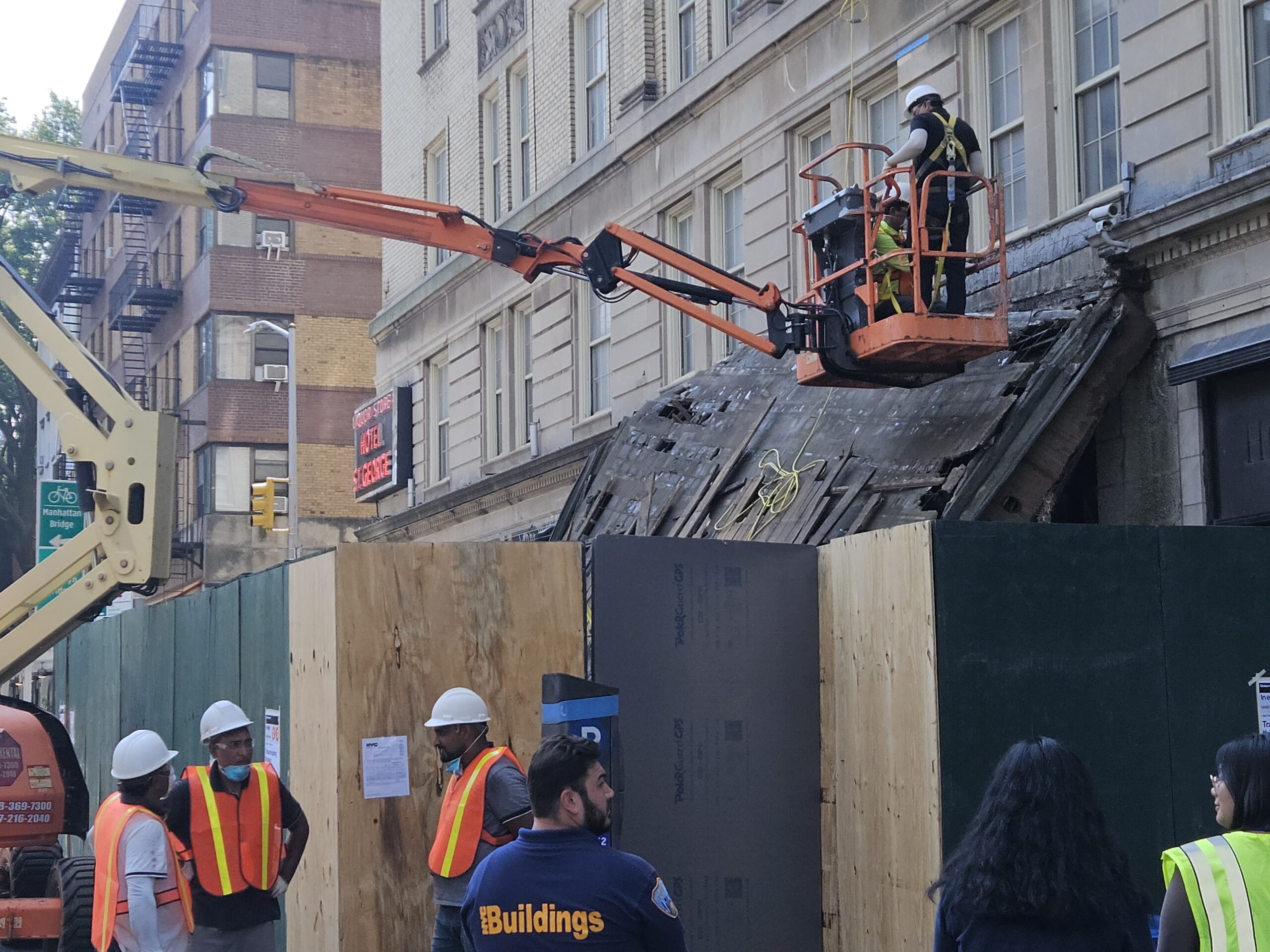
BROOKLYN HEIGHTS — ‘A miracle that no one was killed …’ That’s what neighbors are saying about the collapse of the Hotel St. George marquee. Shown in this photograph are workmen beginning the removal and repair of the historic, old neon sign at the corner, referencing a relic of Brooklyn Heights’ past: the St. George Hotel.
ATLANTIC AVENUE — Exhausted shopper with cluster of bags and goods from mall at Boerum Place stops to look at huge construction site across the street. “Is that REALLY going to be a jail??” Her male companion is reassuring, “Nothing like Rikers … this is 21st Century.”
BROOKLYN HEIGHTS — Overheard in line at one of most popular pastry outlets on Montague Street: “Hope I can get them into a camp …” A mother with two pre-schoolers in tow was showing a friend the Dodge Y flyer for Healthy Kids Day on Saturday, April 18.