‘We can hear Chinese anywhere now’: Behind Staten Island’s immigrant boom
China is now the top country of origin for foreign-born Staten Islanders.
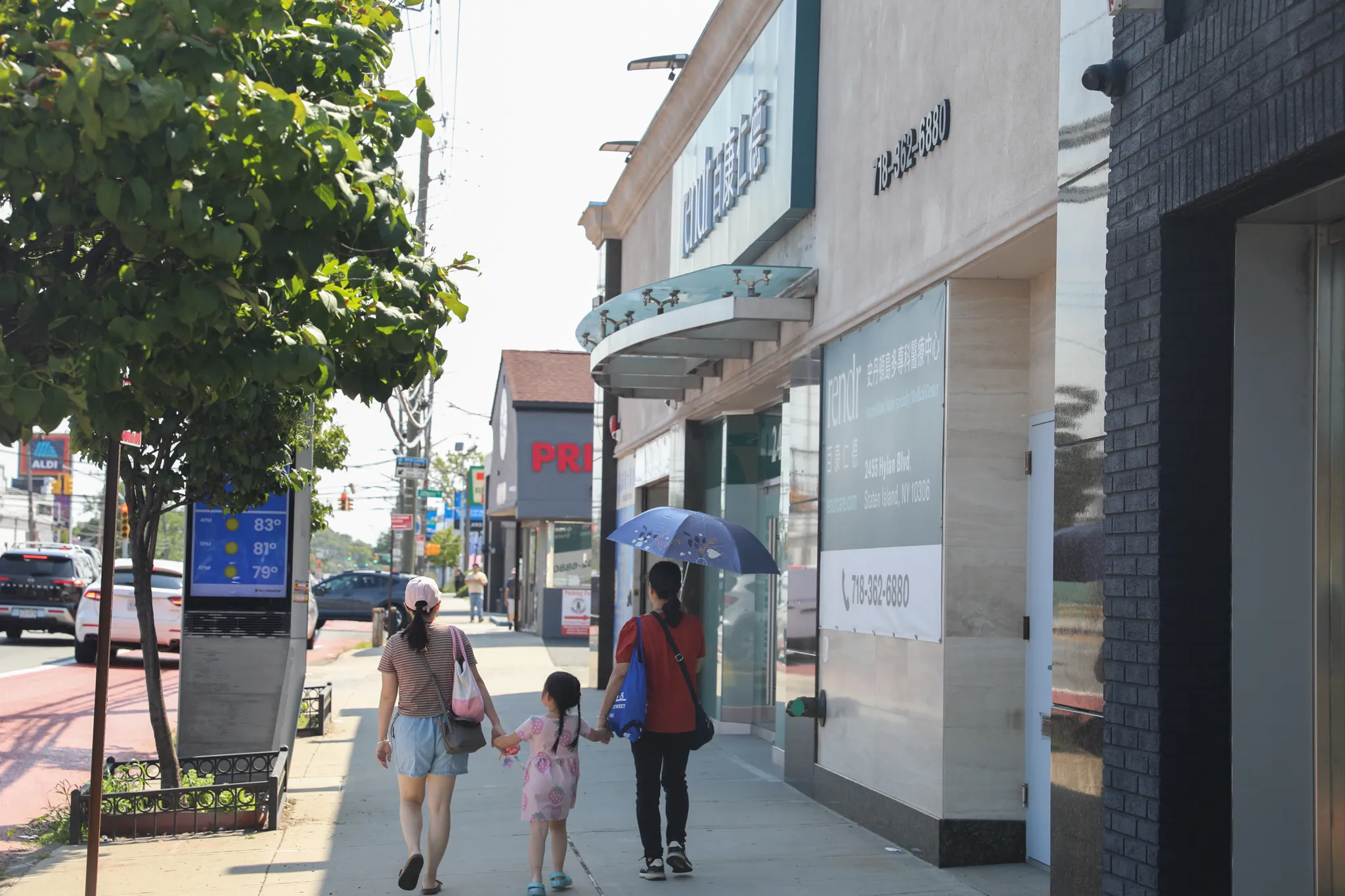
Pedestrians walk past Rendr Family Medical in New Dorp, Staten Island, July 24, 2026. Photo: Alex Krales/The City Reporter
By Carol Chen, The City Reporter
July 28, 2026
Copy Link
Email
Facebook
X
LinkedIn
WhatsApp
Telegram
Pinterest
Print
When Pingzhu Wan, 77, bought her condominium on the northeastern tip of Staten Island more than 40 years ago, hers was the only Chinese family among the 100-odd units in the apartment complex. Her neighbors were mostly Italian and Jewish, and the nearest Chinese grocery store was across the Verrazzano-Narrows Bridge, in southern Brooklyn. She raised her now-51-year-old daughter on the island from age three. The girl was the only Chinese child in her class.
Now, the arrival of new Chinese immigrants has significantly changed the composition of Wan’s neighborhood — and that of the island.
“As soon as a unit opens up in our complex now, the buyers are Chinese,” she said in Mandarin. “Most of them come from Brooklyn.”
Chinese residents are now the largest foreign-born group in New York City at roughly 397,000 people, surpassing Dominicans at 390,000, according to the Department of City Planning’s 2026 “Newest New Yorkers” report, which drew from census data between 2019 and 2023.
The once-a-decade account of the city’s immigrants found that while the pattern of immigrant migration in four of the five boroughs either declined or stayed level, Staten Island’s immigrant population grew from 20.4% of the borough’s overall population in 2013 to 25.5% in 2023. The island gained 28,500 foreign-born residents over the decade, a 30% increase.
Chinese people led that growth, with China becoming Staten Island’s top country of origin among the borough’s foreign-born residents. The island had more than 28,200 Chinese immigrants in 2023, or 17% of its foreign-born population, the report found. Mexicans and Ukrainians follow at 6.8% and 5.5%.
“We can hear Chinese anywhere now,” said Gary Tai, president of the Chinese Society of Staten Island, a cultural association dedicated to serving the community. “On the ferry, on the buses.”
Some neighborhoods, especially those near the Verrazzano Bridge, have seen a particularly high rate of Chinese people move in. In Rosebank, Shore Acres and Park Hill, Chinese residents represent 28.7% of the total foreign-born population. In Arrochar, South Beach, Dongan Hills and Grasmere — all with easy access to the bridge — 26.9% of the foreign-born population is Chinese.
The City Planning report called those neighborhoods “common destinations for immigrants relocating from Brooklyn,” and said the pattern of moving from southern Brooklyn to Staten Island “mirrors a similar trajectory taken by Brooklyn’s Italian immigrant community” a half-century earlier. The growth of Chinese businesses and services on the island has also helped recent arrivals build an independent neighborhood, apart from southern Brooklyn’s Chinese community and other city Chinatowns.
Frank Morano, the City Councilmember for Staten Island’s South Shore, said the borough has always been a place where people “come looking for a little more space, a good education for their kids [and] a home they can call their own,” including his own family.
“Italians did that in enormous numbers a generation or two ago, and today more Chinese families are doing it,” said Morano, a Republican. “That’s not a departure from Staten Island’s story. It’s just a continuation of it.”
A supermarket in New Dorp, Staten Island advertised to the neighborhood’s growing Chinese population, July 24, 2026. Photo: Alex Krales/The City Reporter
Bryan Li, a 40-year-old employee at Ya Ya Roasted, a Hong Kong-style restaurant on Hylan Boulevard in New Dorp, made his move across the Verrazzano four years ago. He left Sunset Park, where he lived for about a few years after coming from China, and paid about $500,000 for a house on Staten Island.
“You come to a new place, you put down roots,” he said in Mandarin. “It’s the traditional Chinese way of thinking. Before anything else, buy a home.”
Homeowner haven
Each of the more than a dozen Chinese Staten Islanders interviewed by The City Reporter pointed to the same force that pulled them to the borough: the chance to buy a house and put down roots.
“The main reason is affordability, to buy a whole one-family house that’s still affordable and still part of New York City,” said Tianting Huang, a real estate agent who has helped people sell and buy houses on the island since 2014.
Huang said the Chinese buyers he’s worked with prioritize good school zones first, then a yard and parking. The buyers are usually young families buying their first home, though some of the more expensive properties go to Chinese Brooklyn transplants trading up for more space and a slower-paced environment.
Census data from the American Community Survey in 2024 analyzed by John Mollenkopf, director of the Center for Urban Research at the CUNY Graduate Center, shows how home ownership has defined the community.
New Dorp in Staten Island has seen an influx of Chinese residents, driven largely by the affordable real estate, July 24, 2026. Photo: Alex Krales/The City Reporter
Of Chinese-led households on Staten Island, 95% own their homes, the highest rate of any borough and far above Manhattan’s 22.9% rate for the same demographic. Meanwhile, the median value of a Chinese-owned home in the city, about $626,000, is the lowest in the five boroughs, compared to a citywide average of $848,000 for all Chinese-led households.
The Chinese families who settle in Staten Island are also younger, with 25% of the population having children younger than 18 years old, compared to 18% on average among Chinese-led households across the city.
For Bryan Li’s generation of millennial Cantonese people, moving to the island was a practical choice. Previous waves of New York’s Cantonese community shunned Staten Island for decades, he said.
“The old-timers looked down on it. It used to be a dump,” he said, referring to the Fresh Kills Landfill that closed on the island’s western shore in 2001. “And the [bridge] toll was expensive.”
But as home prices in Brooklyn climbed past what working families could pay, Li said, “The first wave moved in, and it turned out it wasn’t as bad as people imagined. They told their friends, and their friends came.”
The median home sale price for Staten Island is $710,000 today, while the median for Brooklyn is $771,500, according to Realtor.com. But measured by price per square foot, Staten Island comes in much cheaper at $485, compared to $778 in Brooklyn.
New businesses and services
As Staten Island’s Chinese population boomed, more Chinese businesses and services cropped up, mainly concentrated around one street — New Dorp Lane on the island’s east side.
“Every time my husband and I wanted dim sum, we had to drive to Manhattan,” Pingzhu Wan said of her first decades on the island.
Now, along the New Dorp commercial strip, an array of restaurants, pharmacies, dentist’s offices and clinics operate under Chinese-language awnings.
“A new Shanghainese restaurant just opened the other week,” Wan said, complimenting the food at Little Kitchen on Hylan Boulevard. “It’s a wonderful place to gather with friends and eat.”
Many new healthcare businesses targeting Chinese residents have also opened in the area, including adult daycare centers that provide “a space for people to get services and gather,” Tai of the Chinese Society said.
HL Market, a large Asian grocery store with a fresh seafood aisle and an in-store butcher, arrived in 2022. The excitement around the store was so high that its opening weekend reportedly jammed traffic on the surrounding blocks.
People Shop at HL Supermarket in New Dorp, Staten Island, July 24, 2026. Photo: Carol Chen/The City Reporter
“It used to be, when you had to go shopping or you needed services, you had to go to Brooklyn or Chinatown,” Tianting Huang said. “With the supermarket opening up a couple of years ago and the new community developing in New Dorp, there’s less need to leave the island. It’s becoming more of an independent community instead of just a satellite of Brooklyn.”
Yuqi Shao, 42, opened a dumpling and noodle shop near New Dorp Lane, modeled on the Shaxian Snacks chain she knew from China, after leaving Sunset Park in 2024.
“A friend lived here and said that there are increasingly more Chinese residents,” she said, noting she saw potential in catering to the population and decided to launch her business there.
The clutch of Chinese storefronts along New Dorp Lane does not resemble the city’s denser Chinatowns in Manhattan, Brooklyn and Queens where businesses are concentrated on several streets. Instead, they are loosely spread out over three blocks in a relatively residential area.
“We don’t really call it a Chinatown yet,” Tai said. “People live all over.”
A longstanding community
Although the uptick in Chinese immigrants on Staten Island is relatively recent, there has been an established Chinese community there for decades — and many of its members are expanding their services and community groups to accommodate the more recent arrivals.
New Dorp’s Staten Island Chinese School began in 1972 as what the Chinese Society calls the first Chinese school incorporated on the East Coast. The school says it runs eight or nine classes of varying levels at a time and saw a 45% increase in enrollment in 2023, its first year back to in-person classes, compared to the year before, and an 18% gain in 2024.
Linda Chan, the school’s incoming vice principal, said parents are choosing to enroll their children because they want their kids to have friends with similar backgrounds, so that Chinese culture “isn’t just a home-based thing.”
HL Supermarket in New Dorp, Staten Island advertises deals to its growing Chinese community, May 2, 2024. Photo: Ben Fractenberg/The City Reporter
The families also find community through the school, she said. “It definitely fostered a lot of friendships within the community. When we have our Chinese New Year events, it’s just that much more festive, because there’s a large number of people participating.”
Another longstanding institution for Chinese families is the Staten Island Chinese Christian Church, which held its first Sunday service in 1975 in a rented chapel and spent two decades in borrowed rooms before buying its current property in Mid-Island in 1994.
Jojo Williams, the church’s secretary, joined the institution the year it moved onto its own property. The congregation has grown from 250 to 400 members in the past three years, according to Williams, and holds separate Sunday services in English, Mandarin and Cantonese, as well as weekly youth fellowship activities and programming for older people.
Williams described the array of programming with pride: “We don’t ask for government help. No funding. We do our own funding.”
Integration and an ‘invitation’
As more Chinese households start to live in Staten Island, many have remained apart in one key way: their language. Roughly 40% of Chinese-speaking households in the borough are linguistically isolated, with no adult who speaks English well, according to census data.
When Gary Tai’s parents moved to Staten Island in 1991, the borough’s sparse Chinese community was a selling point for their children to pick up the language quickly, he said.
“Since there were not many Chinese people, it would be easier for us to learn English here,” Tai said of his parents’ logic.
Nearly 40 years later, he’s working to smooth the way for newcomers, building out more bilingual services on Staten Island, especially in hospitals and in government services.
“If someone gets sick in the middle of the night, they should go to the emergency room first, even though they don’t speak English, because they will receive translators,” Tai said.
To address the language gap, some city officials have tried to engage the growing population in small ways. Councilmember Morano said his district office posts signs in Mandarin and Cantonese for constituents who “may never have interacted with an American government official before.”
“When a community grows quickly, civic engagement may take a bit of time to catch up with population growth,” he said. “I’d like to see even more participation in civic associations, in community boards, in all the political parties and merchant groups. But that’s not a criticism, that’s an invitation.”
SUNSET PARK — “As a resident of Marine Park, one of the great surprises I found biking around Industry City and visiting Japan Village was to discover Bush Terminal Park. I continue to be amazed at the serene hideaways that the city offers in some of the busiest places — and, still, with an iconic view.”
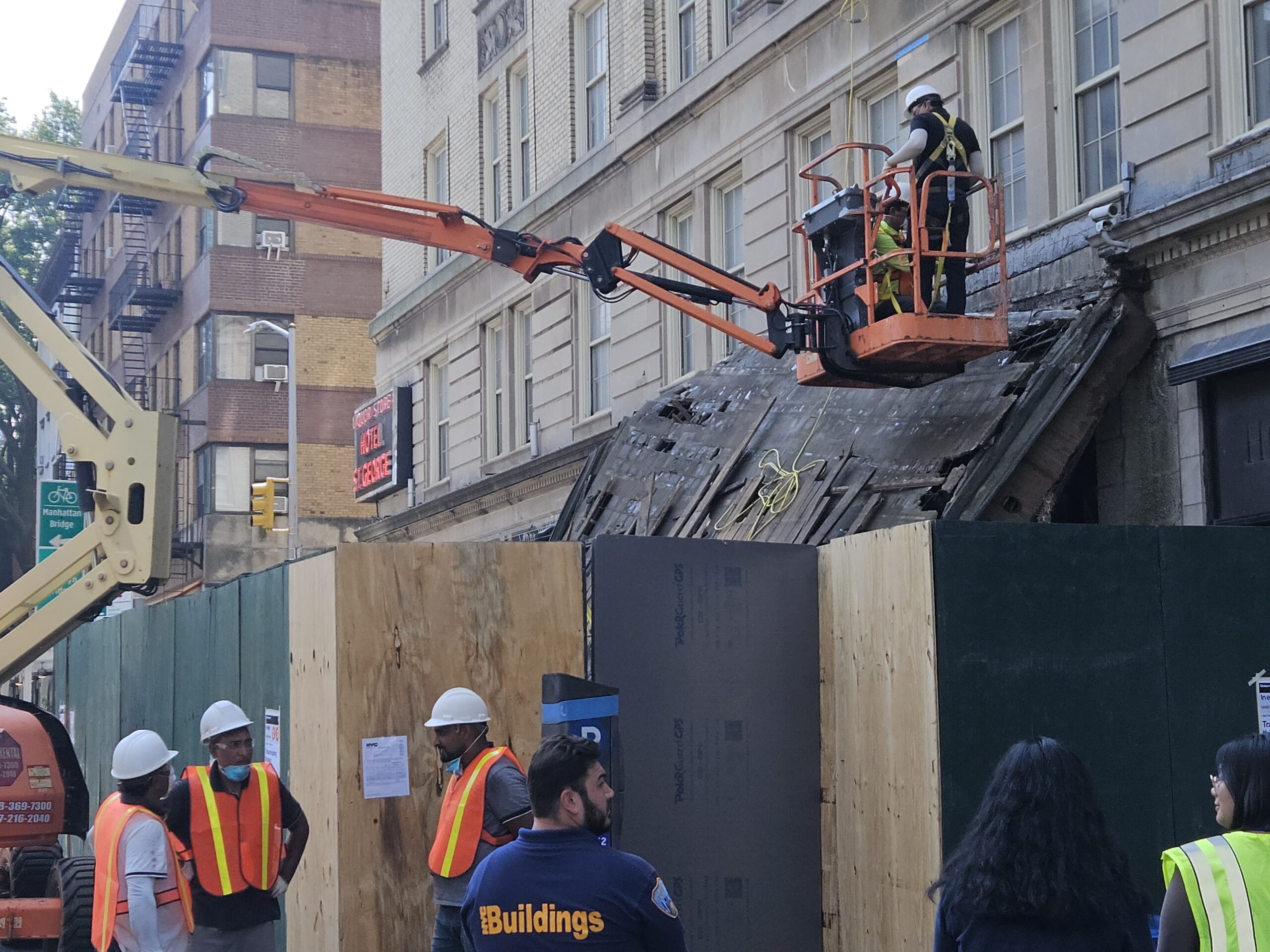
BROOKLYN HEIGHTS — ‘A miracle that no one was killed …’ That’s what neighbors are saying about the collapse of the Hotel St. George marquee. Shown in this photograph are workmen beginning the removal and repair of the historic, old neon sign at the corner, referencing a relic of Brooklyn Heights’ past: the St. George Hotel.
ATLANTIC AVENUE — Exhausted shopper with cluster of bags and goods from mall at Boerum Place stops to look at huge construction site across the street. “Is that REALLY going to be a jail??” Her male companion is reassuring, “Nothing like Rikers … this is 21st Century.”
BROOKLYN HEIGHTS — Overheard in line at one of most popular pastry outlets on Montague Street: “Hope I can get them into a camp …” A mother with two pre-schoolers in tow was showing a friend the Dodge Y flyer for Healthy Kids Day on Saturday, April 18.