For July’s missive, I could have chosen Don Drysdale, but he only pitched two years in Brooklyn, his first two.
I love nicknames, so I could have gone with Pop Shriver of the 1886 Trolley Dodgers, until I discovered that almost every team in the 1800s that had an older ballplayer had a “Pop” on their team.
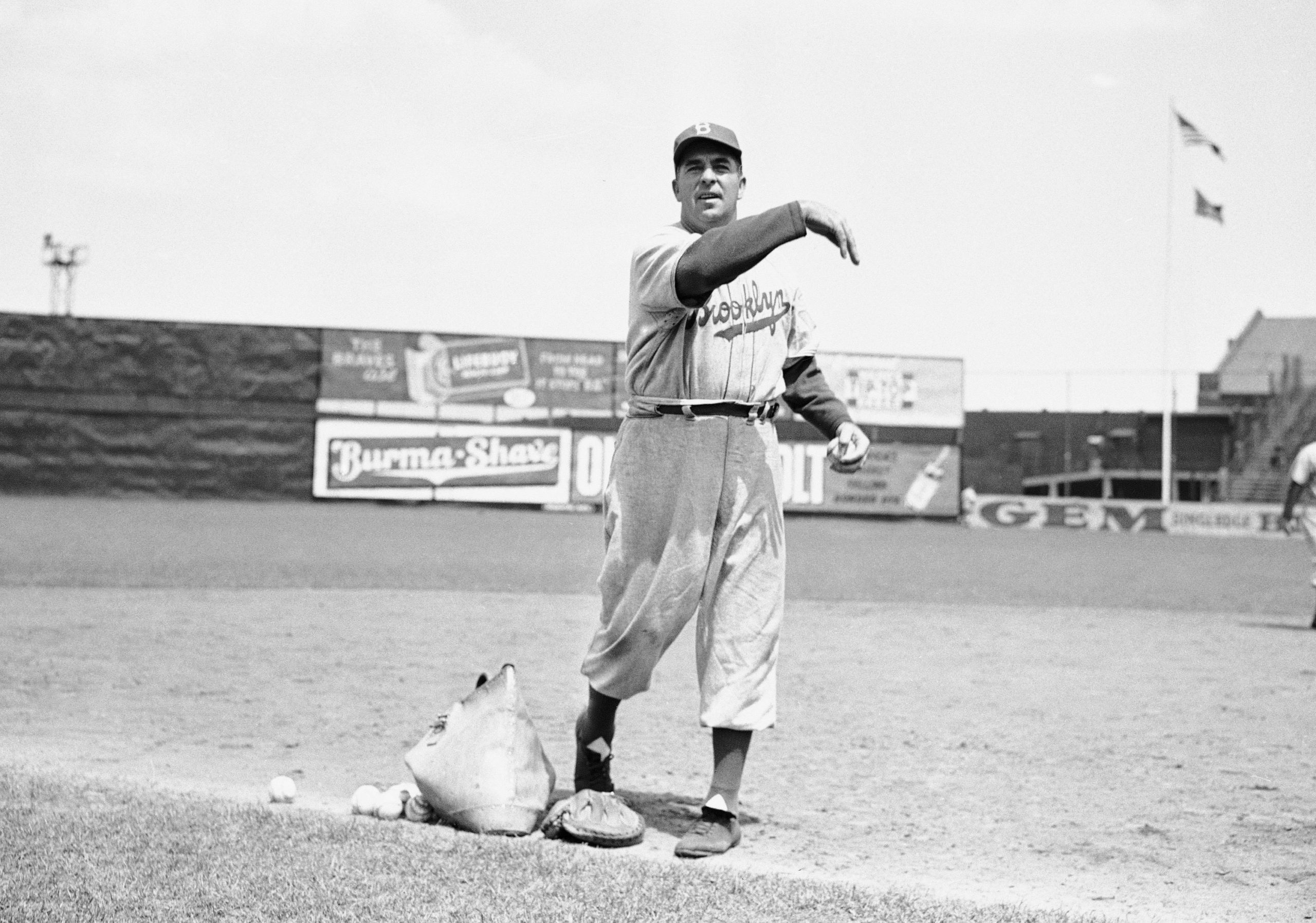
Then I came across Freddie Fitzsimmons.
How do you pass on a guy who spent his whole life in baseball, who some called the “Black Irishman” because of his skin tone, who many called “Fat Freddie” when his weight ballooned to about 225, who was universally liked, and, according to some, went through every day of his 19-year career with a smile on his face?
Fitzsimmons was a staple of the high-flying New York Giants pitching staff in the 1920s and ’30s, when they were either top contenders or flat-out winners. As time began to take its toll, Fat Freddie was unceremoniously traded to the Dodgers, where he was expected to pitch less and lose more. Probably the best thing about this story is how he surprised everyone.
Just as I like nicknames, I’m a sucker for unusual reference sites. These start-us-off basics come from a site called “Baseball Egg.” Frederick Landis (no relation to the long-ago Commissioner) Fitzsimmons was born on July 28, in the year of our Lord 1901. He was a right-handed pitcher standing 5 feet, 11 inches tall.
Society for American Baseball Research gives us this recap: “(Fitzsimmons) may not have looked like a major-league pitcher during his 19-year career with the New York Giants and Brooklyn Dodgers from 1925 to 1943. But with one of baseball’s most effective knuckleballs and a deceptive, whirling delivery, he won 217 games.”
A note about that delivery. As he wound up, Fitz, as his teammates called him, would twist his body while rotating his arm. Before he came to face the plate, he was facing second base. It was murder to try and pick up the ball at its release point.
Back to SABR. “One of the era’s most popular players and arguably the best fielding pitcher in all of baseball (despite his size), Fitzsimmons helped lead the Giants to the World Series in 1933 and 1936 and the Dodgers in 1941. He was a baseball lifer. While he joined the Giants in 1925, he began his career in Muskegon, Michigan, in 1920.”
Not every good ball player gets into the Hall of Fame. Fitzsimmons didn’t make it. Pardon the editorial comment, but I don’t see why he didn’t get in on an old-timers’ vote. Ask any knuckleballer how many of them could consistently throw the floater for strikes. The answer is almost no one, and based on that alone, I would have voted him in.
Since this article is about the Dodgers, we’re going to zero in on the trade and the resurrection. Here goes. Fitzsimmons was everybody’s favorite. His teammates loved him, and so did the fans. The trade to the hated Dodgers was very unpopular. Most felt he should have been allowed to retire with ceremony and fanfare. Few expected anything but a miserable end to his career — everyone, that is, except Fitzsimmons, who proved that he had a lot more gas left in his tank than anyone expected.
Fitzsimmons pitched for the Brooklyn Dodgers from 1937 to 1943, going 27-14 with a 3.42 ERA. He then spent the 1942 season as a player-coach for the franchise. In the 1940 season, he had a superlative 16-2 record, maintaining an .889 winning percentage that stood as a major league record until 1959. Remember the Pirates’ Elroy Face? He broke it. Fitzsimmons helped the Dodgers secure the National League pennant and pitched in the 1941 World Series against the New York Yankees.
Then came a short period of being a hybrid, so to speak. He was a player-coach in ’42 and ’43, but pitched fewer than 20 games over those two seasons.
One of the reasons that Fitzsimmons was able to resurrect his career was his ability to throw the knuckleball over the plate. It was a pitch that fascinated him as a teenage ball player. A minor leaguer named High Pocket Daniels taught him how to throw it. When Fitzsimmons himself got to the minors, he came under the tutelage of Carl Skinny McDaniels, another neat nicknamed pitcher. Since it was the pitch that made him famous and is a pitch that still today bedevils batters, we’ll take a brief detour here. The knuckleball was easy on the arm, but it took dedication and talent to master.
Probably the most successful knuckleballer, though not the most famous, was R.A. Dickey of the New York Mets, who used the pitch to turn himself from a mediocre, nothing-special pitcher into a pitcher who pitched himself into the record books. In 2012, Dickey had a historic breakout season, posting a 2.73 ERA and striking out a league-leading 230 batters. He became the first knuckleball pitcher in history to win the Cy Young Award. Dickey estimated that it took at least a year to grasp the knuckleball’s fundamentals because it is radically different from any other pitch in a pitcher’s arsenal, making it less predictable and more difficult to control.
Phil Niekro, arguably one of the two most famous modern-day knuckleball pitchers, rarely threw his. He preferred to throw it when there was a slight breeze blowing towards the mound. The air current added to the unpredictability of what the ball would do. There are reams of scientific papers dedicated to explaining the physics of what made a knuckleball so unpredictable. I read some of them. A fair guess would be that none of those theories helped the hitter hit or were in the mind of the pitcher as he let one go. It did what it did, seemingly having a mind of its own.
Another great knuckleballer was Hoyt Wilhelm who leaned on the pitch to throw a no-hitter. Like Niekro’s, his was a soft floater, a butterfly effect, if you will, but not Fitz’s. The difference was the wrist. Knuckleballs, which, it should be pointed out, are not thrown with the knuckle but with fingers dug into the ball’s hide, are thrown without breaking the wrist. Not Fitzsimmons’. His was thrown like a fastball, but it didn’t move like one.
Hitting it was one thing; catching it was another. Bob Uecker, a fairly good catcher and a superb humorist, said that the way to catch a knuckleball is to wait until it stops rolling and then pick it up.In Fitzsimmons’ day, catchers hadn’t yet begun to wear today’s large, thickly padded gloves with deep pockets — like the one Roy Campanella famously used — making their task even more difficult. Yogi Berra, a great catcher and also a great humorist, mused that it was fortunate that there was only one knuckleballer in the league. He said, “If everyone threw one, no one would hit above .200.”
Bobby Bragan, one of Fitz’ catchers and one of many catchers who went on to become coaches and managers, famously described Fitzsimmons’ knuckleball as “a knuckleball without a knuckle.” Bragan explained that while the pitch moved with the erratic, unpredictable fluttering of a true knuckleball, Fitzsimmons threw it with the hard snap of a regular fastball, making it an incredibly deceptive and difficult pitch for hitters to track. Fitzsimmons himself said his pitch acted like a spitter, with a sharp downward break. Today’s pitchers would call it a knuckle curve.
As it is said, “It ain’t over ‘til the fat lady sings.” In this case, it was Fat Freddie who said it wasn’t over, even though he was no longer a major league-caliber pitcher.
After retiring as a player, Baseball Britannica reports that he managed the Philadelphia Phillies (1943–45) and coached for the Boston Braves (1948), the New York Giants (1949–55), and the Chicago Cubs (1957–58 and 1966).
The end of the Freddie Fitzsimmons story is a puzzler. Universally liked, clearly excellent at what he did, he and his wife retired to Yucca Valley, California. There, on Nov. 18, 1979, at the age of 78, the jovial, fondly remembered Frederick Landis Fitzsimmons committed suicide with a self-inflicted gunshot. It’s a real head-scratcher after a life and career that showed no signs of ending that way. More puzzling is that, according to Baseball Fever, the Fitzsimmons obit listed heart attack as the cause.
He’s my supposition. Since it is pretty difficult to miss a gunshot wound, I think two things were at play. The first was that the family didn’t want their loved one to go out with the stigma of suicide or leave them with inquiring minds asking endless questions about it. The other is that sometimes after a long, successful career, a person can’t adjust to retirement. The roar of the crowd and the smell of the greasepaint are gone, remaining only in one’s mind. Fitzsimmons might not have been able to live without them. ‘Tis a puzzlement. As grandma used to say, “Go know.”