Brooklyn beginnings: How the teddy bear became a childhood treasure
The toy was first made by Bed-Stuy candy store owners
A miniature plastic teddy bear sits atop a stuffed teddy bear. Photo: Dario Lopez-Mills/AP
By Terry Tang, Associated Press
April 16, 2026
Copy Link
Email
Facebook
X
LinkedIn
WhatsApp
Telegram
Pinterest
Print
BEDFORD-STUYVESANT — The circular muzzle. The little nose tip. The button eyes and two round, fuzzy ears. What is it about the teddy bear that has kept children wrapped around its furry paws for over a century?
The quintessential American toy started in 1902 as just clothing scraps and sawdust stitched together by Morris and Rose Michtom, Jewish candy store owners in Brooklyn.
“Nothing says childhood better than a teddy bear,” says Michael Kimmel, author of “Playmakers: The Jewish Entrepreneurs Who Created the Toy Industry in America” and Morris Michtom’s great-great-nephew. “It’s an utterly genderless toy. It is embraced by both boys and girls.”
In this Library of Congress handout image, President Theodore Roosevelt reads a book with his dog skip on his lap, in the doorway of the West Divide Creek ranch house in Meeker, Colo., Sept 12, 1905. Photo: Library of Congress via AP
The teddy bear’s origin story actually starts earlier that year. President Theodore Roosevelt had refused to shoot a tied-up black bear during a hunting trip. Cartoonist Clifford Berryman published a political cartoon depicting Roosevelt’s decision that caught the Michtoms’ eyes. They were inspired to fashion a toy that went on to be called “Teddy’s Bear” as a nod to the president and his nickname.
And a fad was born.
After selling a few, the Michtoms — whose store was located in Bedford-Stuyvesant — began receiving more orders. Copycats emerged. The teddy bear was widely considered the first stuffed toy that wasn’t a rag or porcelain doll, Kimmel said. It was affordable, comforting and kid-size. Some preachers actually worried the playful plushies would somehow corrupt young girls and extinguish their desire to be a mother.
Over the decades, the teddy bear became an icon. Elvis Presley crooned about being someone’s “lovin’ teddy bear.” An original Michtom-crafted teddy bear retains a place of honor in the Smithsonian National Museum of American History. And, of course, being a “teddy bear” has come to mean someone who is, in general, sweet and cuddly.
Says Kimmel: “There are people who, when they finally move out of the house and go to college or get married, that’s the one thing that they just can’t part with because it connects them to that innocent childhood.”
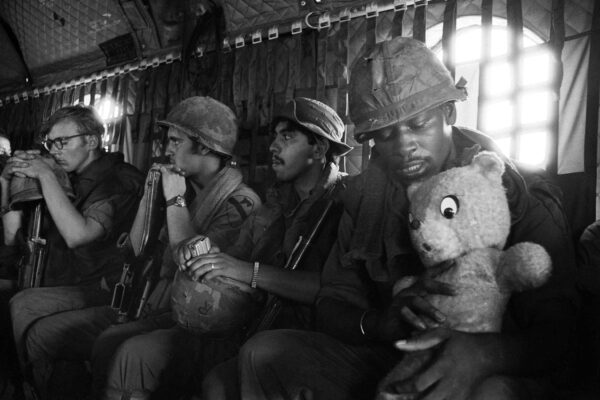
A GI headed into Kontum in the central highlands with a tank-killing unit, cradles his lucky teddy bear during the helicopter ride in Vietnam, June 3, 1972. Photo: Josip Lee/AP, File
SUNSET PARK — “As a resident of Marine Park, one of the great surprises I found biking around Industry City and visiting Japan Village was to discover Bush Terminal Park. I continue to be amazed at the serene hideaways that the city offers in some of the busiest places — and, still, with an iconic view.”
BROOKLYN HEIGHTS — ‘A miracle that no one was killed …’ That’s what neighbors are saying about the collapse of the Hotel St. George marquee. Shown in this photograph are workmen beginning the removal and repair of the historic, old neon sign at the corner, referencing a relic of Brooklyn Heights’ past: the St. George Hotel.
ATLANTIC AVENUE — Exhausted shopper with cluster of bags and goods from mall at Boerum Place stops to look at huge construction site across the street. “Is that REALLY going to be a jail??” Her male companion is reassuring, “Nothing like Rikers … this is 21st Century.”
BROOKLYN HEIGHTS — Overheard in line at one of most popular pastry outlets on Montague Street: “Hope I can get them into a camp …” A mother with two pre-schoolers in tow was showing a friend the Dodge Y flyer for Healthy Kids Day on Saturday, April 18.