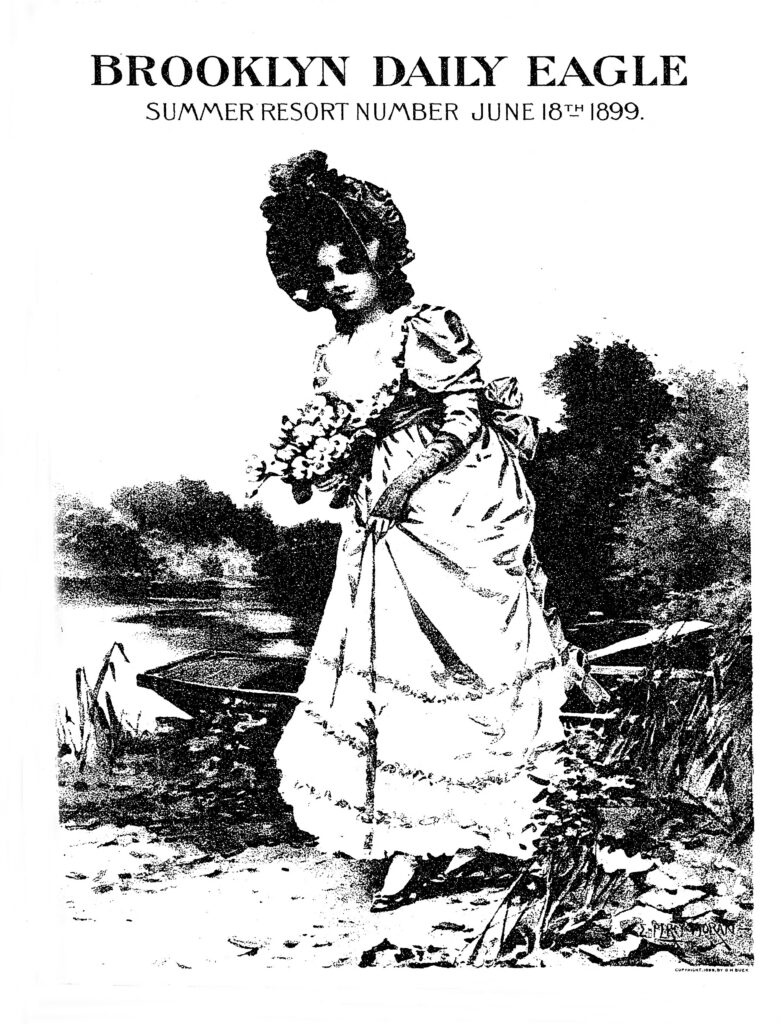
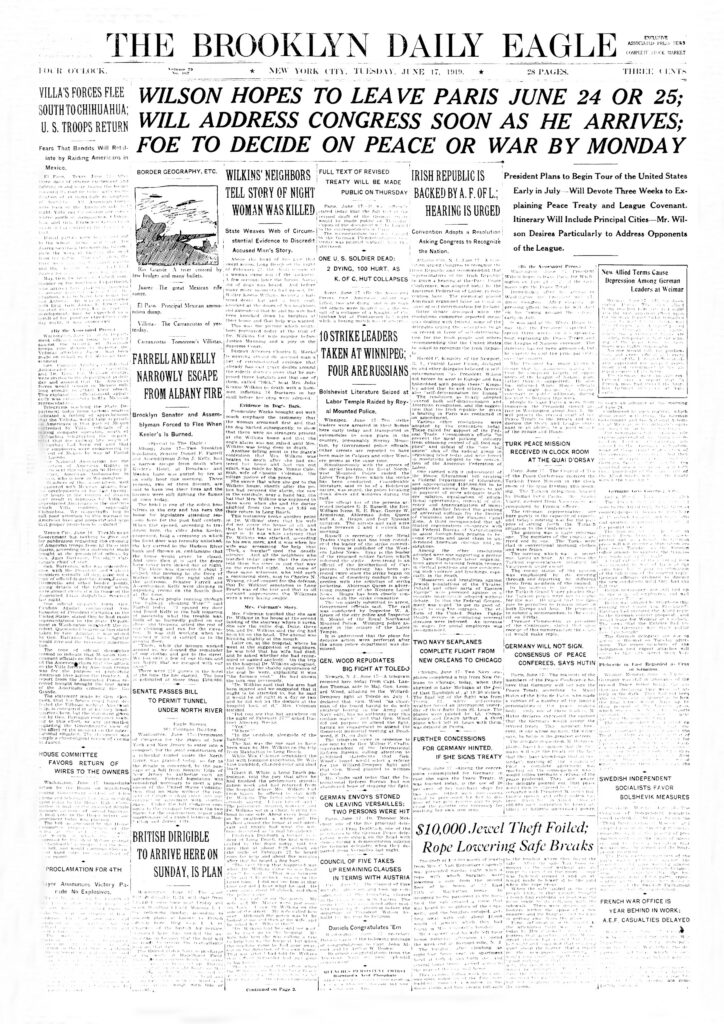
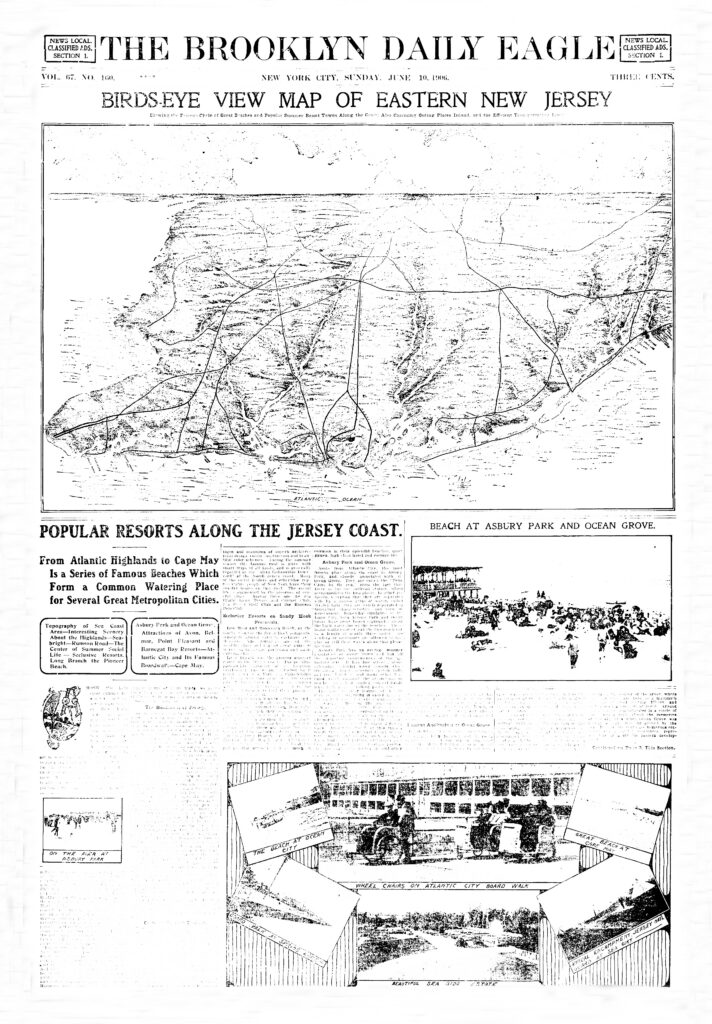
ON THIS DAY IN 1862, the Brooklyn Daily Eagle reported, “The bill to provide for the extraordinary expenditure of the government on account of the present unfortunate war left the hands of the printer yesterday, and a copy of it covering over one hundred pages was placed in our hands this morning. The document is of vital importance to our readers, and we therefore present them with a full synopsis of its contents.For the purpose of superintending the collection of the tax, a new office is created, to be called the office of the Commissioner of Internal Revenues. The incumbent is to be appointed by the President, with the advice and consent of the Senate, and is to receive a salary of five thousand dollars per annum.”
***
ON THIS DAY IN 1921, the Eagle reported, “The Long Island Railroad will probably shift its entire train schedule to conform to the local daylight saving time on the last Sunday of this month, according to word today in well-informed railroad circles. It was stated at the Long Island executive offices that no formal determination had been reached, and that a meeting of road officials had been called for tomorrow morning to take up the question, but since the road’s business is largely concerned with the carrying of people whose employment is in the Greater City, it was stated that the road would give first consideration to service to them and that this probably meant a change in the time tables to conform to the city time. The New York Central has already announced that it will follow the course of last year — advance the schedules of the local trains one hour, but run the road on the standard time. The present ordinance of the city for daylight saving applies this year.The State law just passed, while it changes the official State time back to the Eastern standard time, gave municipalities the right to adopt daylight saving locally, and with respect to New York, this simply means legalizing the ordinance already on the city statute books. A movement is underway, however, to amend this by reducing the time for daylight saving from 7 to 5 months.”
***
ON THIS DAY IN 1929, the Eagle published, “EL PASO, TEXAS (AP) — First American blood was spilled today when a stray bullet fired in the battle between rebel troops and the defending Federal soldiery in Juarez, 200 feet across the border, struck Louis Chavez, 6, here. Panic reigned in the thickly populated tenement sections of South El Paso as bullets flew thick and fast over the international boundary. The rebel cavalrymen charged down the streets of Juarez, and rebel machine gun nests in the nearby mountains raked the streets of the Mexican town. Brig. Gen. Van Horne Mosely today refused permission to Gen. Matias Ramos to gather his Mexican Federal troops on the United States side of the International border for an attempt to recapture the City of Juarez from victorious rebel troops. General Ramos had established headquarters at the southern base of the International Bridge across the Rio Grande, where a small group of Federals were still holding out. Several American automobiles were struck by bullets from the Mexican side. In one El Paso home, a bullet crashed through a window. American soldiers were ready to protect life and property if the fighting seriously threatened the American border city.”
***
ON THIS DAY IN 1963, the Eagle published, “WASHINGTON (UPI) — The U.S. Air Force has devised a five-year space plan that calls for operation of military spacecraft in the region extending out to 22,000 miles from earth. As the service with the main responsibility for space defense, the Air Force’s chief concern is to develop rapidly a ‘military patrol’ capability in the near-earth regions so that the nation’s scientific and military space endeavors can be protected. What with Soviet progress and unconcealed military ambitions there, no certainty exists as to how soon a space patrol may be needed. The Air Force plan calls for both manned and unmanned space patrol craft. But it also envisions communications and other automatic spacecraft that can operate out to ‘synchronous orbital distances.’ That means orbits of about 22,000 miles, where the spacecraft would circle the Earth every 24 hours and thus appear to remain stationary. While public attention has been focused on vexing domestic and international issues in the new Congressional session, the Air Force has been quietly building up its case before the committees concerned. At least parts of its plan are well in hand.”
***
Lester Holt. Photo: Charles Sykes/Invision/AP
NOTABLE PEOPLE BORN ON THIS DAY include jazz saxophonist George Coleman, who was born in 1935; “Webster” star Susan Clark, who was born in 1943; Songwriters Hall of Famer Carole Bayer Sager, who was born in 1944; Monkees drummer Micky Dolenz, who was born in 1945; Baseball Hall of Famer Jim Rice, who was born in 1953; “Dateline NBC” anchor Lester Holt, who was born in 1959; “The Practice” star Camryn Manheim, who was born in 1961; former NBA point guard Kenny Smith, who was born in 1965; “She’s All That” star Freddie Prinze Jr., who was born in 1976; “Young Sheldon” star Montana Jordan, who was born in 2003; and “Heartstopper” star Kit Connor, who was born in 2004.
***
Freddie Prinze Jr. Photo: Charles Sykes/AP
ROBBERY IN PROGRESS: The Internal Revenue Service began to levy and collect income taxes on this day in 1913. The 16th Amendment to the Constitution, ratified Feb. 3, 1913, gave Congress the authority to tax income. The U.S. also levied an income tax during the Civil War.
***
Montana Jordan. Photo: Willy Sanjuan/Invision/AP
COLD WAR HERO: On this day in 1983, President Ronald Reagan, speaking at the convention of the National Association of Evangelicals, referred to the Soviet Union as an “evil empire” and “the focus of evil in the modern world.”
***
Special thanks to “Chase’s Calendar of Events” and the Brooklyn Public Library.
Quotable:
“Carrots might be good for my eyes, but they won’t straighten out the curveball.” — Brooklyn Dodgers outfielder Carl Furillo, who was born on this day in 1922
SUNSET PARK — “As a resident of Marine Park, one of the great surprises I found biking around Industry City and visiting Japan Village was to discover Bush Terminal Park. I continue to be amazed at the serene hideaways that the city offers in some of the busiest places — and, still, with an iconic view.”
BROOKLYN HEIGHTS — ‘A miracle that no one was killed …’ That’s what neighbors are saying about the collapse of the Hotel St. George marquee. Shown in this photograph are workmen beginning the removal and repair of the historic, old neon sign at the corner, referencing a relic of Brooklyn Heights’ past: the St. George Hotel.
ATLANTIC AVENUE — Exhausted shopper with cluster of bags and goods from mall at Boerum Place stops to look at huge construction site across the street. “Is that REALLY going to be a jail??” Her male companion is reassuring, “Nothing like Rikers … this is 21st Century.”
BROOKLYN HEIGHTS — Overheard in line at one of most popular pastry outlets on Montague Street: “Hope I can get them into a camp …” A mother with two pre-schoolers in tow was showing a friend the Dodge Y flyer for Healthy Kids Day on Saturday, April 18.