Back to the Past: When media was all opinion, all the time
Adam L. Penenberg
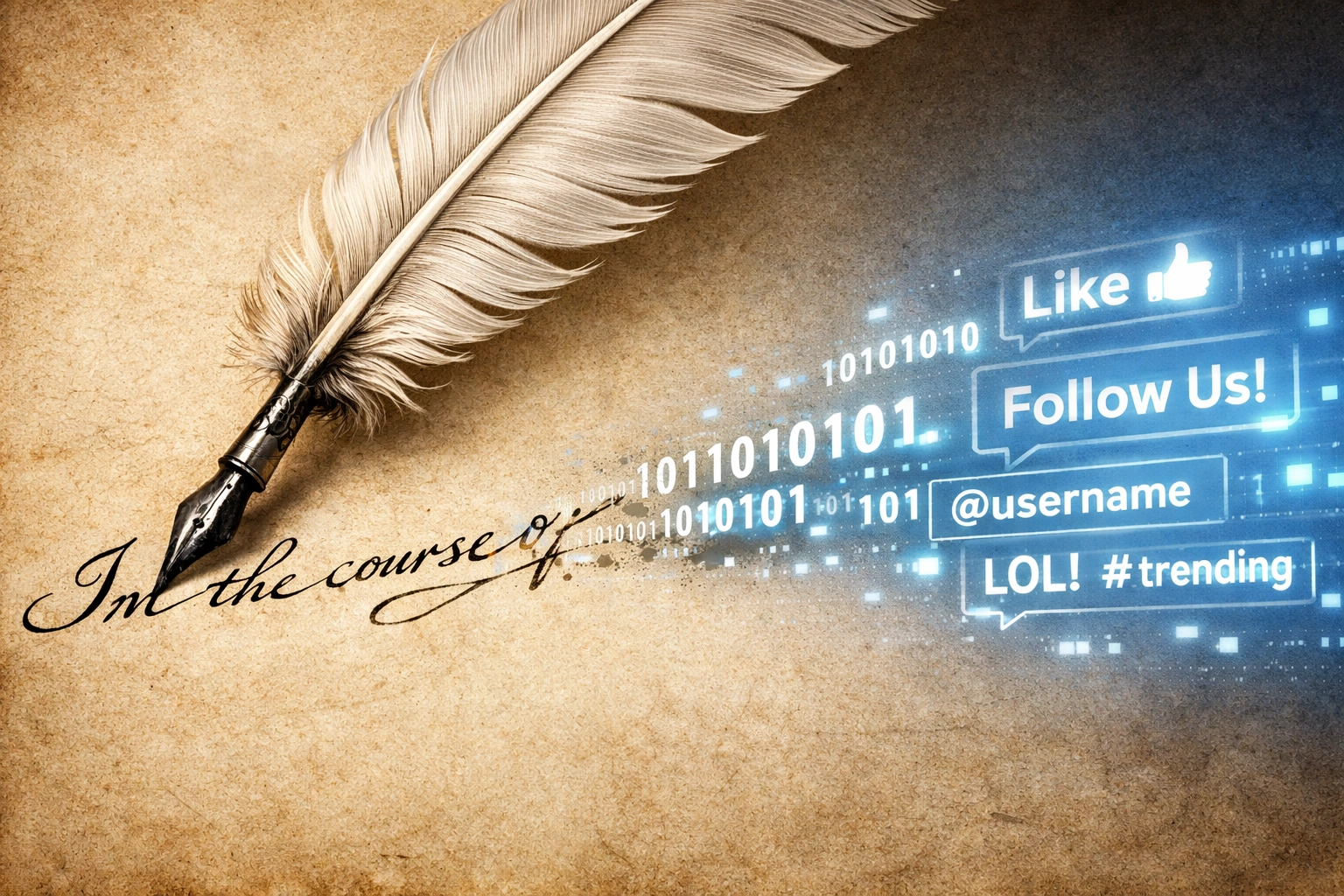
Image generated using ChatGPT.
There was no CNN when the Founding Fathers wrote the First Amendment.
It was 1791, so there was no New York Times, no Bloomberg, and your sister’s friend’s cousin’s boyfriend’s podcast wouldn’t launch for another 235 years.
Back then, news didn’t break unless the town crier tripped over his own words. There were no “breaking reports,” no special election coverage, no bickering pundits crammed into a single screen. News traveled so slowly that it took more than six months for word to spread across the thirteen colonies that the Revolutionary War was over.
What’s more, the Founding Fathers had a completely different understanding of news than we do. To them, news and opinion were largely the same thing.
Information came in the form of political pamphlets like Thomas Paine’s Common Sense, incendiary writing meant to persuade and mobilize.
These pamphlets, and later newspapers, were openly funded by political parties and politicians. There was no pretense of objectivity. The goal wasn’t balance. It was influence.
The attacks could be vicious and often anonymous. One supporter of Thomas Jefferson described John Adams as having a “hideous hermaphroditical character, which has neither the force of a man, nor the gentleness and sensibility of a woman.”
Image generated using ChatGPT.
Not bad, 18th-century insult comic, not bad at all, although it would probably sound even meaner in a tweet.
If this all feels familiar, it should. We are once again swimming in partisan argument, anonymous attacks and opinion masquerading as fact, except now it arrives instantly, endlessly and everywhere at once.
What were once pamphlets and party papers have become social feeds, podcasts and comment threads. And artificial intelligence is about to flood the zone even further, generating persuasive language at a scale the Founders never imagined.
On the one hand, the Founding Fathers lionized a free press. They spoke about it with near-religious fervor.
Benjamin Franklin warned that “whoever would overthrow the liberty of a nation must begin by subduing the freeness of speech.” Samuel Adams wrote that there was “nothing so justly terrible to tyrants” as a free press. George Washington cautioned that if freedom of speech were taken away, Americans could be led “like sheep to the slaughter.” James Madison called freedom of the press “one of the great bulwarks of liberty.”
These were heady words from heady men, men who absolutely despised newspapers.
Image generated using ChatGPT.
John Adams complained that newspapers were “the organs of faction,” devoted to spreading personal slander and inflaming political passions. Alexander Hamilton accused editors of acting against the interests of government. Thomas Paine dismissed newspapers as “the organs of falsehood; they only print what they want you to believe.” And Thomas Jefferson wrote that “nothing can now be believed which is seen in a newspaper,” adding that “truth itself becomes suspicious by being put into that polluted vehicle.”
These were fighting words from men who sometimes settled arguments with pistols. When the Founders talked about “the press,” they weren’t talking about journalism as we understand it today. They were talking about published opinion: free expression, the right to argue in print without fear of punishment.
Read the First Amendment closely. The press appears alongside religion, freedom of speech, the right to assemble and the right to petition the government for redress of grievances. These are not institutions. They are acts of expression. Facts are not mentioned. Objectivity is nowhere to be found.
That idea came later. What we think of as modern journalism — professionalized, fact-checked, separated from opinion — didn’t emerge until the late 19th century, when Adolph Ochs bought The New York Times.
Ochs separated editorials from news and rejected fraudulent advertising, a radical move at the time. He summed up his philosophy with a line that would become famous: “All the news that’s fit to print.”
The irony is that this slogan is itself an exercise in editorial judgment, which is subjective.
This brings us back to the present. Today’s fragmented, opinionated media ecosystem doesn’t represent a catastrophic break from American tradition. It represents a return to the original model — pamphlets everywhere, factions everywhere, persuasion everywhere — only now operating at digital speed.
Image generated using Sora.
Social media is Common Sense with an algorithm. AI is a printing press that can’t be unplugged.
The danger isn’t opinion. The Founders assumed opinion. The danger is scale — amplification without friction, persuasion without accountability and now, automation without judgment.
The First Amendment was built for pamphleteers, not platforms. It assumed bad speech would be answered by more speech, not multiplied endlessly by machines to the point no one can possibly make sense of it all.
So when we worry that the media is broken, it’s worth remembering: this isn’t collapse; it’s reversion, with a powerful new accelerant.
Now the question isn’t how to return to a mythical age of objectivity that never truly existed.
It’s whether a democracy designed for pamphlets can survive algorithms.