Précis: Elizabeth Hénaff, a professor at NYU Tandon, keeps a jar of Gowanus sludge in her office. The Gowanus Canal is an EPA Superfund site and one of the country’s most polluted waterways due to a legacy of industrial use and sewer runoff. Included in the pollution is PAHs, PCBs, VOCs and heavy metals.
Hénaff started studying the microbiome of the Gowanus Canal after the EPA’s invasive remediation process was announced. Last year, her team did a genetic study of the canal, collecting samples via canoe with the Gowanus Dredgers Canoe Club, and found a thriving community of microbes that have evolved to break down the canal’s pollution. Though these microbes may find application in other remediation projects, they work too slowly for the Gowanus Canal, which is in the middle of an increasingly residential neighborhood.
Hénaff used water and sludge from the canal in “CHANNEL,” an art exhibition at the BioBAT art space in Sunset Park, where her team let the microbes grow undisturbed. In CHANNEL, Hénaff studied the biofilms, or three-dimensional superstructures, that microbes form, which are her next subject of interest.
Elizabeth Hénaff, assistant professor at the NYU Tandon School of Engineering, has studied the rich microbiome of the Gowanus Canal for years. Photo: NYU Tandon School of Engineering
GOWANUS — Elizabeth Hénaff’s office in the NYU Tandon School of Engineering, where she is an assistant professor in the Integrated Design and Media program, has a desk, chairs, a landline and notes scribbled on a whiteboard.
It also has a jar of sludge in a biohazard bin on the floor. A close-up of the same sludge decorates her wall: green-brown, definitely toxic and definitely alive.
“Oh, that’s sludge from the Gowanus Canal,” explained Hénaff.
In 2010, the EPA designated the Gowanus Canal a Superfund site. They also named it “one of the nation’s most seriously contaminated water bodies” due to the potent combination of pollution from over a century of heavy industrial use and sewage that flows into the canal after heavy rains.
“It’s black, it’s viscous, and it smells like gasoline,” said Hénaff. It also presents a risk to human health in the center of an increasingly dense residential neighborhood.
Hénaff, whose background is in biology and computer science, is interested in how organisms interact with their environment. This interest has taken her in many directions in both science and art: from studying how plants respond to gravity to delving into the microbiome of Brooklyn’s environment.
Microbial biofilms, three-dimensional structures made up of individual microbes, form out of Gowanus Canal water. Photo: Elizabeth Hénaff
Her engagement with the Gowanus Canal specifically started when, in the early 2010s, the EPA announced their environmental remediation plans for the Superfund site. The broad strokes of these plans, which began in earnest in 2020, involve dredging massive amounts of contaminated sediment from the bottom of the canal and capping the rest with concrete.
Elizabeth Hénaff geared up to paddle down the Gowanus, for science and art. Photo: Dave Rife
Some of Hénaff’s friends thought: “If an agency were to suggest doing that in any other natural body of water, it would feel like a really destructive intervention to whatever ecosystem is there,” she told the Brooklyn Eagle. “So then was the question mark: Well, what is the ecosystem of the Gowanus Canal?”
There wasn’t much vibrant life that met the naked eye. So Hénaff and her collaborators explored the genetics of the sludge.
Gowanus Canal sludge took on a second life in “CHANNEL,” a public art exhibit at the BioBAT Art Space last year. Photo: Elizabeth Hénaff
To collect core samples of the top layer of Gowanus Canal sediment required a canoe and a PVC pipe. Photo: Dave Rife
What did they find in the sludge? The canal may be uninhabitable for most multicellular organisms (fish, crabs, birds, humans), but it’s full of life.
“What we found was that there’s actually a vibrant community of microorganisms that is inhabiting this chemical cocktail. They’re not only surviving, but they’re also thriving in a certain sense,” said Hénaff. “They’re degrading the toxic compounds that they’re challenged with.”
Algal life blooms out of the Gowanus Canal water. Photo: Elizabeth Hénaff
Microbes live an entire generation in about twenty of our minutes. The canal’s microbes, over generations and generations, have evolved to meet their less-than-ideal conditions.
These extremophiles, faced with the canal’s harmful compounds, break them down into smaller forms until they are no longer harmful. Heavy metals, already in their elemental forms, can’t be broken down any further.
But the microbes have evolved another strategy for the metals. “[They] have capacities to make them less bioavailable, so less detrimental to themselves as organisms but also the environment,” said Hénaff.
She also noted that collaboration is critical to their impact: “Isolated individuals of those [microbial] species would not necessarily be able to perform the functions to a similar level as a community together is able to.”
Isolating DNA out of Gowanus Sludge. Photo: Elizabeth Hénaff
There are exciting implications to this discovery. “On one hand, these microbes have, all by themselves, developed a really refined biotechnological solution to this contamination,” said Hénaff. “Which is meaningful to understand how microbes could contribute to remediation efforts in other contexts.”
Paddling down the Gowanus is a dirty business. Photo: Dave Rife
While microbes evolve quickly relative to organisms like humans or plants, they’re also incredibly small. The rate at which they would clean the canal is extremely slow.
“It’s really important to keep New York City residents safe and not be exposed to these chemical contaminants,” she continued. “So it’s not fair or feasible to just wait when this Superfund is embedded in such a residential neighborhood.”
Brooklyn’s Gowanus Canal, an EPA Superfund site and one of the nation’s most polluted waterways. Photo: Elizabeth Hénaff
Dredge-and-cap will have to do for the Gowanus Canal.
Hénaff continues to study this community of microbes, her scientific work and art practice merging into one. That 300 gallons of water that went to the BioBAT art center was the central feature of a work entitled “CHANNEL,” designed by a four-person team, including Hénaff, called the Scope Collective.
In “CHANNEL,” the microbes were left to grow on their own, allowing humans to contemplate them up close and over time. The space of the exhibit, instead of the lab, allows Hénaff to engage differently with these organisms.
“A lot of the time in the lab, the relationship that we have to living organisms is one of control. We’re trying to force organisms to exist in really strict frameworks so that we can apply the scientific method,” said Hénaff. “It’s nice to have opportunities to have a direct relationship with the organism of study in which it’s not the dynamic of control.”
“CHANNEL” at the BioBAT Art Space allowed the Gowanus Canal’s microbe community to grow undisturbed for a year. Photo: Stefan Hagen
Simply watching the microbes over a year yielded unexpected discoveries.
“It was awesome. There were so many things that happened. There was a fish that was born. There were biofilms, these ghostly shapes that came and went. Entire epochs of algal bloom and crash,” Hénaff said.
Hénaff’s next scientific inquiries are pulled from her observations of the biofilms, or three-dimensional structures, that formed at BioBAT.
“Microbes are single cell organisms, but they often assemble into these superstructures that are almost akin to organs: there will be a certain division of labor between different species and meaningful three-dimensional organization,” she said. “So we’re really interested in understanding better who’s doing what and how they are collaborating to perform this really complex set of functions.”
The life of Gowanus microbes was available to observe up close at the “CHANNEL” exhibit. Photo: Stefan Hagen
Perhaps these studies will reveal insights that will help clean up the next environmental disaster. In the meantime, the microbes of the Gowanus Canal live on in Hénaff’s work, even as they are dredged-and-capped away in the canal.
The infamous “black mayonnaise” of the Gowanus Canal requires full protective gear to collect. Photo: Dave Rife
For Elizabeth Henaff, a member of the faculty at NYU Tandon and a leading environmental scientist, “hitting bottom” is a positive, heady experience. She just
Brooklyn is noted for fostering a ‘home town devotion to neighborhoods. Vigorous and vital associations thrive all across our streetscapes, often in the wake of
SUNSET PARK — “As a resident of Marine Park, one of the great surprises I found biking around Industry City and visiting Japan Village was to discover Bush Terminal Park. I continue to be amazed at the serene hideaways that the city offers in some of the busiest places — and, still, with an iconic view.”
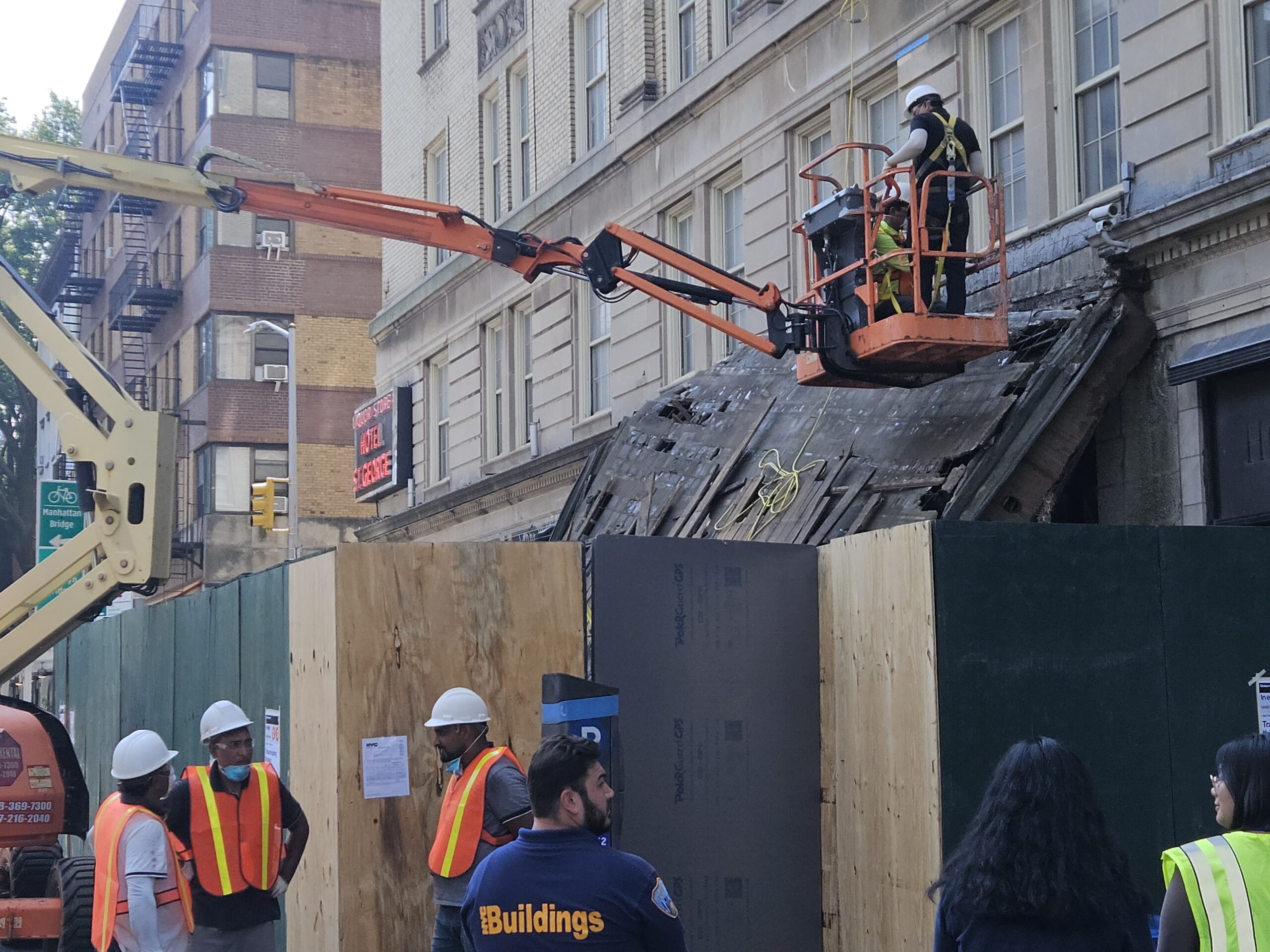
BROOKLYN HEIGHTS — ‘A miracle that no one was killed …’ That’s what neighbors are saying about the collapse of the Hotel St. George marquee. Shown in this photograph are workmen beginning the removal and repair of the historic, old neon sign at the corner, referencing a relic of Brooklyn Heights’ past: the St. George Hotel.
ATLANTIC AVENUE — Exhausted shopper with cluster of bags and goods from mall at Boerum Place stops to look at huge construction site across the street. “Is that REALLY going to be a jail??” Her male companion is reassuring, “Nothing like Rikers … this is 21st Century.”
BROOKLYN HEIGHTS — Overheard in line at one of most popular pastry outlets on Montague Street: “Hope I can get them into a camp …” A mother with two pre-schoolers in tow was showing a friend the Dodge Y flyer for Healthy Kids Day on Saturday, April 18.