What to know after the Supreme Court arguments over Trump’s tariffs
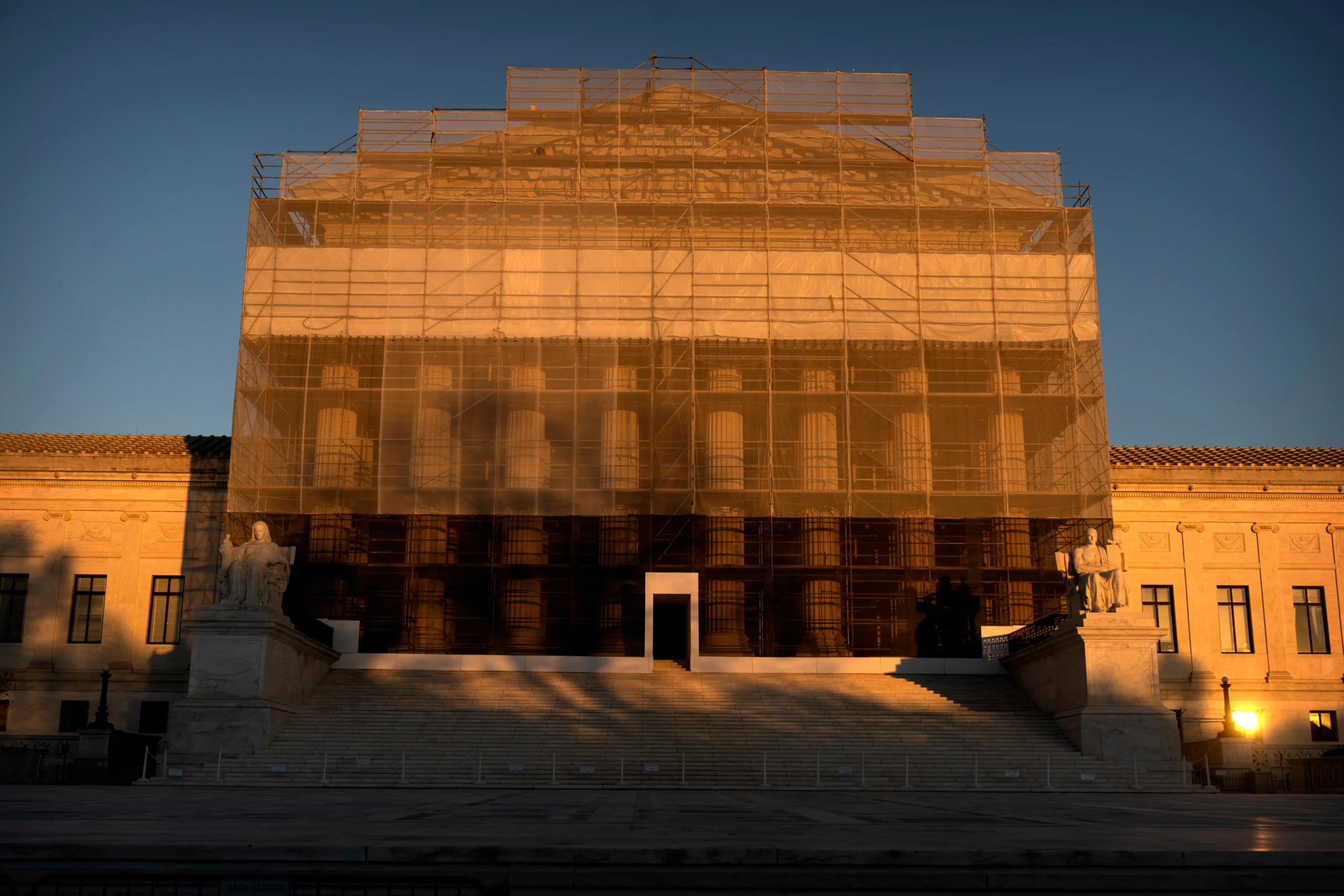
The Supreme Court building is photographed near sunset Tuesday, Nov. 4, 2025, in Washington. Photo: Mark Schiefelbein/AP
By Mark Sherman, Associated Press
November 7, 2025
Copy Link
Email
Facebook
X
LinkedIn
WhatsApp
Telegram
Pinterest
Print
The Trump administration on Wednesday got a chilly reception at the Supreme Court, where a majority of the court questioned President Donald Trump’s novel use of an emergency powers law to impose worldwide tariffs.
The court, with three justices Trump appointed and generally favorable to muscular presidential power, could find that he exceeded his authority.
It’s the first Trump policy that is before the court for a final decision, and the stakes are enormous, both politically and financially.
The Republican president has made tariffs a central piece of his economic and foreign policy and has said it would be a “disaster” if the Supreme Court rules against him.
Here are some things to know about the tariff arguments at the Supreme Court.
Conservative and liberal justices had tough questions for the administration
A potential majority in a ruling against the tariffs would almost certainly bring together the court’s three liberal justices and at least two conservatives.
Justices Amy Coney Barrett and Neil Gorsuch, both Trump appointees, and Chief Justice John Roberts appeared to be the most likely to rule against the president.
The Constitution gives Congress the power to impose tariffs, but Trump has claimed extraordinary power to act without congressional approval by declaring national emergencies under the 1977 International Emergency Economic Powers Act.
In February, he invoked the law to impose tariffs on Canada, Mexico and China, saying that the illegal flow of immigrants and drugs across the U.S. border amounted to a national emergency and that Canada and Mexico needed to do more to stop it, rebuking China for supplying chemicals to make the drugs.
In April, he imposed worldwide tariffs after declaring the United States’ longstanding trade deficits “a national emergency.”
But Roberts didn’t seem sure Trump has that power. The law has “never before been used to justify tariffs. No one has argued that it does until this particular case,” Roberts told Solicitor General D. John Sauer.
Tariffs are taxes on imports, and Gorsuch signaled he was troubled by the idea that Congress could give away its taxing powers to the president.
“The power to reach into the pockets of the American people is just different, and it’s been different since the founding,” Gorsuch said, when disputes over taxes helped spark the American Revolution.
President Donald Trump speaks during an event to announce new tariffs in the Rose Garden at the White House, on April 2, 2025, in Washington. Photo: Mark Schiefelbein/AP
There is a glimmer of hope for Trump
Both Barrett and Roberts asked questions indicating at least some unease about how the case should come out, and Justices Brett Kavanaugh, Samuel Alito and Clarence Thomas also could support the administration.
Kavanaugh led Sauer in some friendly questioning about 10% worldwide tariffs imposed by President Richard Nixon under a predecessor to IEEPA that used very similar language.
Understanding Nixon’s tariffs, which were upheld by an appellate court but never reached the Supreme Court, “is real important to deciding this case correctly.”
Barrett and Kavanaugh seized on arguments made by the challengers that the president could order a complete trade embargo but not impose tariffs of even 1% under the emergency law.
“Doesn’t it seem like it would make sense, then, that Congress would want the President to use something that was … weaker medicine than completely shutting down trade as leverage to try to get a foreign nation to do something?” Barrett asked.
The justices could act more quickly than usual in issuing a decision
The court only agreed to hear the case in September, scheduling arguments less than two months later. The quick turnaround, at least by Supreme Court standards, suggests the court will try to act fast.
High-profile cases can take half a year or more to resolve, often because the majority and dissenting opinions go through rounds of revision.
But the court can act quickly when deadline pressure dictates.
Most recently, the court ruled a week after hearing arguments in the TikTok case, unanimously upholding a law requiring the popular social media app to be banned unless it was sold by its Chinese parent company.
Trump has intervened several times to keep the law from taking effect while negotiations continue with China.
SUNSET PARK — “As a resident of Marine Park, one of the great surprises I found biking around Industry City and visiting Japan Village was to discover Bush Terminal Park. I continue to be amazed at the serene hideaways that the city offers in some of the busiest places — and, still, with an iconic view.”
BROOKLYN HEIGHTS — ‘A miracle that no one was killed …’ That’s what neighbors are saying about the collapse of the Hotel St. George marquee. Shown in this photograph are workmen beginning the removal and repair of the historic, old neon sign at the corner, referencing a relic of Brooklyn Heights’ past: the St. George Hotel.
ATLANTIC AVENUE — Exhausted shopper with cluster of bags and goods from mall at Boerum Place stops to look at huge construction site across the street. “Is that REALLY going to be a jail??” Her male companion is reassuring, “Nothing like Rikers … this is 21st Century.”
BROOKLYN HEIGHTS — Overheard in line at one of most popular pastry outlets on Montague Street: “Hope I can get them into a camp …” A mother with two pre-schoolers in tow was showing a friend the Dodge Y flyer for Healthy Kids Day on Saturday, April 18.